%25201-1.webp)
Imagine standing in a quiet garage, holding the fractured remains of a component that hasn't been manufactured in decades. For owners of vintage or bespoke vehicles in the UAE, this moment often signals a dead end where original materials have finally succumbed to time and the intense desert heat. You understand that a generic, mass-produced replacement will never capture the nuance or the structural integrity required for your project. Learning how to replicate a broken car part is no longer a matter of searching through dusty catalogs, but of embracing a sophisticated marriage of technology and craftsmanship that turns a fragment into a masterpiece.
In this guide, 3DISTICA will demonstrate a meticulous reverse engineering process that transforms damaged geometry into a precision-engineered reality. You'll discover how we utilize industrial 3D scanning and advanced fabrication to create replicas that don't just mimic the original, but often surpass it in durability. With the global automotive aftermarket projected to exceed AED 1.8 trillion in 2026, the ability to restore the unbuildable is more essential than ever. From the initial digital capture to the final surface finish, we'll walk you through the streamlined journey of ensuring your vision remains uncompromisingly intact.
• Learn how to leverage industrial 3D scanning to capture the intricate geometries of a damaged component, transforming fragmented remnants into precise digital blueprints.
• Understand the professional methodology of how to replicate a broken car part through reverse engineering, ensuring every critical tolerance and load-bearing surface is meticulously restored.
• Explore the nuances of material selection to ensure your replica offers superior durability compared to the original, specifically tailored for the harsh climate of the UAE.
• Identify the ideal fabrication technology for your project, balancing the rapid complexity of industrial 3D printing with the structural strength of CNC machining.
• Discover how advanced surface finishing and hydro-chroming can restore the aesthetic soul of a classic car, achieving a factory-perfect look that defies the passage of time.
Every restoration begins with a puzzle. A shattered plastic gear or a cracked aluminum bracket isn't just waste; it's a map. When considering how to replicate a broken car part, the first step is a cold, clinical assessment of the fragments. Even if a component is missing pieces, we can often interpolate the missing data by analyzing the remaining geometry and its mating surfaces. It's a process of forensic engineering where we look past the damage to find the original design intent.
This process is fundamentally a form of Reverse engineering. It goes beyond simple duplication. We deconstruct the original function of the part, identifying critical tolerances where a fraction of a millimeter determines whether a component fits or fails. We don't just look at what the part was; we look at what it needs to be. This involves identifying load-bearing surfaces and areas of high mechanical stress that may have contributed to the initial failure.
We often find that the "why" of a failure is just as important as the "how" of the repair. Many original parts from the 1980s or 1990s were made from early-generation polymers that become brittle over time. If the original design failed under normal load, simply copying it in the same material is a mistake. We look for opportunities to optimize the geometry, perhaps thickening a stress point or choosing a material with a higher glass transition temperature to suit the local environment.
Choosing between manual mold-making and digital capture is the first major fork in the road. While manual casting is suitable for simple shapes, digital 3D scanning is the superior choice for complex organic geometries. It allows us to create a high-fidelity digital twin that we can manipulate, repair, and perfect before a single gram of material is used in production.
The UAE climate demands more than just visual accuracy. A part sitting in an engine bay must withstand temperatures that can exceed 100°C during a Dubai summer. We analyze mechanical stress, whether it's the constant vibration of a mounting bracket or the chemical exposure to fuel, oil, and cleaning agents. This data dictates whether we move toward industrial 3D printing, fiberglass, or CNC machining to ensure the replica doesn't just look the part, but performs better than the original.
Replication is often the only path when a part is discontinued or the manufacturer no longer exists. For a rare 1960s classic, a bespoke fabrication might be the only way to return the vehicle to the road. We gather reference data from sister parts, such as using a left-hand mirror housing to create a mirrored digital model for the right side. This audit ensures the investment in a custom replica provides long-term value over a temporary patch, focusing on parts where the cost of failure is high.
Reverse engineering is the art of deconstruction. It involves dismantling an object to expose its underlying logic, dimensions, and material intent so it can be meticulously reconstructed. For enthusiasts in the UAE, where the high-end automotive culture demands perfection, knowing how to replicate a broken car part is the difference between a static display and a road-worthy machine. We don't just see a broken bracket; we see the original blueprint hidden within the wreckage.
The digital journey begins by capturing the physical essence of the part. Modern technology allows us to reverse engineer classic car parts with a level of fidelity that was impossible a decade ago. We move from the tangible world into a digital landscape, creating a point-cloud. This is a dense constellation of millions of data points that define every curve and contour. This digital twin serves as our canvas, allowing us to perform repairs in a virtual environment before a single new part is manufactured.
The choice of light defines the result. Structured light scanners are often preferred for their ability to capture complex organic geometries with breathtaking speed. However, for the metallic or dark surfaces common in engine bays, laser scanning provides the necessary contrast to map every detail. We prioritize accuracy down to 20 microns, especially for internal components where hidden mounting points must align perfectly with existing chassis holes. This level of precision ensures that the final product feels like a factory original, not a forced replacement.
Raw data is just the beginning of the narrative. We translate the initial point-cloud into a clean, parametric CAD model through a process known as feature extraction. This stage is where we "heal" the object. If a part has warped under the intense heat of a Sharjah summer or snapped due to mechanical fatigue, our software algorithms can realign the geometry to its original specifications. We identify threads, holes, and mating surfaces, often adding reinforcement to known weak points to improve the part's longevity. If you are ready to begin this transformation, our team specializes in 3D scanning and reverse engineering to bring your project back to life.
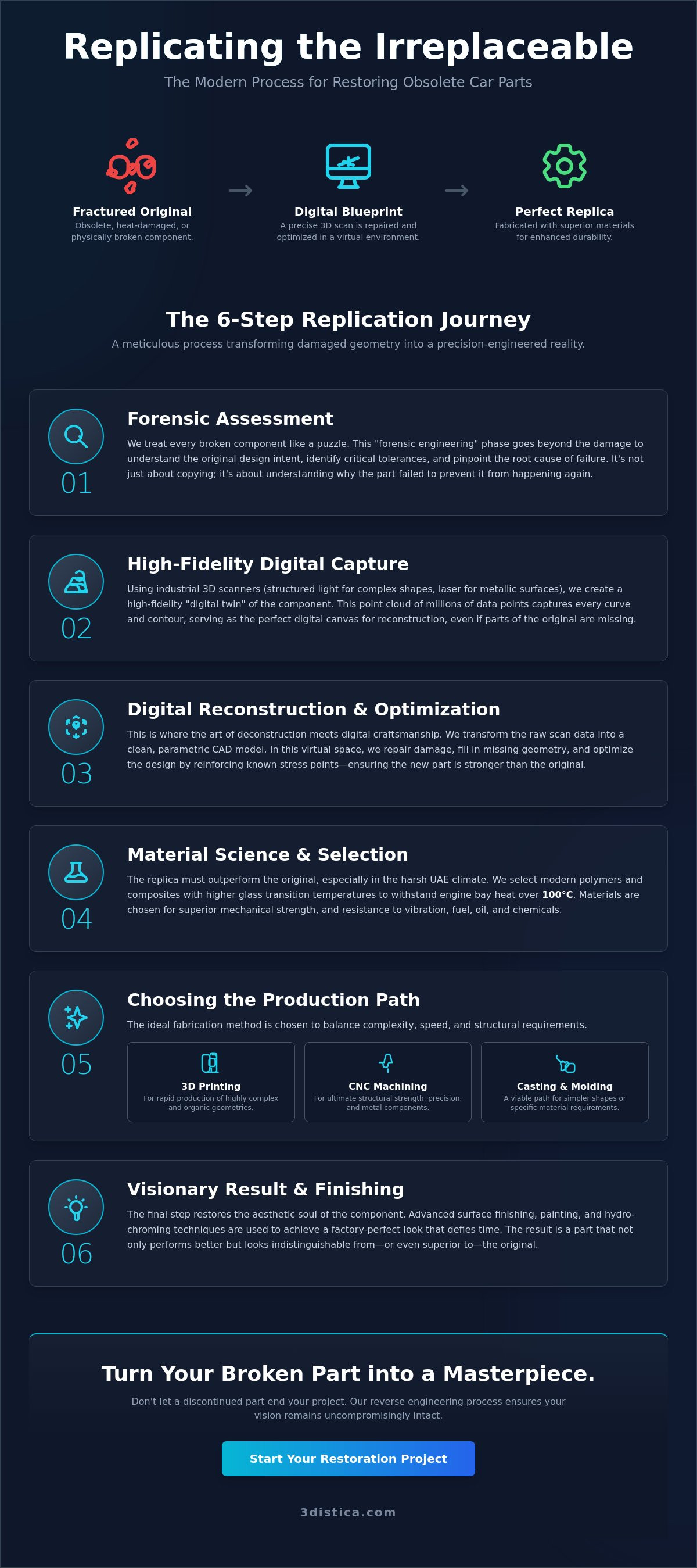
The material of a component is its silent heartbeat. When determining how to replicate a broken car part, the choice of substrate is as critical as the digital scan itself. In the United Arab Emirates, the sun is a relentless architect. Ambient temperatures often reach 50°C, while surface temperatures on a dashboard or engine cover can soar much higher. Standard consumer-grade plastics like PLA or basic ABS simply cannot survive here. We select materials based on their thermal deflection, tensile strength, and UV resistance, ensuring the new part doesn't just fit, but thrives in the harsh GCC climate.
Selecting the right material requires an understanding of the original part's failure mode. If a vintage door handle snapped, we don't just copy the shape; we analyze the grain structure and flex. Our process involves matching the original material's density while often upgrading its chemical resistance. This is particularly vital for parts exposed to the high salinity of coastal air in cities like Dubai and Abu Dhabi. We bridge the gap between the brittle plastics of the past and the high-performance composites of the future.
Scale dictates the method. Fiberglass remains the premier choice for large-scale exterior trim and body panels due to its exceptional strength-to-weight ratio. It provides a level of impact resistance that smaller-scale printing cannot match for expansive surfaces. For intricate mechanical gears or complex clips, industrial 3D printing offers unparalleled precision. We frequently utilize a hybrid approach, creating 3D-printed masters to serve as the foundation for high-fidelity fiberglass molds. This allows us to capture the nuance of a digital model in a material built for the open road.
Under-the-hood components demand engineering-grade solutions. We utilize carbon-fiber reinforced Nylon and specialized resins to replicate parts that must endure constant mechanical stress and chemical exposure. These materials are chosen for their high glass transition temperatures and ability to resist degradation from oils and fuels. With the automotive 3D printing market projected to reach د.إ 24.5 billion by 2026, the availability of these advanced polymers has transformed restoration. Every part we produce is evaluated against these rigorous standards, ensuring that the "soul" of your vehicle is restored with a focus on longevity and safety.
If your project requires this level of material precision, our expertise in fiberglass products and industrial 3D printing ensures a result that is both aesthetically perfect and functionally superior. We don't just make parts; we engineer endurance.
Once the digital blueprint is refined, the choice of production path determines the final character of the object. Deciding how to replicate a broken car part involves balancing the intricate complexity of the design against the mechanical requirements of the vehicle. For a one-off gear with internal channels, industrial 3D printing is the master of the narrative. It offers a rapid turnaround that traditional methods cannot match. However, when the requirement shifts toward absolute structural rigidity or a specific metallic essence, we turn to the subtractive elegance of CNC machining or the time-honored tradition of casting.
Casting remains the preferred route for high-volume replication or when a specific surface texture, such as the granular feel of a vintage engine block, is essential. With the global automotive metal casting market valued at د.إ 322.9 billion in 2026, the relevance of this traditional method remains undisputed. While a custom aluminum prototype carries a notable upfront cost, the investment ensures a part that is indistinguishable from the original. Understanding how to replicate a broken car part requires a deep dive into these manufacturing workflows to select the one that honors the integrity of the design.
CNC routing is the sculptor of the industrial world. It carves the part from a solid block of material, whether it's aircraft-grade aluminum, brass, or high-density engineering foams. This subtractive process is ideal for components that require absolute rigidity and mirror-smooth finishes directly from the machine. With machine time priced according to axis configuration and job complexity, the precision achieved is a testament to architectural accuracy. It's the definitive choice for structural mounts and high-stress engine components where flex is not an option.
Some automotive narratives are told on a monumental scale. When dealing with oversized body panels or bespoke aerodynamic assemblies, the logistics of fabrication require a multi-disciplinary approach. We integrate various methods, perhaps using CNC-routed cores surfaced with hand-laid fiberglass to achieve the perfect balance of scale and detail. These large-scale solutions are not just about dimensions; they're about capturing the emotional impact of a design that demands presence. If you're looking for a partner to navigate these production complexities, explore our services in CNC routing and laser cutting to see how we bring precision to every scale.
Fabrication is merely the midpoint of the creative journey. A part that's technically accurate but aesthetically raw remains an unfinished thought. When mastering how to replicate a broken car part, the final surface treatment is what bridges the gap between a replacement and an original. We treat every component with the same reverence as an architectural model, meticulously erasing the mechanical footprints of production. Whether it's removing the subtle layer lines of industrial 3D printing or the tool paths of a CNC router, the goal is a surface that feels factory-perfect.
This attention to detail is vital in a market where the global automotive aftermarket is projected to exceed د.إ 1.8 trillion in 2026. In the UAE, where show car quality is the standard, we employ specialized coatings and surface finishing and hydro chroming to replicate the deep luster of vintage trim. Hydro-chroming allows us to restore the mirror-like brilliance of classic bumpers and badges, providing a finish that's both durable and visually breathtaking. Every part undergoes a rigorous quality control phase, where we verify dimensions against the original digital twin to ensure micron-level fidelity.
The soul of a vehicle lives in its textures. We go beyond simple smoothing to match original grain patterns, whether it's the pebbled leather look of a 1970s dashboard or the sand-cast grit of a vintage intake manifold. Professional painting and UV-resistant clear-coating are applied to provide essential environmental protection against the intense Gulf sun. This process of invisible replication ensures that even the most discerning collector can't distinguish the new component from its neighbors. It's about maintaining the narrative of the vehicle, ensuring every detail contributes to a cohesive aesthetic whole.
The final act is the seamless integration of the part into its existing assembly. We conduct a dry-fit to confirm an architectural fit, making minor adjustments if the surrounding chassis has shifted over decades of use. Functional testing under real-world automotive conditions follows, ensuring the part performs under the thermal and mechanical stresses discussed in earlier sections. This holistic approach ensures that your restoration isn't just a visual success, but a functional triumph. If you're ready to transform a broken fragment into a precision-engineered masterpiece, Collaborate with 3DISTICA on your next restoration project and let us help you bridge the gap between the unbuilt and the reality.
The journey from a fractured fragment to a precision-engineered masterpiece is a testament to the power of modern fabrication. By integrating the scanning and material science discussed earlier, we've moved beyond simple repairs to achieve true restoration. You now understand that mastering how to replicate a broken car part is a sophisticated process that honors the original design while often improving its resilience for the road ahead. Every detail, from the digital twin to the final hydro-chromed finish, serves the integrity of the whole.
At 3DISTICA, we specialize in classic car parts restoration, providing an end-to-end bespoke production flow that spans from initial design to final installation. Our advanced 3D scanning and reverse engineering capabilities allow us to capture the essence of a component with architectural precision. We don't just deliver a replacement; we provide a collaborative partnership that understands the soul of your project. Invite our visionary artisans to restore your project's soul and witness the transformation of a lost design into a tangible, high-performance reality. Your vision deserves nothing less than perfection.
Yes, we can replicate components even when they're shattered into numerous fragments. Our technicians use high-precision 3D scanning to capture each individual piece and then virtually reassemble them in a digital environment. This process allows us to interpolate missing data and restore the original geometry with aesthetic precision, ensuring the new part is a cohesive and functional whole.
Industrial 3D printed components are absolutely strong enough for daily driving when engineered with high-performance polymers like carbon-fiber reinforced Nylon. These materials offer the structural integrity and impact resistance required for the most demanding automotive environments. We focus exclusively on industrial-grade output that meets rigorous mechanical standards, ensuring your vehicle remains reliable on the road.
3D scanning for small, intricate components is exceptionally precise, reaching tolerances as fine as 20 microns. This level of detail is essential for internal engine gears or electrical housings where a perfect architectural fit is non-negotiable. It ensures that every thread, clip, and mounting point aligns perfectly with the existing assembly, maintaining the integrity of the original design.
Fiberglass products are often the superior choice for exterior trim in the UAE due to their inherent UV stability and resistance to extreme heat. While high-temperature resins are excellent for smaller details, fiberglass provides the durability needed to withstand 50°C summer peaks. This material choice prevents the warping and brittleness often seen in original factory plastics exposed to the intense Gulf sun.
We specialize in replicating discontinued parts for classic vehicles from the 1960s and earlier where manufacturer support no longer exists. Reverse engineering is the definitive solution for restoring these rare machines to their former glory. We take the weathered or broken original and transform it into a functional replica that honors the vehicle's historical narrative while utilizing modern material science.
The professional replication process typically takes between 5 to 15 business days depending on the complexity of the component. This curated timeline accounts for the initial digital capture, CAD refinement, fabrication, and meticulous surface finishing. We maintain a steady rhythm to ensure that the final result meets our standards for craftsmanship without rushing the essential stages of refinement.
It's entirely possible to improve the original design by identifying and reinforcing known failure points. We use digital simulations to analyze how to replicate a broken car part while optimizing its geometry for better performance than the factory original. This often results in a component that is more durable and better suited to modern driving conditions than the part it replaces.
You don't need to provide a digital file; we can scan your physical part directly in our studio. While we accept existing CAD models, most of our clients bring in the physical fragments of their components for us to process. We handle the entire end-to-end journey, serving as a collaborative guide from the first digital capture to the final breathtaking result.
