The most expensive minute in a workshop isn't spent at the lathe; it's the hour lost when a digital vision fails to translate into physical reality. Achieving true precision requires a meticulous approach to avoiding delays in custom manufacturing, especially as rising material costs and complex 2026 regulatory landscapes add new layers of pressure to every timeline. You've likely felt the sting of a project stalling due to unforeseen lead times or a prototype that failed to capture the core essence of your design. It's a common tension that demands a more sophisticated strategy than simply working faster.
This guide provides the framework you need to bridge the gap between abstract ideas and tangible results. We'll show you how to master the art of timeline management in bespoke production by treating the digital phase as your primary insurance policy against physical setbacks. You'll learn to navigate the complexities of modern fabrication, from AI-assisted modeling to meticulous material sourcing, ensuring your project moves from concept to completion with quiet authority and technical excellence. We'll examine the specific steps that transform a fragile schedule into a predictable, rhythmic journey toward a finished masterpiece.
Key Takeaways
• Capture precise environmental dimensions using 3D scanning to eliminate the ambiguity that often stalls bespoke projects.
• Master the art of avoiding delays in custom manufacturing by validating complex designs with small-scale 3D printed mockups before final fabrication.
• Establish a single source of truth for all project data to maintain a steady rhythm and prevent the momentum-killing cycle of late-stage revisions.
• Navigate the specific nuances of material procurement within the GCC region to manage lead times with confidence and strategic foresight.
• Leverage end-to-end integration, from reverse engineering to industrial 3D printing, to ensure your digital vision translates perfectly into a physical masterpiece.
Table of Contents:
• The Anatomy of a Timeline: Why Custom Fabrication Stalls
• The Digital Foundation: Eliminating Ambiguity Through 3D Scanning and CAD
• Material Strategy: Validating Concepts Through Prototyping
• The Communication Framework: Managing Iterations Without Losing Momentum
• Partnering for Precision: How 3DISTICA Streamlines Bespoke Production
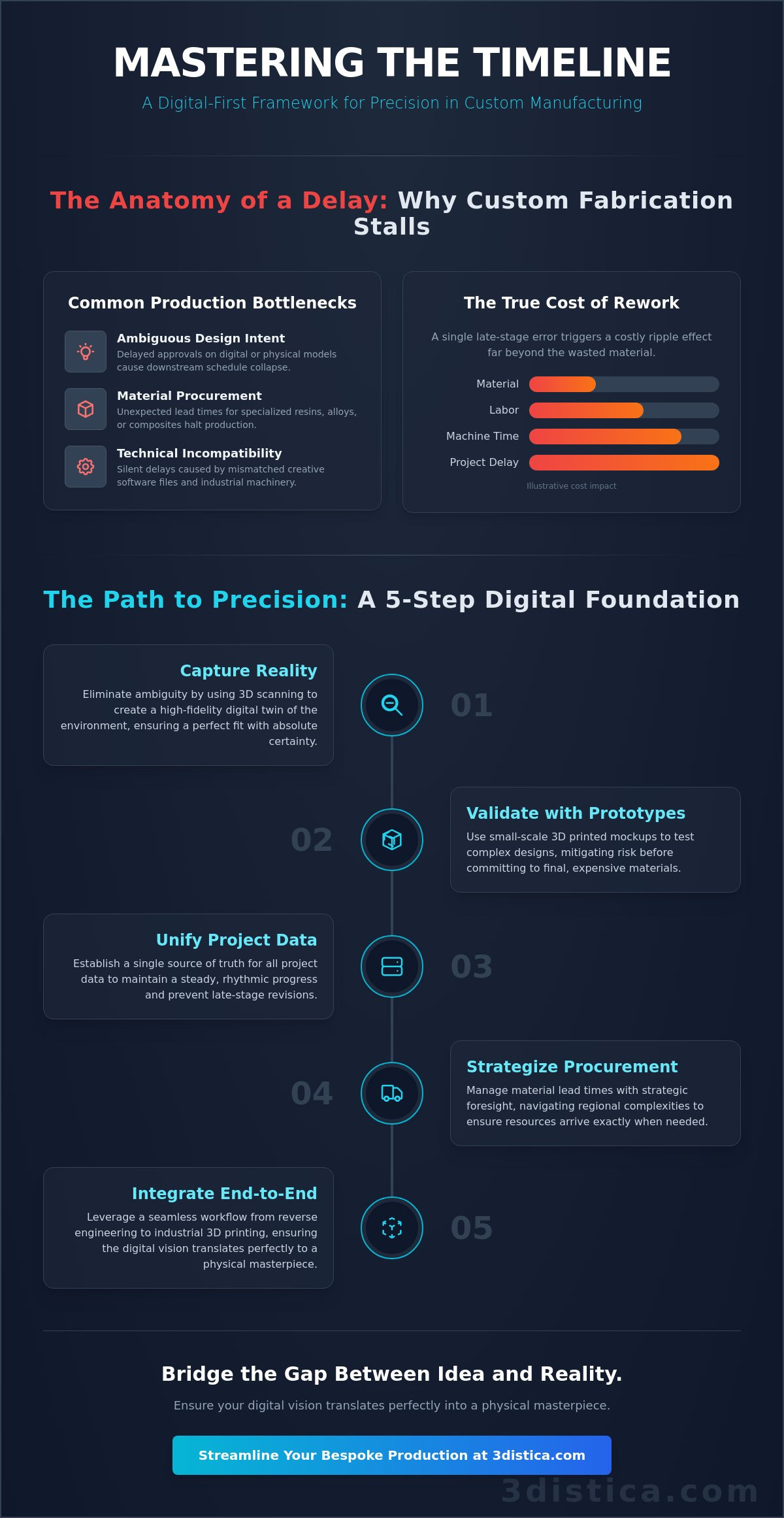
Chaos is expensive. In the world of bespoke production, a single late-stage design change doesn't just alter a drawing; it triggers a ripple effect that can paralyze an entire workshop. Precision is not an accident. It's the result of a deliberate, rhythmic synchronization between the designer's hand and the machine's path. The primary strategy for avoiding delays in custom manufacturing begins with a clear-eyed look at where the process typically fractures. Often, the friction arises from a fundamental disconnect between artistic ambition and technical feasibility, where a beautiful concept lacks the structural data required for physical execution.
In the GCC region, the hidden cost of material procurement adds another layer of complexity. High-performance resins, specific fiberglass reinforcements, or specialized alloys often carry lead times that aren't merely logistical hurdles but strategic variables. When design intent remains ambiguous, these materials sit idle, or worse, are ordered incorrectly. This ambiguity forces a reactive stance, turning a curated fabrication process into a series of urgent corrections. By adopting Lean manufacturing principles, studios can identify these non-value-added steps before they consume the project's momentum and budget.
The conceptual sculpting phase is a frequent site of stagnation. If approvals for a digital maquette or a physical styrofoam prototype are delayed, the downstream CNC routing and manual finishing schedules collapse. Incompatibility between creative software files and industrial machinery also creates silent delays. Environmental factors unique to the region, such as extreme heat and humidity, directly dictate the curing windows for casting and surface finishing. Ignoring these atmospheric constraints leads to compromised structural integrity or aesthetic flaws that require total restarts.
Fixing it in post is a luxury reserved for digital artists; in industrial fabrication, it's a myth that carries a heavy price. When a prototype fails due to poor planning, the loss isn't just the material. It's the specialized labor and the calibration time of high-end machinery. Rework creates a vacuum that sucks in resources intended for other project phases, inevitably delaying on-site installation and downstream logistics. In an era where 2026 manufacturing leaders report higher operating costs as a primary concern, avoiding delays in custom manufacturing is no longer just about speed. It's about preserving the artistic and financial integrity of the work.
Precision is the silent language of successful fabrication. It's not enough to have a vision; one must possess a measurable, digital truth. The most effective method for avoiding delays in custom manufacturing involves creating a high-fidelity digital twin before a single gram of material is cast. By utilizing advanced 3D scanning, we capture the exact geometry of an environment, ensuring that a custom installation fits with the grace of a tailored garment. This process of reverse engineering allows us to account for every architectural nuance, from the subtle curve of a wall to the precise placement of structural supports. It's about replacing "close enough" with absolute certainty.
Digital sculpting serves as our narrative laboratory. Here, we refine the aesthetic details and emotional impact of a design without the risk of physical waste. This stage allows for a collaborative dialogue where technical constraints meet artistic intent. By aligning the design for rapid manufacturing with the specific capabilities of our industrial machinery, we eliminate the guesswork that often plagues bespoke production. When the digital model is perfect, the physical result is inevitable. This foundation of data acts as a roadmap, guiding every subsequent cut, mold, and finish with unwavering accuracy.
Manual measurements are prone to human error, especially in complex spaces. 3D scanning captures millions of data points in seconds, creating a dense point cloud that serves as our absolute reference. This data is vital for translating hand-sculpted physical maquettes into manufacture-ready assets. By digitizing these forms early, we ensure that the final scale model or architectural element retains its original soul while meeting industrial tolerances. It's a bridge between the artisan's touch and the machine's precision. For projects requiring this level of fidelity, exploring professional 3D scanning and reverse engineering services is the first step toward a flawless installation.
Virtual prototyping allows us to stress-test designs in a simulated environment. We don't just look at the shape; we analyze material thickness, weight distribution, and structural integrity. This digital validation prevents the costly "rework loops" that arise when physical prototypes fail unexpectedly. High-fidelity CAD modeling ensures that files are perfectly compatible with CNC routing and industrial 3D printing equipment. By solving technical puzzles in the digital realm, we clear the path for a smooth, uninterrupted manufacturing cycle. This foresight is what separates a successful, on-time project from one mired in technical friction.
Material selection is a dialogue between form and time. It's the moment where the ethereal nature of a digital model meets the uncompromising reality of physics. Choosing the right medium is a cornerstone of avoiding delays in custom manufacturing, as each material carries its own metabolic rate of production. While fiberglass offers unmatched durability and a high-fidelity finish, styrofoam sculpting provides a rapid path to validating large-scale volumes. The choice isn't merely aesthetic; it's a strategic decision that dictates the rhythm of the entire fabrication schedule.
By integrating Quick Response Manufacturing methodologies, we can reduce the time between material specification and the first physical mockup. This approach is vital in an era where the rapid prototyping materials market is expected to grow at a CAGR of 16.87% through 2035, reflecting a global shift toward more agile production cycles. In our studio, we treat material sourcing as a proactive discipline, ensuring that specialized resins and composites are secured long before the CNC routing begins. This foresight prevents the stagnation that occurs when a project waits on a global supply chain.
Prototyping is the bridge that spans the gap between vision and reality. We use industrial 3D printing to create small-scale mockups that allow for rapid visual and functional validation. These maquettes are essential for identifying assembly challenges that might not be apparent in a purely digital environment. Securing client sign-off on a high-fidelity physical sample provides the confidence needed to move into full-scale production. It's a curated process of refinement that ensures the final piece, whether it's a custom award or a complex architectural element, arrives without the need for corrective rework.
The environmental conditions of the GCC region demand a specialized approach to fabrication. Climate-controlled environments are not a luxury; they're a technical necessity for maintaining the integrity of fiberglass products and specialized surface finishes. High-heat and humidity can alter the curing times of resins, potentially introducing delays if not meticulously managed. Our logistics strategy accounts for the unique challenges of large-scale sculpture transport within the UAE, ensuring that finished pieces move from our facility to the site with the same precision used in their creation. From hydro-chroming schedules to the final delivery, every movement is choreographed to maintain the project's momentum.
Clarity is the ultimate luxury in high-end fabrication. In a high-stakes production environment, miscommunication acts as a friction point that erodes both artistic integrity and the project schedule. Establishing a single source of truth ensures that every stakeholder, from the visionary architect to the technical artisan, operates from the same set of precise coordinates. This alignment is the most reliable method for avoiding delays in custom manufacturing, as it prevents the expensive divergence of intent and execution that often occurs in complex, bespoke projects. When the digital data and the physical intent are perfectly synced, the path to completion becomes a steady, guided exhibition rather than a frantic race against the clock.
Real-time project monitoring replaces guesswork with transparent, data-driven reporting. By providing curated digital visualizations, we invite our partners into the refinement process, allowing them to see how their vision is being translated into physical form. It's about capturing the essence of a design through constant, calibrated dialogue. This level of transparency builds the exclusivity and trust necessary for a successful creative partnership, ensuring that the final outcome feels like a shared triumph of technology and art. It's a process where technical precision meets a narrative-driven presentation, allowing the brand's quiet authority to guide the project to its inevitable conclusion.
Iteration shouldn't be an infinite loop. We structure the creative process with defined milestones that prevent momentum from stalling during the conceptual sculpting phase. Setting hard deadlines for design approvals is a cornerstone of avoiding delays in custom manufacturing, as it ensures that the transition to CNC routing and surface finishing remains uninterrupted. We also standardize the change request process, allowing us to immediately quantify the impact of any modification on the overall timeline. Using high-fidelity digital visualizations aligns expectations early, ensuring that the spatial feeling of the project is captured before the first physical cut is made. This disciplined approach preserves the rhythm of production while allowing for necessary artistic refinement.
Bespoke partnerships thrive on clear roles and shared accountability. We define the boundaries between the design team and the fabrication studio early, ensuring that every technical requirement is met without compromising the artistic vision. A dedicated project lead acts as the collaborative guide, navigating the complexities of multi-month projects with calm confidence. This steady communication rhythm is particularly vital for large-scale installations, such as custom wall cladding or architectural scale models, where downstream logistics are tightly coupled with the fabrication schedule. To begin a partnership built on this level of technical and narrative alignment, we invite you to explore our collaborative fabrication process and see how we bridge the gap between abstract ideas and tangible reality.
True mastery in fabrication is found at the intersection of technical discipline and artistic soul. It's one thing to design a monumental structure; it's another to ensure its realization follows a curated, uninterrupted path. We position ourselves as the definitive partner for avoiding delays in custom manufacturing by internalizing every critical phase of the production lifecycle. By maintaining a single point of accountability from the initial 3D scan to the final surface finishing, we eliminate the fragmented handovers that so often dilute a project's essence and derail its schedule. Our studio is a place where industrial capacity meets the meticulous hand of the artisan. Precision is our promise. It's the anchor of every project we undertake.
Our approach goes beyond mere production. We act as a collaborative guide, helping you navigate the structural and logistical challenges that define large-scale bespoke work. By bridging the gap between digital vision and physical reality, we ensure that the transformative power of your design is never lost to technical friction. This synergy of technology and art allows us to maintain a steady, professional rhythm, moving with the grace of a guided exhibition from concept to completion. Avoiding delays in custom manufacturing isn't just a goal for us; it's a structural reality built into our internal processes.
Our unified methodology relies on a multi-disciplinary team that speaks the language of both the digital and the physical. We don't just route foam or print polymers; we orchestrate a process where high-fidelity digital assets guide our industrial 3D printing and CNC milling with absolute fidelity. This integration allows us to bypass the common vendor-handover delays that plague traditional workflows. Every architectural scale model or custom award undergoes a rigorous quality control process where digital precision is validated by manual craftsmanship. It's a process of constant refinement, ensuring that the final result captures the emotional impact of the original design.
A commitment to timelines is a commitment to trust. We approach every project with a proactive risk assessment, identifying potential material lead-time challenges or technical hurdles before they manifest as physical delays. Our deep understanding of GCC-wide logistics ensures that even the most complex wall cladding or monumental fiberglass products are delivered and installed with surgical precision. This reliability has allowed us to build a national track record for on-time delivery on projects that define the regional landscape. We invite you to Begin your next visionary project with 3DISTICA and experience a partnership where technical rigor and artistic integrity move in perfect harmony.
The journey from a conceptual sketch to a monumental physical installation requires more than just speed; it demands a curated synchronization of technology and craft. We've explored how a meticulous digital foundation and a proactive material strategy serve as the essential pillars of a successful timeline. By embracing high-fidelity 3D scanning and virtual prototyping, you eliminate the ambiguity that often fractures production cycles. A disciplined communication framework further ensures that your artistic intent remains the single source of truth throughout the entire fabrication journey. Mastering these elements is the most reliable method for avoiding delays in custom manufacturing and ensuring your project maintains its momentum.
Our studio provides the technical rigor and visionary craftsmanship required for the most ambitious designs. With advanced industrial 3D printing, precision CNC routing, and specialized expertise in fiberglass and surface finishing, we offer seamless end-to-end support from initial prototyping to final installation. We invite you to Partner with 3DISTICA for your next bespoke fabrication project and experience a collaboration where every detail is handled with quiet authority and technical excellence. Let's transform your abstract ideas into a polished, physical reality that inspires wonder.
The most frequent disruption stems from a disconnect between the initial artistic vision and its technical feasibility. When design intent remains vague, it triggers a ripple effect of revisions that stall the workshop. Establishing a single source of truth early in the process is the most effective method for avoiding delays in custom manufacturing. This clarity allows the fabrication team to proceed with the quiet authority necessary for high-fidelity results.
3D scanning eliminates the manual measurement errors that often lead to on-site assembly failures. By capturing millions of data points, we create a precise digital twin of the installation environment. This ensures that every component, from architectural wall cladding to complex sculptures, fits perfectly the first time. It replaces guesswork with mathematical certainty, preventing the need for corrective rework during the final stages of the project.
Prototyping serves as a vital insurance policy against the unforeseen technical hurdles that can derail a schedule. Small-scale 3D printed mockups allow us to validate structural integrity and assembly logic before committing to final materials. This phase identifies potential friction points in the digital model that would be costly to fix in the physical realm. By solving these puzzles early, we maintain a steady, uninterrupted rhythm throughout the larger fabrication cycle.
Material selection directly dictates the metabolic rate of your project's production. Some high-end composites or specialized resins carry significant lead times, while others, like styrofoam, allow for rapid conceptual sculpting. Additionally, environmental factors in the UAE, such as high humidity, affect the curing times for fiberglass and surface finishes. Strategic material planning ensures that your choice balances aesthetic ambition with the realities of the fabrication calendar.
Optimal file preparation requires aligning your digital vision with the specific requirements of CNC routing and industrial 3D printing. Files should be provided in high-fidelity formats that preserve the nuances of the geometry while remaining watertight for manufacturing. It's helpful to include clear annotations regarding material thickness and critical tolerances. This technical rigor ensures a seamless transition from the designer's screen to the artisan's machine, reducing the risk of interpretation errors.
Lead times for large-scale fiberglass work are influenced by the complexity of the mold-making process and the required surface fidelity. Typically, a project involves several weeks of dedicated fabrication, accounting for the meticulous layering of materials and the necessary curing windows. The extreme heat of the region necessitates climate-controlled environments to ensure structural integrity. We provide a curated timeline for each project, ensuring that every monumental piece arrives according to a predictable, professional schedule.
We manage iterations through a structured change request process that immediately quantifies the impact on both the narrative and the timeline. While we remain flexible as a creative partner, we prioritize the project's momentum by assessing how a change affects downstream processes like CNC routing or hydro-chroming. This transparency allows for informed decision-making. It ensures that any refinement enhances the final outcome without compromising the established delivery milestones.
Acceleration is achieved by collapsing the gaps between design, prototyping, and final production. By utilizing advanced 3D scanning and in-house industrial capabilities, we streamline the workflow and reduce vendor-handover delays. True speed is a byproduct of precision, not a compromise of it. Avoiding delays in custom manufacturing through these integrated methods allows for a faster path to completion while maintaining the high-fidelity finish that bespoke work demands.
