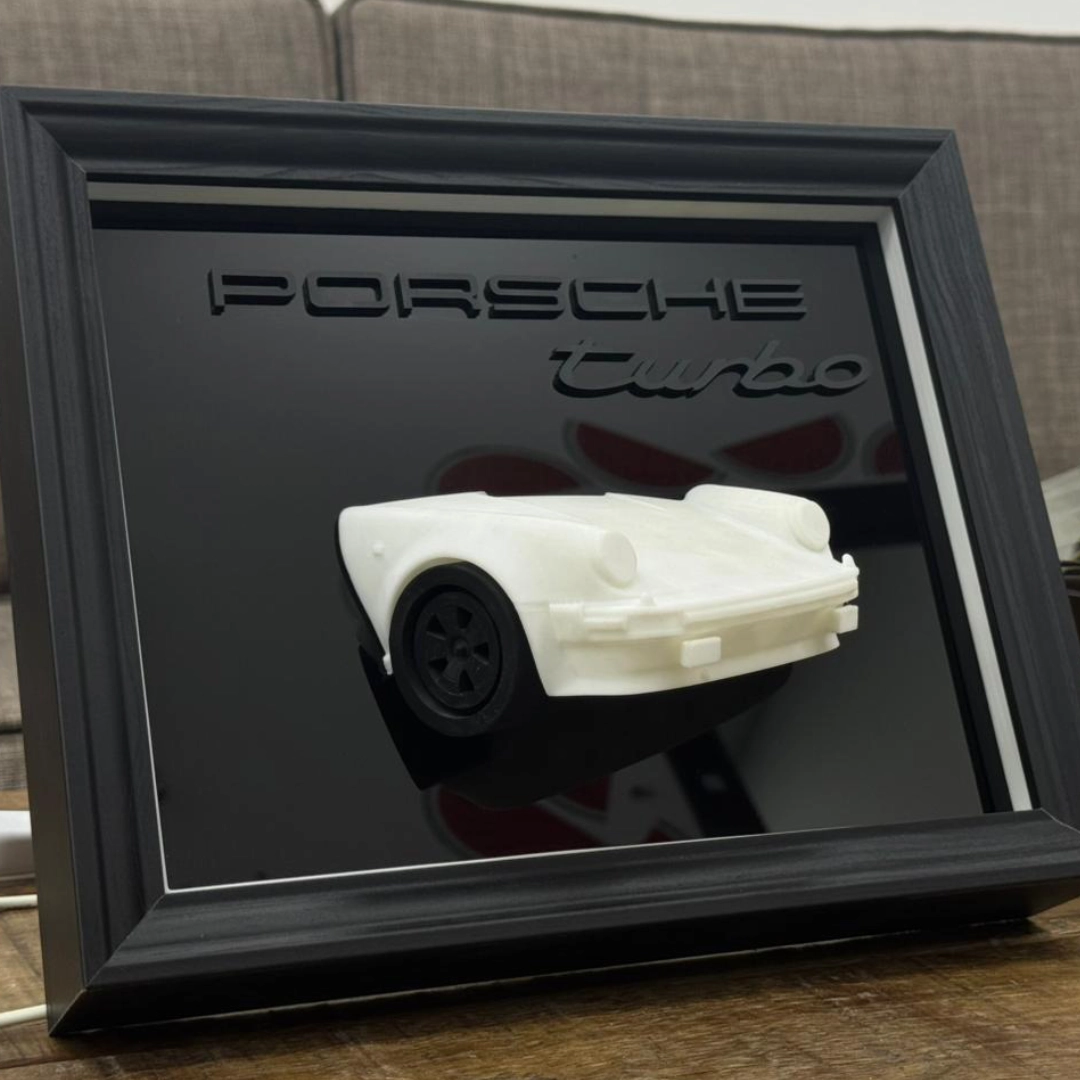
What if the final component needed to complete your 1960s masterpiece isn't sitting in a dusty European warehouse, but exists as a digital silhouette waiting to be materialized? For many collectors, the search for 3d printing classic car parts Dubai represents the essential bridge between a dormant engine and the open road. It's a frustrating reality that the global supply of vintage components is rapidly vanishing. You shouldn't have to compromise the integrity of a legacy vehicle with ill-fitting, low-quality replicas that feel more like toys than engineering feats.
This article reveals how the marriage of 3D scanning and industrial additive manufacturing breathes life back into automotive history. We'll show you how reverse engineering recreates obsolete parts with a level of precision that often surpasses original factory standards. You'll discover the meticulous process of achieving show-quality surface finishes and structural durability, ensuring every bespoke piece honors the car's heritage while meeting modern RTA and ESMA safety expectations. We are moving beyond simple prototyping to create functional art that stands the test of time.
• Understand why digital preservation is the definitive solution to the vanishing market for OEM vintage components.
• Learn how 3d printing classic car parts Dubai utilizes high-resolution scanning to recreate obsolete geometries with surgical precision.
• Identify the material properties required to ensure functional components withstand the unique climatic challenges of the Middle East.
• Discover the post-processing secrets used to replicate authentic leather grains and matte finishes for a seamless, show-quality appearance.
• Explore how the integration of industrial design and CNC routing delivers a tailored approach to automotive heritage restoration.
A classic car is a vessel for history. It's a curated narrative of design, engineering, and cultural identity. However, for many owners in the UAE, that narrative is often interrupted by a single broken bracket or a shattered tail-light lens that hasn't been manufactured in decades. The market for Original Equipment Manufacturer (OEM) vintage parts isn't just shrinking; it's effectively vanishing. This scarcity transforms a weekend drive into a source of anxiety. Digital preservation through 3d printing classic car parts Dubai offers a sophisticated alternative to the endless search for unobtainable components. It isn't just about making a replacement. It's about securing the vehicle's roadworthiness and long-term value through high-fidelity restoration that respects the original artisan's intent.
Sourcing authentic components often feels like an exercise in futility. International scrap-yard hunting involves high shipping costs and the risk of receiving parts that are just as fatigued as the ones being replaced. Even "New Old Stock" (NOS) items present significant risks. Rubber seals and plastic interior trim degrade over time, even when stored in a box. Time is an unforgiving chemist. The Applications of 3D printing in the automotive industry have revolutionized this dynamic by eliminating the need for expensive, traditional tooling. We don't need to commission a factory run of a thousand units to get the one specific gear you need. Custom fabrication allows for the creation of single, bespoke units with a precision that honors the original design while utilizing modern material strengths.
Advanced 3D fabrication acts as a bridge, connecting the visionary engineering of the past with the material resilience of the future.
The goal is never to make a part look "new" in a way that clashes with the car's soul. Instead, we focus on a delicate balance. We use modern polymers that resist the intense UAE heat while matching the period-correct aesthetics of the original cabin or engine bay. This shift represents a transition from merely fixing a mechanical failure to re-engineering the vehicle's future. By integrating 3d printing classic car parts Dubai into the restoration process, collectors ensure their automotive heritage remains functional, beautiful, and authentic. It's a process that moves beyond "good enough" replicas, aiming instead for a perfect synergy between historical accuracy and contemporary durability.
Restoration is a dialogue between the physical past and a digital future. While traditional methods rely on manual measurements and guesswork, 3d printing classic car parts Dubai begins with a meticulous digital harvest. We capture the soul of a component using high-resolution industrial 3D scanning. This non-contact methodology is vital for preserving fragile vintage components that might crumble under the pressure of physical calipers. By projecting light patterns across the surface, we create a high-fidelity point cloud that mirrors every nuance of the original design. It's a silent, respectful process that treats the artifact with the reverence it deserves.
Capturing the complex organic curves of 1950s and 60s automotive design requires micron-level accuracy. Modern scanners allow us to document the subtle sweeps of a dashboard or the intricate cooling fins of a vintage housing with absolute fidelity. It's about more than just dimensions; it's about capturing the emotional impact of the design. This data serves as the foundation for why 3D Printing Technology Is Keeping Old Cars Running by providing a perfect blueprint where none exists in the physical world. If you possess a rare component that requires this level of digital preservation, our studio offers specialized 3D scanning and reverse engineering to begin the journey.
Raw scan data is often imperfect, reflecting years of wear, corrosion, or impact damage. Our technicians act as digital surgeons, repairing geometry within a virtual environment. We don't just copy the scan; we reconstruct the intent. If a mounting tab is missing or a housing is cracked, we use CAD refinement to "rebuild" those features based on the surrounding symmetry and mechanical requirements. This transition from a raw point cloud to a manufacture-ready file is where the true artistry happens. We validate every tolerance against the original assembly to ensure the final print integrates seamlessly into the vehicle's ecosystem.
The process concludes with a "check-twice" philosophy. Before committing to high-performance materials, we often produce rapid prototypes to verify fitment. These mockups allow us to test the spatial feeling and mechanical interaction within the car. It's a curated approach that ensures the final industrial-grade component isn't just a part, but a perfect fit for a legacy that deserves nothing less. By refining the digital geometry before the final fabrication, we eliminate the trial-and-error often associated with traditional restoration, delivering a result that is both technically superior and aesthetically flawless.
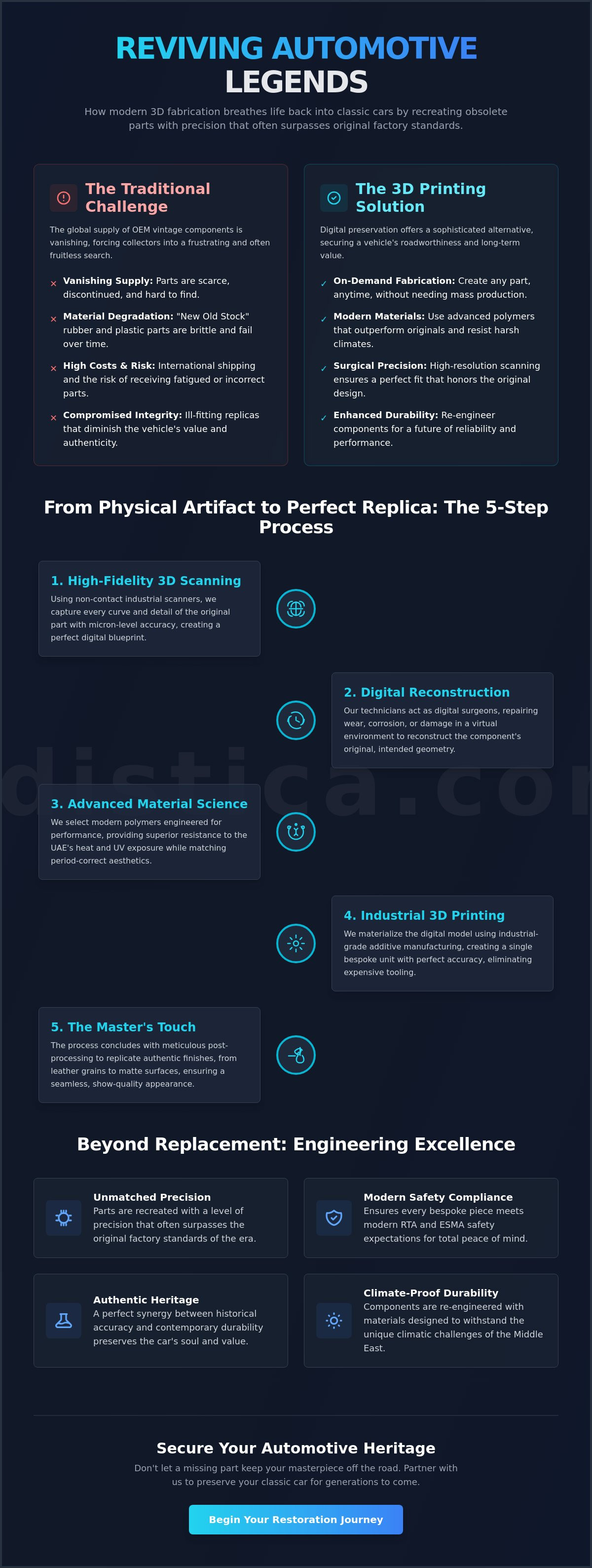
The beauty of a vintage vehicle is only as enduring as the materials that compose it. In a region where summer temperatures frequently exceed 45 degrees Celsius, material science becomes the primary guardian of automotive heritage. Utilizing 3d printing classic car parts Dubai requires a sophisticated understanding of thermal dynamics and UV exposure. It's not enough for a part to look correct; it must survive the environmental rigors of the Middle East. We select mediums that respect the original's tactile essence while offering the resilience of modern engineering. This ensures that every component isn't just a placeholder, but a permanent addition to the car's legacy.
Standard consumer-grade PLA is a liability in an automotive context. It begins to soften at temperatures as low as 60 degrees Celsius, a threshold easily reached inside a parked car in Dubai. We prioritize industrial-grade polymers like ASA (Acrylonitrile Styrene Acrylate) or high-temperature Nylon. ASA offers exceptional UV resistance and maintains its structural integrity under the relentless desert sun, making it ideal for exterior trim and mirror housings. High-temp Nylon provides the thermal deflection necessary for engine bay components. This ensures your bespoke restoration doesn't warp or degrade during a spirited drive through the Hajar Mountains.
Choosing the right medium is a delicate balance of tactile feeling and mechanical necessity. Interior trim requires a different approach than structural brackets or engine components. We utilize a curated selection of materials to ensure every part serves its specific purpose within the vehicle assembly.
| Material Type | Best For | Key Property |
|---|---|---|
| Aesthetic Resins | Dashboard knobs, dial faces | High-fidelity detail and smooth finish |
| Fiber-Reinforced Composites | Structural brackets, housings | High strength-to-weight ratio |
| ASA (Industrial) | Exterior trim, mirror housings | UV stability and weather resistance |
| High-Temp Nylon | Engine components, clips | Superior thermal deflection |
For components requiring ultimate structural integrity, metal 3D printing has emerged as a transformative force. We can now recreate structural vintage components in alloys that offer significant weight reduction and superior heat management. This allows for the production of complex geometries that were often impossible to cast sixty years ago. It's a process that doesn't just replicate the past; it improves upon it. By integrating advanced 3d printing classic car parts Dubai into the build, we ensure the vehicle's heart beats stronger than ever before, matching historical aesthetics with future-proof durability.
A raw industrial print is merely a skeleton. While the previous sections detailed the technical precision of scanning and material selection, the true soul of 3d printing classic car parts Dubai emerges during the post-processing phase. We erase the digital origins of a component through meticulous manual labor. Professional sanding and vapor smoothing are essential to eliminate the characteristic layer lines of additive manufacturing. This results in a surface so fluid and seamless that it becomes indistinguishable from a factory-cast original. It is a process of refinement that honors the tactile heritage of the vehicle.
Replicating the specific ambiance of a vintage interior requires more than just a shape. It requires a perfect match of texture and sheen. Our artisans employ a multi-stage manual finishing process to ensure every piece belongs in a concours-level restoration. The workflow typically includes:
Applying high-build primers to bridge microscopic gaps between print layers.
Progressive sanding stages that prepare the surface for final pigment application.
Recreating specific leather grains or pebble-matte finishes found in 1960s and 70s cabins.
Custom mixing paints to match the aged patina of the surrounding original components.
This attention to detail ensures that a newly fabricated vent or dial doesn't look like a modern intrusion. Instead, it feels like a preserved relic that has lived with the car since its inception.
Classic cars are defined by their brilliance. Many vintage badges, emblems, and trim pieces were originally cast in heavy metals, but 3D printing allows us to recreate these in lightweight, durable polymers. To restore the mirror-finish, we utilize advanced hydro-chroming. Unlike traditional electroplating, which requires a conductive metal substrate, hydro-chroming allows us to apply a genuine metallic layer to non-metal parts. This creates a flawless, reflective surface that captures the light exactly like chrome. Modern coatings provide an essential layer of UV protection and chemical resistance. These finishes are specifically engineered to maintain their luster against the high salt content and humidity of the Dubai coastline; they ensure the vehicle remains a showpiece for years to come.
Our studio specializes in these advanced surface finishing and hydro chroming techniques to ensure your restoration project meets the highest standards of automotive excellence.
Choosing a partner for a restoration project is a decision rooted in trust. It's about finding a visionary artisan who understands that a vehicle is more than a machine. At 3DISTICA, we position ourselves as high-end creative partners, bridging the gap between an abstract restoration goal and a tangible, high-fidelity reality. Our studio is a preferred destination for 3d printing classic car parts Dubai because we treat every component as a bespoke art form. We don't just manufacture; we curate a process that respects the historical essence of your vehicle while utilizing the full spectrum of modern technology.
Our expertise exists at the intersection of technical precision and narrative-driven design. While additive manufacturing is a core pillar, we often integrate CNC routing and laser cutting to achieve the complex assemblies required for vintage automotive interiors and chassis. This holistic approach allows us to manage end-to-end projects with a level of organization that mirrors the harmony of the cars we restore. We provide a steady, curated rhythm from the initial conceptual purpose to the final installation, ensuring the outcome is as polished as the vehicle it inhabits.
We believe that a successful restoration is a shared narrative. Our process begins by listening to the collector to understand the specific "feeling" or atmosphere they wish to preserve within the cabin. This focus on spatial feeling and environmental mood allows us to move beyond mere dimensions. We maintain complete transparency throughout the fabrication workflow, offering a steady flow of information that builds exclusivity and trust. Our commitment is to deliver tangible assets that don't just meet specifications but exceed the emotional expectations of the most discerning enthusiast.
Transforming your automotive vision into reality begins with a simple evaluation. Whether you have a shattered door handle or a missing dashboard panel, the first step is submitting the original sample or its housing for 3D scanning. For large-scale components like bumpers or structural fairings, we often utilize fiberglass products and industrial-scale printing to ensure structural integrity and a perfect fit. We invite you to collaborate with a studio that prioritizes artistic integrity and technical mastery. By choosing 3d printing classic car parts Dubai through our bespoke service, you aren't just repairing a car; you are authoring the next chapter of its history.
Restoring a vintage vehicle is a profound act of storytelling. We've explored how the precision of 3d printing classic car parts Dubai transforms obsolete components into durable, show-quality assets that honor the original designer's intent. By merging high-resolution 3D scanning with advanced material science, we ensure your vehicle thrives in the unique Middle Eastern climate without compromising its historical essence. Our deep expertise in reverse engineering and advanced surface finishing, including hydro-chroming, guarantees that every piece mirrors the original's aesthetic while offering modern structural integrity. As a dedicated division of SOLIDIFY Technical Services L.L.C., we bring a meticulous, artisan-led approach to every bespoke project.
The road ahead shouldn't be limited by the vanishing supply of factory parts. It's time to bridge the gap between historical design and future-proof technology through a partnership that values artistic integrity. We invite you to begin your automotive restoration journey with 3DISTICA and rediscover the wonder of your classic vehicle. Your heritage is worth the precision of a visionary guide who understands that some legends are meant to be driven forever.
Durability is ensured through the selection of industrial-grade, UV-stable polymers like ASA and high-temperature Nylon. These materials are meticulously chosen to maintain structural integrity even when interior cabin temperatures peak during the height of a Dubai summer. Unlike standard consumer plastics, our industrial mediums offer the thermal deflection necessary for long-term reliability in the intense desert environment.
Yes, functional engine components can be produced using high-performance composites or metal 3D printing. We focus on non-combustion parts such as specialized brackets, housings, and cooling system connectors that must withstand vibration and thermal stress. These components perform as reliably as the original factory-cast items while often offering superior weight characteristics and corrosion resistance.
Industrial 3D scanning is a non-contact process that is entirely safe for even the most fragile or rare original parts. We utilize structured light technology to capture every detail without ever physically touching the artifact. This methodology protects the delicate patina of vintage plastics and aged metals, providing a digital twin that serves as a permanent record for future preservation without any risk of physical damage.
Lead times vary based on the complexity of the digital reconstruction and the required surface finishing. A typical project involving 3d printing classic car parts Dubai moves through scanning, CAD refinement, and industrial fabrication over several weeks. This curated timeline ensures that every stage of the artisan-led process receives the meticulous attention required to meet our high-fidelity standards.
Every 3D printed part can be professionally finished with custom paint or hydro-chroming to achieve a perfect visual match. Our post-processing techniques are designed to erase the digital origin of the component. We utilize multi-stage sanding and specialized primers to create a surface that accepts high-end automotive coatings, allowing new parts to blend seamlessly with the aged interior or exterior of your vehicle.
3D printing is often the most cost-effective solution when original spares are obsolete or require expensive international sourcing. While the initial digital engineering involves a tailored investment, it eliminates the need for expensive tooling or the high risk of purchasing degraded "New Old Stock." It provides a bespoke, high-quality component that is often more durable than a decades-old original part found in a salvage yard.
To provide an accurate quote, we typically require the original part or its remaining fragments for a physical evaluation. Providing clear photographs and the specific make and model of the vehicle helps establish the initial project scope. Our technicians use these details to assess the complexity of the reverse engineering required and to recommend the most appropriate material for the part's functional environment.
We can often recreate missing parts by referencing symmetrical components or using historical design documentation. If a left-side mirror housing is missing, we can scan the right-side original and mirror the digital geometry to create its perfect counterpart. For completely unique missing items, our designers work from period-correct technical drawings and photographic evidence to reconstruct the component's narrative and dimensions from scratch.
