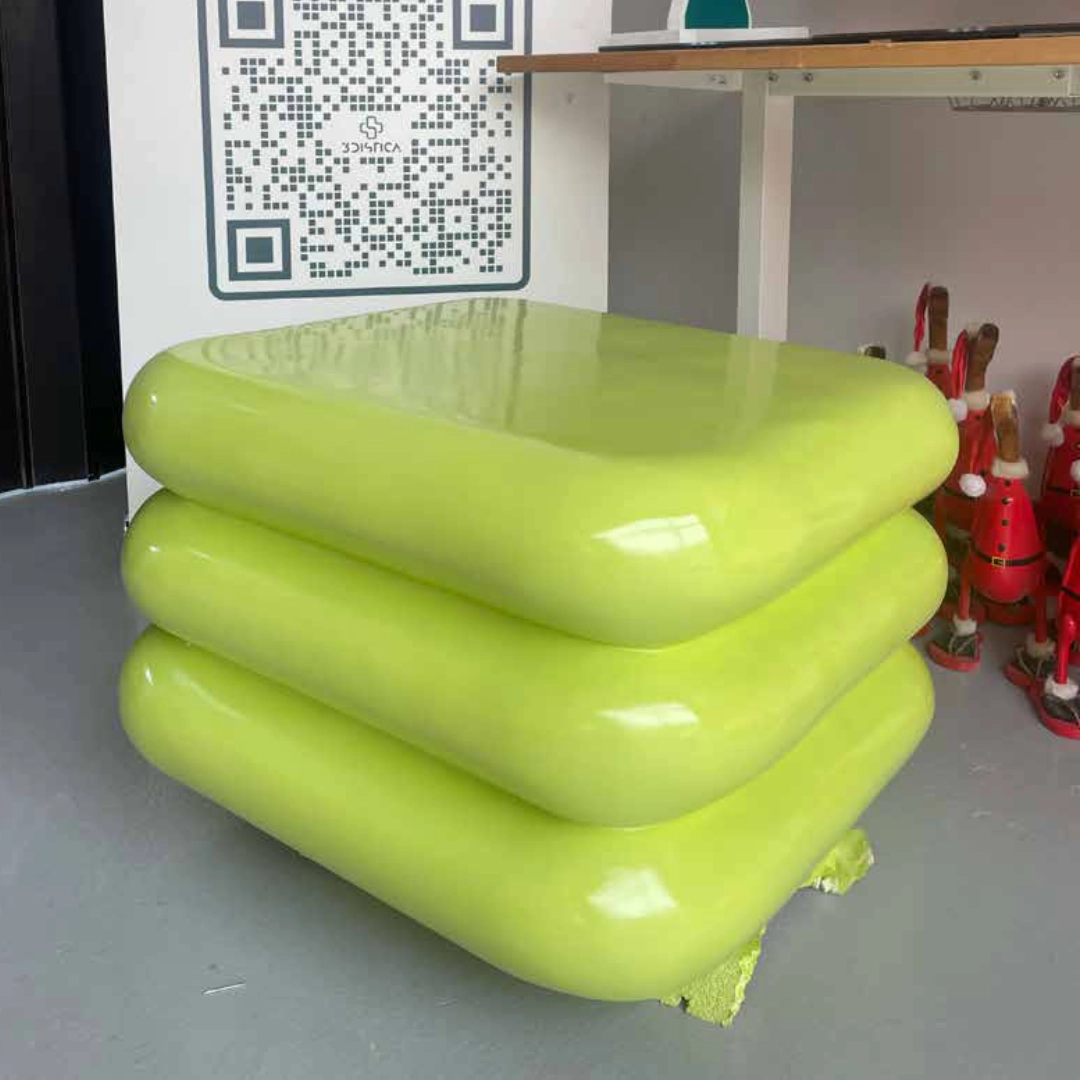
A digital render is a promise; the physical world is often a compromise. When you design an organic, sweeping architectural form, the transition from screen to site usually demands a sacrifice in detail or a struggle with structural weight. You've likely felt the frustration of watching a visionary concept get diluted by the limitations of traditional materials that can't handle intricate geometries or harsh coastal climates. It's a persistent tension between the limitless imagination of the studio and the rigid realities of fabrication.
The benefits of fiberglass molding offer a definitive solution to this creative friction. This guide explores how bespoke fabrication transforms high-fidelity digital models into lightweight, monumental structures that defy environmental degradation. You'll discover the technical precision behind seamless surface finishes and learn why the global fiberglass market, valued at 12.5 billion dollars in 2026, is the cornerstone of modern architectural resilience. We will examine the interplay of structural integrity and aesthetic fluidity that defines the next generation of physical masterpieces.
• Learn how the meticulous transition from a precision-crafted master model to a final asset preserves every nuance of your original digital vision.
• Explore how the high tensile strength and minimal mass of molded components simplify the logistics and installation of monumental architectural works.
• Understand the techniques for achieving infinite geometric complexity and seamless surface finishes that traditional fabrication methods simply cannot replicate.
• Discover the long-term benefits of fiberglass molding for projects in demanding climates, where UV stability and corrosion resistance are essential for lasting impact.
• See how the integration of 3D scanning and industrial printing into the mold-making process bridges the gap between digital precision and artisanal craftsmanship.
Fiberglass molding isn't just a technical choice; it's a commitment to preserving the integrity of a design from concept to completion. By carefully layering glass fibers and specialized resins, we produce Glass-Reinforced Plastic (GRP) components that offer a rare blend of lightness and durability. Understanding Fiberglass and its chemical properties is essential for any designer who wishes to push the boundaries of what's possible in bespoke fabrication. This process highlights the primary benefits of fiberglass molding, allowing for a level of detail and structural permanence that other methods can't match.
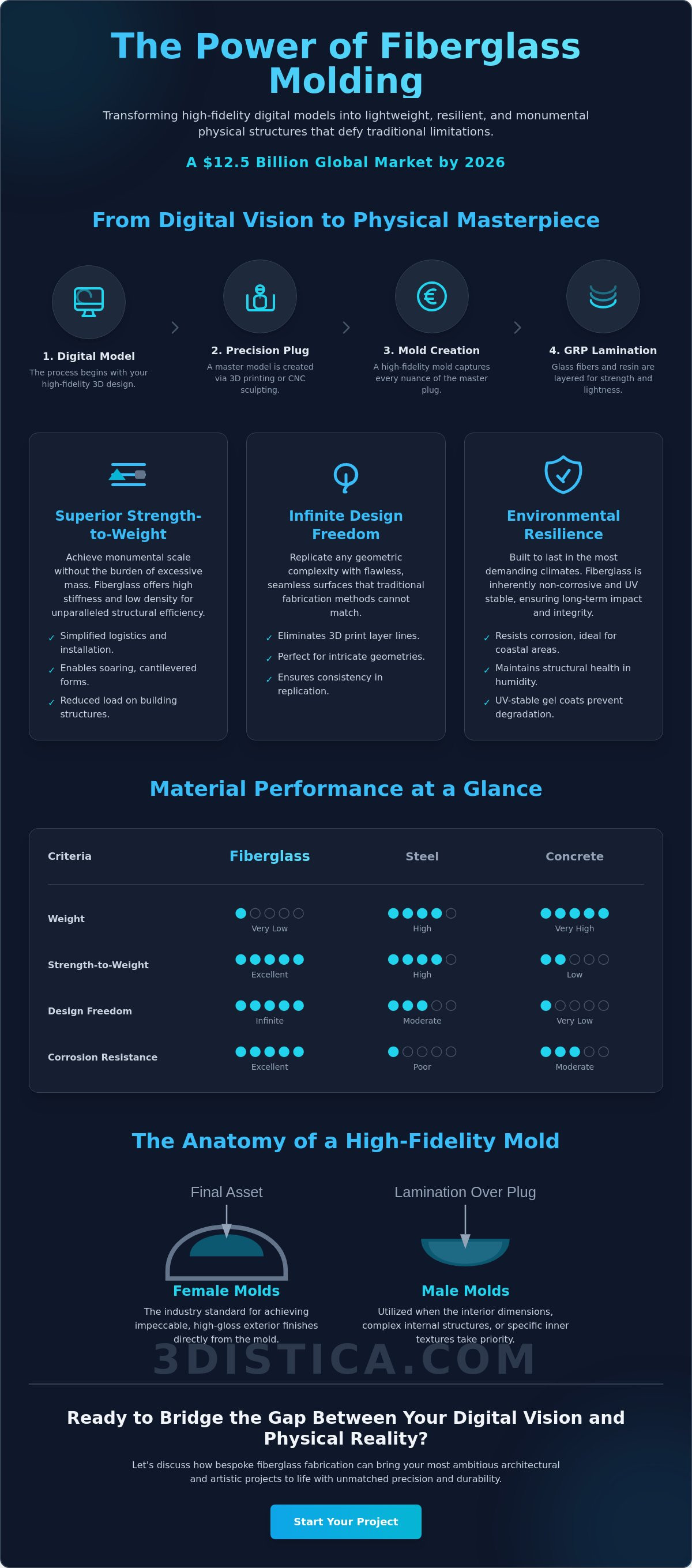
The workflow moves with a curated rhythm. We start with a high-precision plug, often derived from industrial 3D printing or styrofoam sculpting, which acts as the physical blueprint. From this master model, we create a precision mold that captures every curve and nuance. This process is particularly advantageous for large-scale architectural scale models or custom interior panels where consistency across multiple units is required. It's the primary way we turn a 3D scan into a tangible, permanent asset.
The surface of a masterpiece is defined by its first layer. We apply a specialized gel coat to the mold's interior to ensure a finish that is both visually stunning and structurally resilient. The choice of mold type depends on the final narrative of the piece:
These are the standard for achieving an impeccable, high-gloss exterior finish.
These are utilized when the interior dimensions or specific internal textures take priority.
The plug serves as the artistic soul of the fabrication process, embodying the original intent before it's immortalized in composite form.
One of the core benefits of fiberglass molding lies in its ability to achieve a level of surface smoothness that additive manufacturing alone often struggles to reach. While industrial 3D printing is invaluable for creating the initial plug, the molding process eliminates the characteristic layer lines of printed parts, resulting in a seamless, fluid aesthetic. For limited-run bespoke collections or wall cladding panels, molding offers a distinct efficiency, allowing for the replication of complex forms without sacrificing the hand-finished quality of a singular sculpture. Every mold undergoes a rigorous refinement process, where artisans hand-finish the surfaces to ensure the final assets reflect the highest fidelity possible.
The structural allure of composites lies in a singular, compelling paradox. While traditional materials often equate mass with stability, the benefits of fiberglass molding stem from a superior strength-to-weight ratio that challenges conventional engineering. This material possesses high stiffness and low density, allowing it to perform under significant stress without the burden of excessive weight. For monumental installations, this translates to a radical reduction in logistical complexity. Moving a massive sculpture or an intricate wall panel becomes a choreographed exercise in precision rather than a brute-force challenge of heavy machinery.
Lightweight components don't just ease transport; they redefine what a structure can achieve. Because fiberglass is exceptionally light, it can support its own weight over expansive spans that would cause stone or concrete to fracture under their own gravity. This allows for the creation of soaring, cantilevered forms and delicate architectural features that seem to float within a space. In high-traffic public areas, the safety implications are profound. A lightweight installation reduces the load on a building's primary structure and minimizes risks during structural shifts or environmental vibrations.
When we look at steel, we see a material prone to the slow decay of oxidation. Fiberglass is inherently non-corrosive, maintaining its structural health even in salt-laden coastal air or humid interior environments. Compared to concrete, fiberglass allows us to replicate the heavy, tactile presence of stone without the prohibitive weight. This is the essence of the high-strength shell concept. We create a thin, rigid exterior that carries the visual narrative of the project while remaining light enough for easy mounting as wall cladding or interior panels.
Durability is more than just hardness. It's the ability to absorb energy and remain unchanged. Fiberglass molding creates a surface that can withstand impacts without the permanent deformation common in metals. By adjusting our resin formulations, we can tune the material to be either glass-hard or slightly flexible, depending on the specific needs of the environment. Ultimately, fiberglass is a material that defies its own lightness through sheer structural density. It provides a sense of permanence that belies its ease of handling, ensuring that artistic visions remain intact for generations.
Design is rarely a matter of straight lines; it's a conversation between light, shadow, and space. One of the most significant benefits of fiberglass molding is the ability to transcend the geometric limitations inherent in traditional machining. While CNC routing or laser cutting offer incredible precision, they often struggle with deep undercuts or aggressive organic curves that require multiple setups or compromise the material's integrity. Molding captures these complexities with effortless grace. It allows a creator to move from a digital sculpt to a physical asset without losing the delicate soul of the original form.
The 2024 State of the Industry Report by the American Composites Manufacturers Association emphasizes how this versatility drives innovation in sectors where high-aesthetic demand meets structural performance. In the world of bespoke fabrication, this means creating monumental installations that appear entirely monolithic. By utilizing advanced mold-making techniques, we eliminate the visible joints and seams that often plague large-scale projects. This creates a sense of mystery and continuity, allowing the viewer to focus on the narrative of the work rather than the mechanics of its assembly.
Modern architecture increasingly relies on parametric design, resulting in complex mathematical surfaces that defy simple fabrication. These forms require a medium that can adapt to every twist and turn. Multi-piece molds are the secret to achieving this 360-degree detail, allowing us to capture every angle of a vinyl figure or a complex architectural maquette. We don't just replicate the shape; we integrate functional elements like mounting points or lighting channels directly into the mold. This ensures the final piece is ready for installation the moment it leaves the studio.
The skin of a piece tells its story. Molding excels at capturing micro-textures, enabling hyper-realistic replicas of natural materials or perfectly smooth, futuristic surfaces. Whether you're seeking the reflective depth of hydro-chroming or a high-gloss automotive finish, the mold provides the essential foundation. At 3DISTICA, we focus on this high-fidelity visual representation through meticulous finishing. We understand that the emotional impact of a design often rests in the subtle details of its surface, and we ensure every piece reflects the intended environmental mood and spatial feeling.
Material degradation is a silent thief of artistic intent. It robs a project of its original brilliance over years of exposure to the relentless outdoors. One of the most practical benefits of fiberglass molding is its inherent defiance of the elements. Unlike wood that rots or metals that oxidize, Glass-Reinforced Plastic (GRP) remains structurally indifferent to environmental shifts. This is especially critical for monumental works placed in coastal regions where salt air acts as a constant corrosive force. By choosing GRP, you ensure that the spatial feeling of your installation remains unchanged by time.
Precision matters even in extreme heat. Many synthetic materials expand or warp when subjected to direct sunlight, compromising the fit of wall cladding or the alignment of architectural models. Fiberglass maintains remarkable thermal stability. It doesn't buckle or distort under the sun. This ensures that the geometric complexity of your design remains crisp and intentional for decades. It's a material designed for a 20-year lifecycle, requiring minimal intervention to maintain its high-fidelity appearance.
Solar radiation is the primary cause of yellowing and brittleness in lesser composites. We utilize specialized UV-stable resins and high-end surface coatings to protect the structural core from solar degradation. Pigments can be integrated directly into the resin during the molding process, ensuring that the color isn't just a surface treatment but part of the material's DNA. Effectively, fiberglass acts as an inert barrier against the harshest atmospheric forces. This protection preserves the narrative impact of the piece, keeping the visual quality exactly as the designer intended from day one.
For outdoor kiosks, public art, and custom interior panels, moisture resistance is non-negotiable. Fiberglass is the gold standard for these applications because it's completely non-porous. It won't absorb humidity or harbor mold, which is a common failure point for traditional materials. This creates a "set-and-forget" dynamic for public-facing assets. Maintenance is reduced to simple cleaning and occasional restorative polishing, a stark contrast to the constant sanding and repainting required for wood or steel. It's a long-term solution that respects both the project's budget and its aesthetic integrity. If you're planning a project for a challenging environment, explore our bespoke fiberglass products to ensure lasting quality.
Precision is our baseline. Artistry is our goal. At 3DISTICA, we've synthesized these two worlds to offer a fabrication process that honors the complexity of your original vision. We utilize advanced 3D scanning and industrial 3D printing to create the initial architecture of a piece, ensuring that every digital nuance is captured in the physical plug. One of the primary benefits of fiberglass molding within our specific workflow is the ability to maintain this mathematical fidelity while gaining the tactile, permanent qualities of high-end composites. We don't just produce objects; we build narratives that resonate within a space.
Technology serves the story, never the other way around. Our approach as a visionary artisan means we prioritize the environmental mood and the emotional impact of a design. Whether we are developing architectural scale models or intricate custom awards, we act as a collaborative guide through the technical maze of fabrication. This end-to-end service allows us to manage everything from conceptual modeling to national-scale installation, ensuring the final asset arrives with its integrity fully intact. The benefits of fiberglass molding are most apparent when the material’s durability meets our studio's obsession with detail.
The journey from screen to site requires a bridge of absolute accuracy. We employ CNC routing and large-format 3D printing to fabricate the master plug, creating a foundation that is mathematically perfect. Once the mold is established, our team begins a meticulous hand-lamination process. This manual layering ensures a structural density and level of quality control that mass-production systems simply cannot replicate. We take pride in our ability to handle the complex logistics of monumental works, coordinating the movement and installation of large-scale assets across the country with professional ease.
Every project we undertake is a unique artifact. We intentionally avoid the world of mass production to focus on bespoke assets that carry a specific spatial feeling. Our partners value this exclusivity, knowing that their work is being handled by technicians who speak the language of design. We understand that a project’s success depends on the interplay of light, texture, and form. We don't just deliver a product; we help you navigate the complexities of visual communication with elegance and technical authority. We invite you to Invite a conversation on your next visionary project.
The transition from an abstract digital concept to a tangible architectural presence doesn't have to involve a loss of detail. By embracing the diverse benefits of fiberglass molding, you secure a medium that respects the nuances of your design while providing the structural integrity required for monumental scale. We've explored how GRP defies environmental decay and allows for a seamless, monolithic aesthetic that traditional fabrication simply can't achieve. This material serves as the definitive bridge between the precision of a 3D scan and the permanence of a physical masterpiece.
3DISTICA specializes in this high-fidelity transformation. Our precision-driven hybrid workflow combines industrial 3D technology with artisanal molding to deliver end-to-end bespoke production. Whether you're envisioning large-scale monumental sculptures or intricate wall cladding, our studio acts as a collaborative guide from the initial design to the final installation. We understand that your project is more than a service; it's a narrative waiting to take form in the physical world.
Begin your journey from concept to reality with our fabrication experts. We look forward to bringing your most ambitious visions to life with elegance and technical authority.
Molding provides a level of surface smoothness and structural density that direct 3D printing often struggles to achieve. While industrial printing is perfect for creating the initial plug, the benefits of fiberglass molding include the elimination of visible layer lines and the creation of a monolithic, high-strength shell. This process ensures the final asset possesses a refined, hand-finished quality that reflects the highest standards of bespoke fabrication.
Fiberglass products are engineered for a lifecycle exceeding 20 years, even when subjected to intense solar radiation and extreme temperatures. The material's inherent thermal stability prevents the warping or buckling common in lesser synthetics. By utilizing specialized, UV-stable resins, we ensure that the structural core and surface pigments remain vibrant and intact through decades of atmospheric exposure.
Fiberglass is a strategic investment for unique projects that demand intricate geometric complexity and long-term resilience. While the creation of a precision mold requires an initial artisanal effort, the resulting piece offers a strength-to-weight ratio that reduces long-term maintenance and installation costs. It's the preferred choice for visionary partners who prioritize design fidelity and environmental permanence over mass-produced alternatives.
Fiberglass molds are exceptionally capable of replicating micro-textures and aggressive organic curves with absolute precision. Whether the goal is a hyper-realistic replica of natural stone or a perfectly smooth surface for hydro-chroming, the mold captures every nuance of the master model. This high-fidelity representation allows for the seamless translation of a digital sculpt into a tangible, physical masterpiece.
Architecture, public art, and high-end automotive restoration sectors find the most value in custom fiberglass solutions. The material is indispensable for creating lightweight wall cladding, monumental sculptures, and architectural scale models that must withstand public interaction. Any industry that speaks the language of design and requires a blend of technical precision and artistic soul will find fiberglass to be an ideal medium.
We utilize a precision-driven hybrid workflow that begins with 3D scanning and CNC routing to create a mathematically perfect plug. This digital foundation ensures that the benefits of fiberglass molding are realized through a mold that is accurate to the original render. Our artisans then hand-refine the surfaces to ensure that every curve and undercut meets our rigorous standards for spatial feeling and visual impact.
Lead times are influenced by the scale of the project and the intricacy of the required geometric detail. The process is a curated journey that moves from digital design and 3D scanning to plug fabrication, hand-lamination, and final surface finishing. Professional partners should consult with our team during the conceptual phase to establish a timeline that respects the meticulous nature of bespoke craftsmanship.
The environmental value of fiberglass lies in its extreme longevity and minimal maintenance requirements. Because it doesn't rot, rust, or degrade like traditional materials, it eliminates the need for frequent replacement cycles and the chemical treatments associated with wood or steel. This "set-and-forget" durability ensures that the total material footprint remains low over the project's multi-decade existence.
