
A prop's true value isn't measured by its weight; it's defined by its ability to hold a narrative under the uncompromising gaze of a high-fidelity environment. The classic debate of styrofoam vs fiberglass for props often forces a false choice between rapid execution and long-term permanence. You likely feel the tension of tight production timelines while worrying that a finished piece might look unfinished or succumb to the unique demands of the UAE climate. It's a common concern for those who view every environmental element as a vital chapter in a larger story.
We share your commitment to projects that transcend the ordinary and demand absolute technical excellence. This guide promises to clarify the nuanced differences between these materials, helping you assess a landscape where resin costs and polystyrene indices are shifting in 2026. We'll explore how modern engineering allows for high-fidelity visual impact without compromising on structural integrity. By the end, you'll have the clarity to choose a fabrication partner who treats your vision as a bespoke art form, ensuring your next creation resonates with both precision and soul.
• Align project volume with the correct medium. Contrast the rapid sculpting potential of expanded polystyrene against the high-impact resilience of glass-reinforced composites.
• Master the technical nuances of styrofoam vs fiberglass for props. This ensures your design maintains its integrity in high-traffic settings and the unique UAE climate.
• Optimize your production timeline and budget. Evaluate the total cost of ownership by comparing the agility of foam with the enduring permanence of fiberglass.
• Define the ideal fabrication path. Use a selection matrix that considers the prop's intended lifecycle and the specific ways your audience will interact with the piece.
• Elevate raw materials into high-fidelity elements. Discover how advanced technologies like industrial 3D printing and CNC routing are refined through meticulous surface finishing.
Materiality serves as the foundation of any immersive experience. When evaluating styrofoam vs fiberglass for props, the decision moves beyond simple cost analysis. It becomes a question of how a physical object should occupy space and engage the senses. In the 2026 fabrication environment, where the Producer Price Index for polystyrene foam has seen a 3.84% increase over the past year, precision in selection is more critical than ever. Every curve and texture communicates a specific intent. The choice of material ultimately dictates the emotional resonance of the final installation, bridging the gap between a conceptual sketch and a tangible reality.
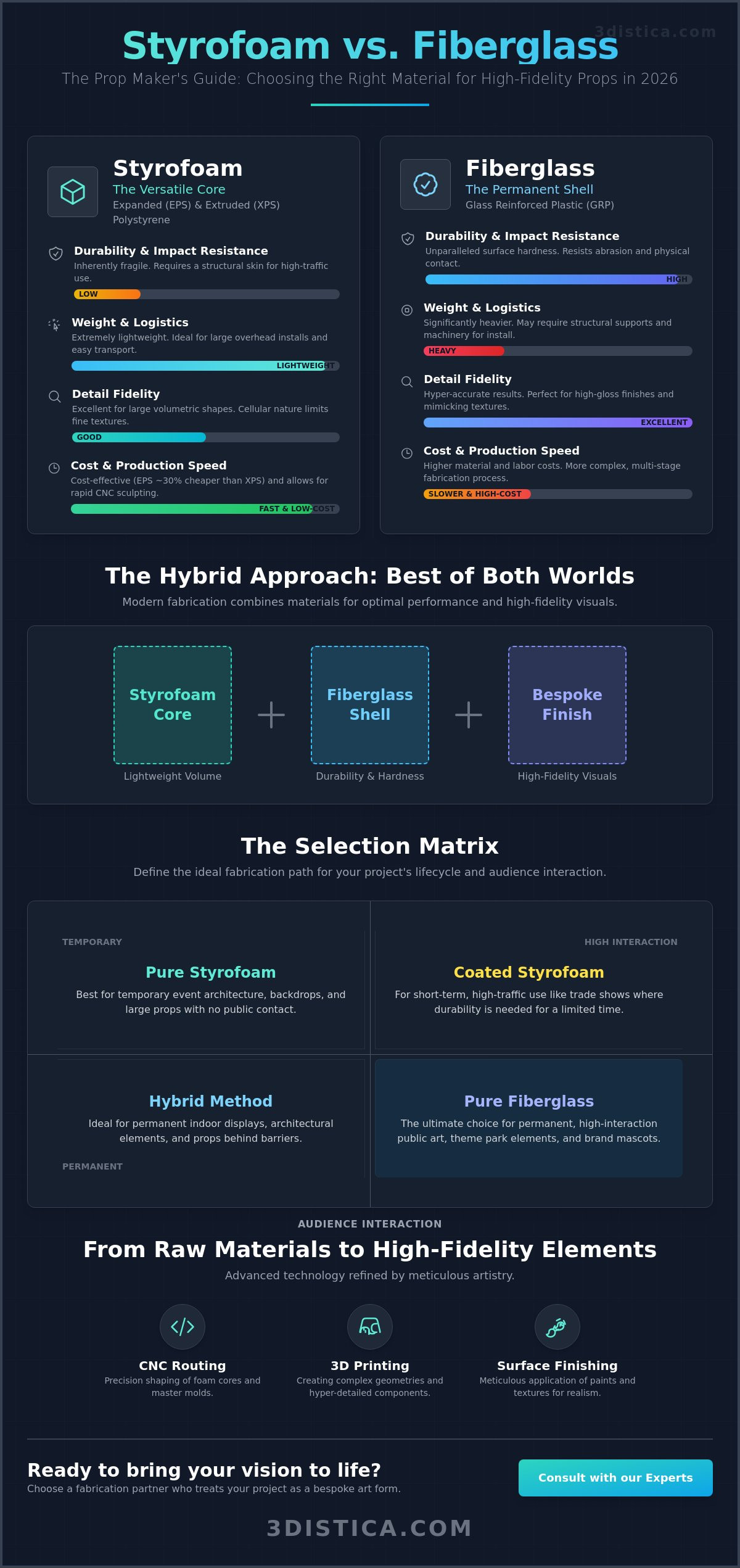
Expanded Polystyrene (EPS) and Extruded Polystyrene (XPS) represent the ultimate canvas for rapid, large-scale volumetric shaping. EPS is frequently selected for its cost-effectiveness, as it remains roughly 30% cheaper than XPS for the same R-value, making it a powerhouse for temporary event architecture. Its unique cellular structure allows for effortless CNC routing and laser cutting. These technologies enable the creation of intricate geometries that would be prohibitively heavy or complex in other media. For massive overhead installations or rapid prototyping, these lightweight cores provide necessary volume without the structural burden of traditional materials. They are the silent architects of temporary wonder.
Fiberglass, or Glass Reinforced Plastic, operates as a structural composite designed for endurance. It offers an unparalleled surface hardness that withstands the rigors of public interaction and the demanding UAE climate. To understand its fundamental properties, one can look at a comprehensive overview of fiberglass which details the synergy between glass fibers and resin binders. This chemistry creates a "forever" prop capable of supporting high-gloss automotive paints or bespoke surface finishing that mimics natural stone or metallic textures. It's the industry standard for permanent branding and public art. It provides a tactile sense of quality and permanence that foam alone cannot achieve.
The 2026 landscape has evolved toward a hybrid methodology. We no longer view these materials as isolated choices; instead, we see them as layers of a single narrative. A fiberglass shell offers a cold, hard permanence that commands respect. A foam sculpture suggests a fleeting, ethereal wonder. Both materials are now subject to the updated OSHA Hazard Communication Standards, which require full compliance with the GHS-aligned Safety Data Sheet (SDS) format as of January 2026. This regulatory shift ensures that the artistry of fabrication remains as safe as it is visually stunning. By understanding the soul of these materials, you can choose the path that best serves your project's lifecycle.
Performance is where the abstract narrative of a design meets the uncompromising reality of the physical world. When evaluating styrofoam vs fiberglass for props, tensile strength and impact resistance become the primary metrics for success in high-traffic environments. A prop that lives in a busy retail atrium or a public exhibition must possess a surface hardness capable of resisting casual physical contact and accidental abrasion. While styrofoam provides the volumetric presence required for large-scale impact, it remains inherently fragile without a structural skin. Fiberglass, as a structural composite, offers a level of durability that ensures a project's visual fidelity remains intact from the first day of installation to the last.
Weight is the silent architect of logistics and on-site assembly. For massive overhead installations or mobile sets, the density of the material dictates the complexity of the support structures and the cost of transport. Styrofoam sculpting allows for the creation of towering elements that can be moved by a small team without heavy machinery. This lightweight nature is a significant advantage for temporary events, yet it must be balanced against the "detail ceiling" of the material. While CNC routing can achieve remarkable precision in foam, the cellular nature of the material limits the sharpness of fine textures compared to the hyper-accurate results possible with bespoke fiberglass products.
The UAE climate presents a unique set of challenges that test the limits of fabrication materials. Extreme UV exposure and ambient temperatures that can exceed 50°C lead to rapid degradation in unprotected materials. Unprotected foam is particularly vulnerable to heat distortion and physical warping over time. Fiberglass remains stable under these conditions, maintaining its structural integrity and surface finish despite intense solar radiation. For outdoor placements or semi-permanent installations, protective coatings are not just an option; they are a technical necessity to prevent the environment from eroding the artist's intent.
The most sophisticated solutions in modern fabrication often lie in the marriage of these two distinct materials. By applying a structural layer of polyurea or fiberglass over a precision CNC-milled foam core, we achieve the lightweight benefits of foam with the rugged, high-fidelity exterior of a composite. This process allows for the rapid production of massive volumes while ensuring the final piece can withstand the rigors of public interaction. Applying a structural fiberglass shell over a CNC-milled foam core represents the gold standard of 2026 prop making. This hybrid methodology ensures that your vision is not only captured with technical precision but is also built to endure.
Financial clarity in fabrication isn't merely about the initial quote. It's a calculation of the project's entire lifecycle. When choosing between styrofoam vs fiberglass for props, you're balancing the immediate need for visual impact with the long-term reality of maintenance and storage. While the Producer Price Index for polystyrene foam showed a 3.84% increase through April 2026, resin volatility has been more pronounced. These market shifts demand a more sophisticated approach to material selection. Investing in the right medium ensures the narrative quality of the piece remains uncompromised by budget constraints or logistical hurdles.
For a one-off bespoke sculpture, CNC routing a foam core often proves most efficient. It bypasses the labor-intensive mold-making stage required for composites. However, for limited-run custom awards or repeatable architectural elements, the investment in a master mold becomes the superior choice. Selecting the wrong reinforcement, such as mat versus cloth, can increase total fiberglass costs by 20-40%. In these scenarios, the mold allows for consistent high-fidelity replication that foam carving simply cannot match at scale. This investment pays dividends when the project requires a uniform aesthetic across multiple touchpoints within a single environment.
Speed is often the deciding factor for event-driven projects. Styrofoam sculpting offers a rapid path from digital model to physical form. It's the ideal medium for tight deadlines where monumental volumes must be achieved in days rather than weeks. Fiberglass requires a multi-stage process involving mold preparation, layup, and meticulous curing times. Resin costs have surged 20-50% since January 2025, which also impacts how we stage production to minimize waste and keep schedules tight. Complex surface finishing adds further layers to the delivery timeline. We optimize this pipeline by integrating industrial 3D printing for intricate components, ensuring that even the most ambitious projects meet their launch dates without sacrificing artistic integrity. Balancing these timelines requires a partner who understands the nuance of every curing hour and every tool path.
Ultimately, the economics of a project are tied to its intended interaction. A temporary installation that only needs to survive a 48-hour exhibition has vastly different cost requirements than a public landmark designed for a decade of exposure. By aligning the material choice with the project's lifespan, we ensure that every dirham spent translates into a more immersive and impactful experience for your audience. It's about making the technology serve the story, rather than letting the budget dictate the limits of your imagination.
Choosing the right medium is an act of strategic alignment rather than a simple binary preference. When navigating the nuances of styrofoam vs fiberglass for props, the decision must be rooted in the specific environmental forces and human interactions the piece will encounter. A prop is not a static object; it is a functional element of a broader spatial narrative. By applying a rigorous selection matrix, you ensure that the technical specifications of your fabrication path mirror the artistic ambitions of your project. This systematic approach transforms uncertainty into a curated roadmap for success.
The first step involves distinguishing between a "disposable" event element and a "legacy" architectural asset. A temporary installation meant for a 48-hour exhibition demands the rapid volumetric agility of foam, whereas a permanent public landmark requires the ten-year endurance of a composite shell. Planning for modular transport and future re-use is essential for projects that may travel between international galleries or corporate headquarters. The 2026 industry trend favors sustainable, multi-use assets that can be repurposed across different environments. This shift toward longevity reduces environmental impact while maximizing the storytelling potential of every bespoke element.
Interaction levels dictate the structural necessity of your material. If the public is intended to touch, sit on, or walk through the prop, the structural reinforcement of fiberglass becomes non-negotiable. "Touchable" art demands a surface hardness that resists indentation and maintains its high-fidelity finish under constant tactile engagement. Safety requirements for interactive installations also involve calculating the structural load for suspended elements, where the weight-to-strength ratio of the material is a critical safety factor. For projects requiring this level of durability and precision, we invite you to explore our specialized styrofoam sculpting and composite finishing services to find your ideal solution.
The final layer of the matrix evaluates the aesthetic finish against the installation environment. An indoor gallery allows for more delicate surface treatments, while an outdoor public plaza in the UAE requires materials that can host metallic or stone-mimicking textures without degrading under UV stress. Whether your vision calls for an organic, hand-carved feel or a hyper-smooth automotive sheen, the material properties must support the required finish. By matching the materiality to the environment, you create a seamless bridge between the abstract idea and the tangible visual reality. This ensures your project doesn't just occupy space, but truly defines it.
The synthesis of technological rigor and artistic intuition defines our methodology. When navigating the complexities of styrofoam vs fiberglass for props, we move beyond the limitations of a single material to embrace a hybrid philosophy. Our approach integrates industrial 3D printing and precision CNC routing to create hyper-accurate foam cores that serve as the internal skeleton for ambitious designs. This technical foundation allows us to capture the essence of a space with a level of fidelity that traditional hand-carving cannot achieve alone. It's about bridging the gap between a digital vision and a tangible, high-impact reality that commands attention in any environment.
Surface finishing is where raw materials become art. Our signature lies in the meticulous application of bespoke textures and coatings that transform a structural shell into a narrative element. Whether it's the subtle grain of weathered stone or a flawless, hydro-chromed metallic sheen, the finish is never an afterthought. It's the final layer of a carefully curated process that ensures every project resonates with its intended emotional impact. This commitment to technical precision ensures that the storytelling potential of your design is never diluted by the constraints of the fabrication process.
We utilize digital sculpting to ensure that every curve of the physical prop aligns perfectly with the initial 3D vision. This digital-to-physical workflow is refined in our national production studio through the steady hands of visionary artisans who understand that perfection lies in the details. Manual craftsmanship remains vital; no machine can replicate the intuitive touch required for high-fidelity refinement and surface smoothing. Beyond the studio, we manage the intricate logistics of monumental installations across the UAE. We ensure that even the most massive architectural scale models arrive at their destination with their structural and aesthetic integrity uncompromised.
Consider a project that begins with a 3D scan of a historical artifact, which is then scaled to a monumental size using a fiberglass-coated foam core. This hybrid approach, which we've established as the industry standard for 2026, allows for immense scale without the prohibitive weight of solid composites. It's a promise of quality that withstands both the test of time and the intensity of the regional climate. Every element we produce is designed to be a legacy asset, offering a sense of permanence and prestige to the spaces they inhabit. We invite you to collaborate with 3DISTICA for your next visionary project and experience a partnership where technical mastery meets pure imagination.
The choice between styrofoam vs fiberglass for props is more than a technical specification; it's the first step in defining how your narrative occupies the physical world. We've explored how the agility of foam cores meets the enduring strength of composite shells to create elements that are both monumental and manageable. Success in 2026 requires a harmony of digital precision and manual craftsmanship, ensuring every detail survives the scrutiny of its audience and the rigors of the environment. By aligning your material strategy with the project's lifecycle, you ensure that artistic integrity remains the central focus of the fabrication process.
At 3DISTICA, we specialize in end-to-end bespoke production that bridges the gap between abstract concepts and high-fidelity reality. By integrating advanced CNC routing and industrial 3D printing with expert surface finishing, we ensure your project achieves its maximum storytelling potential. We invite you to begin your journey from concept to creation with 3DISTICA. Let's collaborate to build something that doesn't just fill a space, but truly transforms it. Your next visionary installation is waiting to be realized with the elegance and precision it deserves.
Unprotected styrofoam isn't suitable for the intense solar radiation and extreme ambient temperatures of the UAE. It requires a structural hard-coat or polyurea skin to prevent UV degradation and physical warping over time. For short-term activations, these treated foam elements offer the necessary volumetric presence without the weight of solid composites, provided they're shielded from direct physical impact.
Fiberglass serves as an exceptional substrate for hyper-realistic finishes that mimic natural elements. Through advanced surface finishing and meticulous hand-painting, we can replicate the organic texture of ancient stone or the refined grain of polished wood. This versatility allows a structural composite to carry the emotional weight of much heavier, traditional materials while remaining functionally superior in durability.
The investment difference depends largely on the project's complexity and the required unit count. While foam is generally more cost-effective for one-off volumetric shapes, fiberglass involves higher initial investments due to mold-making and fluctuating resin costs. However, for recurring installations or limited-run custom awards, the durability of fiberglass often results in a lower total cost of ownership over the project's lifecycle.
Fabrication timelines for fiberglass are governed by a multi-stage curing process and the complexity of the mold preparation. A bespoke sculpture typically requires several weeks to move from digital sculpting to the final cured shell. This duration ensures the material achieves its full structural integrity and surface hardness before the finishing stages begin, ensuring a high-fidelity result that lasts for years.
Standard polystyrene isn't inherently fire-rated; however, we utilize specialized fire-retardant EPS for commercial indoor installations. These materials are treated to meet the specific safety standards required for public exhibitions and retail environments. It's essential to verify the specific fire-safety requirements of your venue during the initial design phase to ensure your project remains fully compliant with local safety regulations.
Styrofoam is technically recyclable in specialized facilities, though the prevailing trend in 2026 favors repurposing these elements as internal cores for new designs. Fiberglass is a permanent composite built for longevity rather than disposal. We encourage a circular approach where legacy assets are refurbished with new surface finishes to extend their narrative life across multiple campaigns and environments.
High-fidelity details at a small scale are best achieved through industrial 3D printing or fiberglass casting. When comparing styrofoam vs fiberglass for props of a diminutive size, foam's cellular structure lacks the sharpness required for intricate textures. Composites allow for a level of precision that captures the subtle nuances of a bespoke award, ensuring every fine line is preserved in the final piece.
Fiberglass is highly repairable due to its composite nature and structural versatility. Scuffs or structural cracks can be patched with fresh resin and glass mat before being refinished to a seamless state. This restoration capability makes it an ideal choice for props that must endure the logistics of international travel or frequent relocation between various event sites across the region.
