A masterpiece no longer requires months of manual labor to achieve eternal relevance. In the high-stakes world of commercial installations and architectural design, sophisticated alternatives to traditional sculpting are redefining the boundaries of what's possible in the physical world. You likely recognize the tension between an ambitious creative vision and the rigid constraints of traditional materials. Hand-carved stone is often too heavy for modern interiors. Manual carving is frequently too slow for the rapid pace of the UAE event calendar.
This guide reveals how advanced fabrication bridges the gap between digital perfection and tangible reality. You'll discover how industrial 3D printing, CNC milling, and fiberglass fabrication provide the speed and scalability necessary for monumental projects. We'll explore methods that ensure your work remains durable in the local climate while maintaining the precise symmetry that hand-sculpting often struggles to replicate. The goal is to help you find a partner who honors the soul of your art through the lens of modern technology.
• Understand how digital sculpting translates virtual concepts into high-fidelity physical forms with surgical precision.
• Explore why industrial 3D printing and CNC milling represent the most efficient alternatives to traditional sculpting for meeting rigorous commercial deadlines.
• Learn to utilize Styrofoam and lightweight cores to produce monumental installations that are easy to transport and install.
• Discover how fiberglass and advanced composites provide the necessary durability to withstand the unique environmental demands of the UAE.
• Master the process of collaborative fabrication to ensure your project maintains its artistic soul from the initial sketch to the final installation.
The dialogue between the artist and the material has changed. For centuries, the chisel and the hammer defined the limits of what a human hand could pull from the earth. We are now witnessing a profound evolution from these purely subtractive, manual processes toward a world of additive and digital manufacturing. This shift represents more than just a technical upgrade; it's a fundamental redefinition of the creative process itself. By embracing alternatives to traditional sculpting, creators can now bridge the gap between abstract thought and physical presence with unprecedented clarity and speed.
In the fast-paced project cycles of the UAE, time is the most precious resource. Waiting for a master carver to chip away at a block of marble for months is often impossible when a global exhibition opens in weeks. Modern fabrication solves this by replacing physical maquettes with high-fidelity digital twins. These digital assets allow for immediate visualization and approval, ensuring that the final installation matches the architect's intent down to the millimeter. This process respects the artistic narrative while honoring the reality of the commercial deadline. As the history of Modern sculpture shows, the industry has always moved toward materials and methods that reflect the spirit of the age. Today, that spirit is defined by precision and scale.
Classical materials like stone, bronze, and clay carry an undeniable prestige, yet they often present significant logistical hurdles. Large-scale stone sculptures are notoriously heavy, frequently exceeding the structural load limits of interior floors or rooftop gardens. Beyond weight, there's the issue of fragility. A single hairline fracture in a clay model can lead to catastrophic failure during the firing process. In outdoor settings, particularly in the intense UAE climate, traditional materials may require constant maintenance to combat weathering and erosion. Achieving perfect symmetry in a hand-carved piece is a test of human endurance that often results in subtle, unintended variations. Digital fabrication removes these physical barriers, offering materials that are both lightweight and resilient.
The transition to digital sculpting and CAD software has unlocked a new era of creative exploration. Artists can now iterate infinitely, refining textures and proportions in a virtual space before a single gram of material is used. This ability to create a digital twin means that a design can be scaled from a desk-size award to a monumental public landmark without any loss of detail. Modern tools also allow for the creation of complex, interlocking geometries that would be physically impossible to carve by hand. This high-fidelity approach ensures that the final product isn't just a representation of an idea, but a perfect physical manifestation of a digital vision.
Digital sculpting allows an artist to manipulate virtual clay with the same nuance as physical material, but without the physical limitations of gravity or drying times. When this digital mastery meets industrial 3D printing, the result is a production cycle that moves at the speed of thought. These technologies provide robust alternatives to traditional sculpting by enabling the creation of intricate, high-fidelity prototypes that serve as the foundation for monumental works. Digital sculpting is a high-fidelity bridge between imagination and matter.
Industrial additive manufacturing has evolved far beyond the capabilities of consumer-grade machines. While desktop printers are often limited to small plastic components, industrial systems utilize advanced polymers and high-performance composite resins to build structural elements. This transition from manual carving to additive layers reduces lead times from months to mere days. It empowers creators to meet the rigorous demands of architectural and event deadlines without compromising the artistic soul of the piece. By utilizing these advanced materials, the final output retains a level of detail that remains crisp even at a massive scale.
Large-format 3D printing is a transformative force for public art and corporate branding. The scale of these machines allows for the production of massive elements in a single print, or in precisely keyed sections that fit together with absolute seamlessness. Layer resolution is a critical consideration here; a finer resolution creates a smoother surface that requires less post-processing, preserving the subtle details of the original digital model. To ensure these massive prints remain stable, we often integrate internal lattice structures. These geometries provide incredible structural integrity while keeping the overall weight manageable for transport and installation.
The journey from a concept to a tangible asset often begins with 3D scanning. This allows for the reverse engineering of existing objects or the digitization of a hand-made maquette. Once the digital file is refined, the slicing process translates the complex geometry into a language the printer understands. This meticulous preparation ensures that the original design intent is preserved throughout the fabrication process. By leveraging digital fabrication in sculpture, artists can explore forms that were once considered unachievable. If you're looking to bring a complex vision to life, exploring industrial 3D printing can provide the technical precision your project deserves.
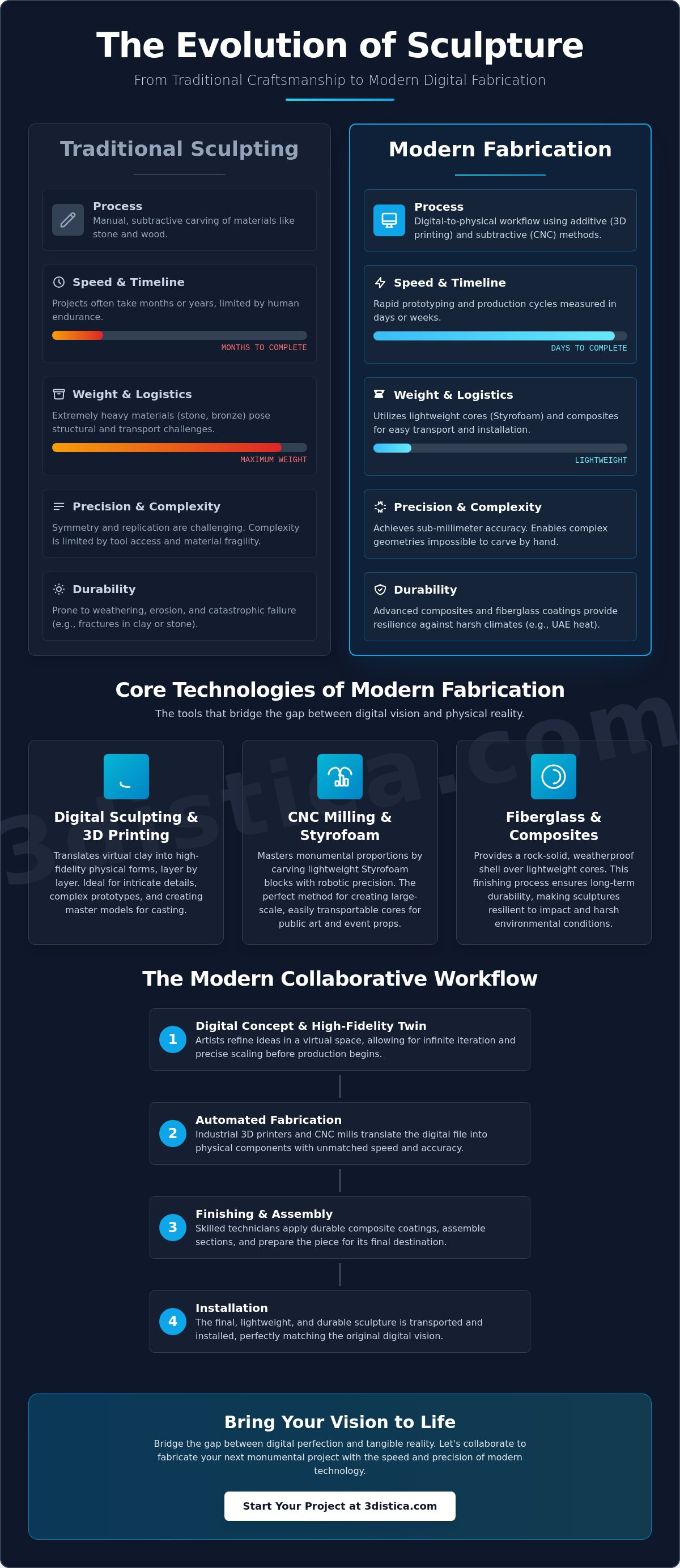
While additive methods build layer by layer, subtractive manufacturing carves beauty from a solid block. CNC routing acts as the modern artisan's tireless chisel; it's capable of translating complex digital maps into physical forms with surgical accuracy. These techniques represent essential alternatives to traditional sculpting when the project demands monumental scale within tight timelines. By using multi-axis milling, we can produce massive volumes that maintain the integrity of the original design intent. This process doesn't replace the artist's touch. Instead, it serves as a high-precision foundation that creators can refine with manual finishing to achieve a bespoke, hand-sculpted feel.
The shift toward these hybrid workflows is part of a broader movement in Digital Fabrication in Modern Sculpture. It allows for a level of complexity and speed that was once reserved for small-scale prototypes. Today, we apply these methods to everything from grand event props to intricate interior panels. The result is a seamless transition from the screen to the physical space. Every cut is calculated, ensuring that the material waste is minimized and the artistic vision is maximized.
Styrofoam, specifically Expanded Polystyrene (EPS), has emerged as the preferred medium for temporary monumental installations. It's incredibly lightweight, making the logistics of transporting and installing massive assets far more manageable than traditional materials. For a high-profile event in the UAE, a ten-meter sculpture can be moved and positioned without the need for heavy industrial cranes. Beyond ease of movement, safety is paramount. Modern foam-based sculptures are treated with fire-retardant coatings to meet strict safety standards for public spaces. This ensures that the visual impact of the installation is matched by its operational reliability.
Architectural maquettes require a level of micro-detail that manual carving often struggles to sustain. CNC routing allows us to achieve these fine tolerances across various materials, including wood, acrylic, and high-density foam. This versatility is particularly useful when creating complex wall cladding or decorative interior panels that must fit together with absolute precision. The interplay between these materials creates a rich, layered aesthetic that speaks to the sophistication of the design. By leveraging CNC accuracy, we ensure that every architectural detail is a faithful representation of the final vision.
While digital sculpting and CNC milling provide the essential geometry of a piece, the final expression of permanence often relies on the material shell. Fiberglass, or Glass Reinforced Plastic (GRP), has emerged as one of the most compelling alternatives to traditional sculpting materials like bronze or stone. It offers a superior strength-to-weight ratio that allows for massive, structurally sound installations without the prohibitive weight of solid masonry. This transition from a 3D-printed prototype to a durable fiberglass final is where technical precision meets long-term resilience.
The UAE climate presents a unique set of challenges for any artistic installation. Intense UV exposure, high humidity, and extreme heat can cause traditional materials to crack, fade, or erode over time. Fiberglass is inherently resistant to these environmental stressors. It provides a stable surface that maintains its integrity for decades. By utilizing GRP, creators can ensure their work survives the elements while remaining light enough for easy installation on building facades or in elevated public spaces.
| Feature | Traditional (Clay/Stone) | Modern (Fiberglass/3D Print) |
|---|---|---|
| Weight | Extremely heavy; requires structural reinforcement. | Lightweight; easy to transport and mount. |
| Speed | Slow; months of manual labor. | Rapid; days or weeks via digital workflows. |
| Durability | Fragile or prone to weathering in UAE heat. | High; UV-resistant and weather-proof. |
Fiberglass is the standard for national infrastructure and high-traffic public art because of its immense versatility. It can be molded into organic, flowing architectural forms that would be nearly impossible to achieve in metal without astronomical costs. For public kiosks or large-scale sculptures, we often reinforce the GRP shell with internal steel skeletons. This ensures the piece can withstand physical interaction in busy urban environments while retaining its elegant, seamless exterior.
The true magic of fiberglass lies in its ability to masquerade as almost any other material. Through advanced surface finishing and hydro chroming, a fiberglass sculpture can take on the appearance of weathered stone, cast bronze, or high-gloss liquid chrome. These high-fidelity finishes deceive the eye and invite touch, providing the visceral impact of traditional materials with none of their logistical drawbacks. It's about achieving a bespoke aesthetic that feels deeply rooted in craftsmanship. Explore our range of fiberglass products to see how we transform digital concepts into permanent landmarks.
The journey from an abstract concept to a physical landmark requires more than just sophisticated machinery. It demands a partner who speaks the language of both the engineer and the poet. When choosing alternatives to traditional sculpting, the most critical factor is the presence of end-to-end support. A bespoke approach ensures that your architectural or branding goals aren't just met, but elevated through technical precision and narrative depth. Without this holistic guidance, the transition from a digital file to a physical installation can lose its intended emotional impact.
Standardized solutions often fall short in a market defined by architectural excellence. A bespoke approach allows for the creation of unique landmarks that define a brand's identity within the urban fabric of the UAE. By leveraging modern alternatives to traditional sculpting, we can produce forms that were previously deemed too complex or too costly to realize. This flexibility is essential for architects and designers who refuse to be constrained by the limitations of off-the-shelf materials or the slow pace of manual carving.
Integrating 3D scanning and reverse engineering into the creative workflow allows us to capture the exact dimensions of a site before fabrication begins. This data-driven foundation informs our technical consultation on material selection. We evaluate the installation environment with meticulous care, considering factors like wind load for high-rise facades or UV resistance for desert locations. Prototyping serves as a vital risk-mitigation tool for large-scale investments. It provides a tactile proof of concept, allowing stakeholders to experience the scale and texture before the final production phase begins.
Handling monumental assets in the UAE requires a specialized technical team familiar with the nuances of local site conditions and safety regulations. We manage the delicate balance of safe transport and precise positioning for every bespoke installation. This phase is the culmination of the sculptural journey, where individual components are assembled into a singular, cohesive narrative. Whether it's a grand entrance feature or an intricate interior panel, the installation process is executed with the same meticulous care as the initial design. This ensures that the final result remains as polished as the original vision. Collaborate with 3DISTICA on your next visionary project to transform your abstract ideas into a tangible, lasting reality.
The evolution of fabrication has transformed the chisel from a physical tool into a digital one. By embracing modern alternatives to traditional sculpting, designers and architects can now achieve levels of detail and scale that were previously unreachable. We've explored how industrial 3D printing and CNC milling provide the precision required for high-fidelity models, while fiberglass fabrication ensures these visions survive the rigors of the UAE climate. These technologies don't just solve logistical problems; they expand the very boundaries of artistic narrative.
Success in monumental public art and architectural scale models requires a partner who balances technical expertise with a deep respect for the original concept. 3DISTICA offers end-to-end bespoke production, specializing in industrial-grade 3D printing and GRP fabrication. Whether you're crafting a grand installation or a detailed maquette, the path from a virtual file to a physical landmark is now more seamless than ever. We invite you to start your bespoke fabrication project with 3DISTICA and witness your most ambitious ideas take shape. The future of spatial design is limited only by the imagination.
Modern fabrication often provides a more efficient cost structure for complex or large-scale projects by significantly reducing manual labor hours. While traditional sculpting requires months of artisan time and expensive raw materials like stone or bronze, digital workflows minimize waste and accelerate production. This efficiency makes modern methods particularly viable for commercial projects with fixed budgets and aggressive delivery timelines where manual carving would be cost-prohibitive.
Fiberglass, or GRP, is engineered specifically to remain stable under the UAE’s extreme UV index and high temperatures. Unlike wood which may warp or stone that can crack under thermal expansion, fiberglass maintains its structural integrity without degrading. When finished with specialized weather-resistant coatings, these installations resist the corrosive effects of humidity and salt air, making them the standard for permanent outdoor public art in the region.
Digital sculpting often surpasses hand-carving by allowing for microscopic precision and perfect mathematical symmetry. Software tools enable artists to refine textures at a granular level that the human eye might miss during manual labor. These alternatives to traditional sculpting ensure that every subtle nuance of the digital model is preserved during the transition to a physical asset, resulting in a high-fidelity finish that invites close inspection.
Lead times for industrial-scale 3D prints typically range from a few days to several weeks, depending on the volume and complexity of the design. Because industrial printers can operate continuously, they bypass the lengthy drying, curing, or carving phases required in classical studios. This rapid turnaround is essential for meeting the high-pressure deadlines of international trade shows and national celebrations where timing is as critical as quality.
Expanded Polystyrene (EPS) and fiberglass are the most effective materials for achieving monumental scale without excessive weight. EPS serves as a lightweight, CNC-milled core that can be easily transported and positioned on-site without heavy machinery. A fiberglass shell is then applied to provide a durable, high-quality finish. This combination allows for massive visual impact while keeping logistics manageable and installation costs significantly lower than traditional counterparts.
The transformation occurs during the specialized surface finishing and hydro-chroming stage. By applying layered patinas and textures, we can replicate the visual weight and tactile feel of cast metal or carved masonry. These advanced painting techniques deceive the eye, ensuring the final piece carries the prestige of a classical sculpture. This allows designers to achieve a high-end aesthetic while benefiting from the speed and flexibility of modern additive manufacturing.
3D scanning allows for the seamless translation of a small hand-made maquette into a digital file that can be scaled to any dimension. This process is one of the most valuable alternatives to traditional sculpting, as it preserves the artist's original fingerprints and subtle gestures. Once digitized, the work can be milled or printed at a monumental scale, ensuring the artistic soul of the original miniature remains intact in the final public landmark.
Architectural firms, luxury retail brands, and event organizers see the greatest impact from adopting modern fabrication. These industries require bespoke, high-fidelity visual elements that can be produced and installed quickly. Whether it is creating intricate wall cladding for a hotel lobby or massive character figures for a theme park, the ability to move from a digital concept to a tangible asset provides a level of creative freedom that traditional methods cannot match.
