A single visible layer line can shatter the silent authority of a professional architectural maquette. When your work exists at the intersection of art and engineering, technical compromises feel like a betrayal of the original design. You likely recognize the frustration of watching fine geometric features vanish during the transition from screen to reality. Choosing between SLA vs FDM for detailed models is more than a logistical decision; it's a narrative choice that defines the soul of your physical asset.
This guide reveals which fabrication path captures the intricate precision your high-fidelity projects demand. You'll discover how to achieve a flawless finish that survives the intense UAE climate while maintaining a balanced cost-to-detail ratio. We'll examine the technical interplay between SLA's 0.05 mm resolution and the structural integrity of FDM systems to help you select the ideal partner for your next visionary creation. By understanding these nuances, you gain the confidence to transform abstract digital concepts into tangible, immersive realities.
• Understand the fundamental mechanics of UV-cured resins versus extruded thermoplastics to select the medium that best honors your design's intent.
• Master the technical nuances of SLA vs FDM for detailed models to ensure every subtle geometric feature is captured with absolute fidelity.
• Discover how modern industrial resins provide the surface integrity required for high-fidelity architectural maquettes while resisting environmental challenges.
• Learn to balance aesthetic perfection with functional testing requirements, ensuring your physical asset reflects the true essence of your digital vision.
• Explore why elite fabrication transcends machine specifications, relying instead on a collaborative partnership between visionary technology and artistic craftsmanship.
Precision is a language. When we evaluate the merits of SLA vs FDM for detailed models, we aren't just comparing hardware; we're choosing the vocabulary of a physical narrative. For a general prototype, a rough approximation might suffice. However, for high-fidelity architectural scale models and maquettes, every micron carries the weight of the designer's intent. The choice between these two foundational 3D printing processes dictates whether a finished piece feels like a mass-produced object or a bespoke work of art.
High-fidelity outcomes depend on the interplay between layer height and XY resolution. While layer height determines the vertical smoothness, XY resolution defines the smallest feature a machine can draw in a single plane. In the context of industrial 3D printing, the ability to replicate a sharp corner or a delicate lattice determines the emotional impact of the final representation. A model that loses its geometric essence during fabrication fails to bridge the gap between digital concept and tangible reality.
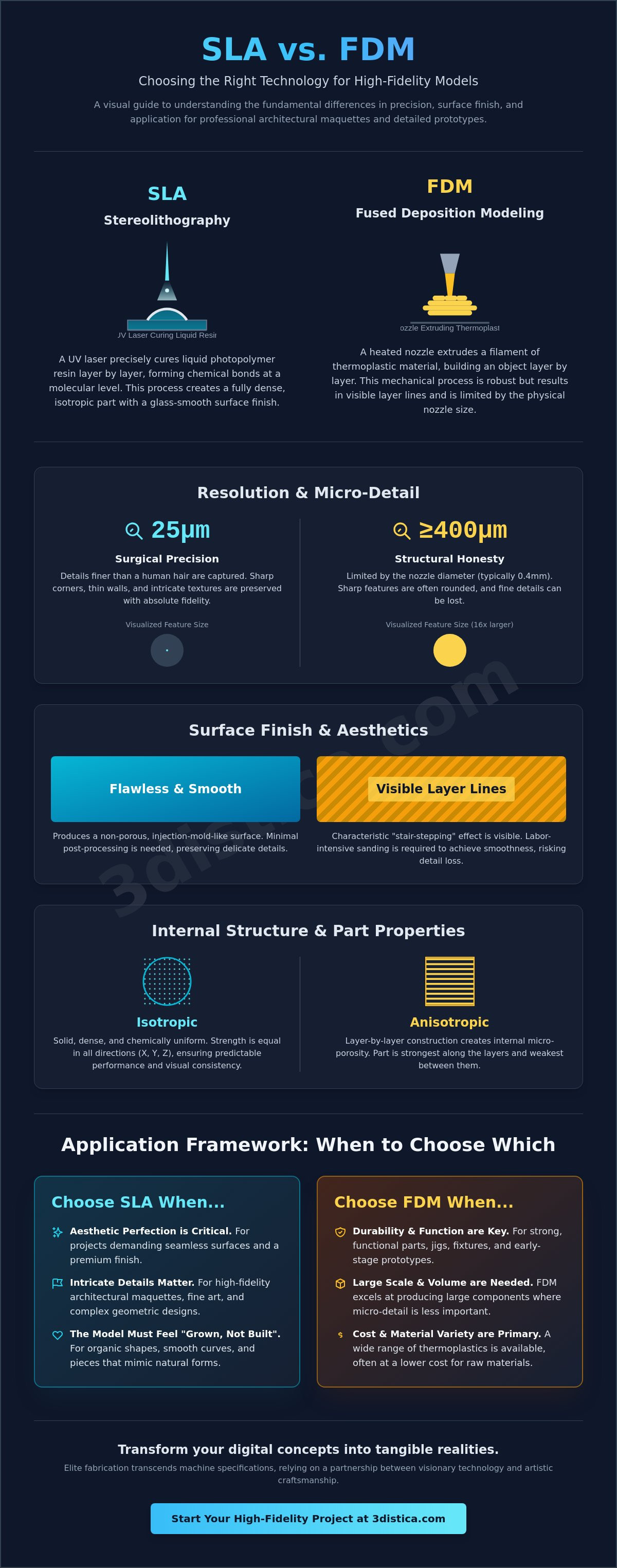
SLA operates through the graceful precision of a UV laser. By curing liquid resin into solid form, it creates chemical bonds at the molecular level, resulting in isotropic parts that possess equal strength in all directions. This process allows for a level of detail that traditional mechanical nozzles simply can't mirror. Because the laser's focal point is incredibly fine, SLA remains the gold standard for intricate geometries and organic textures. It's the preferred path when a project demands seamless surfaces that feel grown rather than built.
FDM relies on the rhythmic extrusion of melted thermoplastics. It builds volume through a series of discrete layers, a method that introduces the characteristic stair-stepping effect on shallow curves and spheres. While this technology excels in producing large-scale components and functional parts using industrial-grade materials, it faces physical limitations when tasked with micro-detail. There's a structural honesty to FDM; the visible layers tell a story of additive construction. It's a robust choice for projects where volume and material variety outweigh the need for microscopic surface perfection. Understanding these core mechanics is the first step in ensuring your fabrication partner delivers a result that honors the soul of your design.
Resolution is the threshold where a physical object begins to feel real. When comparing SLA vs FDM for detailed models, the difference in minimum feature size is profound. Industrial SLA systems often achieve a 25-micron capability, allowing for details thinner than a human hair to manifest in physical space. FDM printers are inherently limited by the physical diameter of their nozzles, which usually start at 0.4 mm. This mechanical constraint means FDM often rounds off sharp corners that SLA preserves with surgical precision.
The internal structure of these models also dictates their visual success. SLA produces isotropic parts; they're chemically uniform in every direction. This creates a solid, dense internal composition. FDM parts are anisotropic, meaning their strength and appearance depend on the orientation of the layers. This often results in micro-porosity. For high-fidelity work, these internal voids can cause subtle visual inconsistencies that distract from the overall aesthetic harmony.
The pursuit of perfection is most evident in architectural maquettes. These models require the sharp, clean edges of SLA to represent structural glass and fine masonry. FDM struggles with thin walls and sharp points, often leaving behind "blobs" or strings where the nozzle retracts. XY resolution is the precision of horizontal movement that dictates the sharpness of a model's footprint and its finest surface features. Without high XY resolution, the geometric soul of an architectural design is lost in translation.
Surface integrity directly influences the time spent in the artisan's workshop. SLA's smooth, non-porous surface significantly reduces the need for aggressive sanding, which can accidentally dull fine features. In contrast, filling FDM layer lines is a labor-intensive process that risks burying the very details you worked to create. This is particularly vital when considering advanced finishes like surface finishing and hydro-chroming. While FDM's porosity makes it difficult to achieve a true mirror finish without extensive sealing, SLA's density provides a perfect substrate for specialized paints and metallic coatings. The result is a model that doesn't just represent a space; it captures the environmental mood and spatial feeling of the original vision.
The perception of a physical asset is often shaped by how it withstands the passage of time. While early stereolithography was synonymous with fragility, the narrative surrounding "brittle resin" has been largely dismantled by the evolution of industrial-grade materials. Modern resins now offer a spectrum of properties that rival traditional plastics, ensuring that the choice between SLA vs FDM for detailed models isn't a sacrifice of strength for beauty. Instead, it's about matching the material's molecular personality to the project's ultimate environment. The decision often hinges on this delicate interplay between tactile weight and surface resilience.
Fused Deposition Modelling maintains a distinct advantage in functional testing scenarios where impact resistance is paramount. Thermoplastics like ABS or polycarbonate provide high heat deflection temperatures, making them ideal for components that must endure mechanical stress. However, for a high-fidelity architectural scale model, the priority often shifts from raw impact strength to dimensional stability and surface longevity. In the intense climate of the UAE, where ambient heat and UV exposure are constant variables, the chemical composition of your model determines whether it remains a masterpiece or becomes a relic.
Standard FDM materials like PLA offer ease of use but lack the sophisticated finish required for premium maquettes. Engineering resins used in industrial 3D printing bridge this gap by offering "Tough" and "Durable" variants that mimic the properties of ABS while retaining microscopic detail. When weighing SLA vs FDM for detailed models, these engineering-grade resins allow for a balance of beauty and resilience. They are specifically formulated for UV stability, a critical factor for models displayed in the sun-drenched environments of the GCC region. Selecting a resin with high-performance light-fastness ensures that your digital asset's physical twin doesn't yellow or degrade when exposed to natural light.
A model that feels substantial in the hand carries an unspoken promise of quality. There's a psychological weight to professionalism; clients often associate the mass of a physical representation with the prestige of the project itself. SLA prints, which are often solid or printed with thick internal walls, offer a dense, premium feel that FDM's honeycomb infill often lacks. While hollowing techniques can be used to manage material use in SLA, the result still feels more like a singular, cast object rather than a hollow shell. This tactile feedback is essential for custom awards and trophies where the physical presence must match the significance of the achievement. Choosing the right material isn't just a technical requirement; it's a way to reinforce the emotional impact of your design.
Selecting a fabrication process isn't a binary choice; it's an architectural strategy. When determining the path of SLA vs FDM for detailed models, the intended application serves as the ultimate compass. A model's purpose dictates whether the priority lies in the microscopic sharpness of a facade or the rugged durability of a functional component. By aligning the technical strengths of each method with the specific demands of your project, you ensure the final physical asset resonates with the same clarity as your digital vision.
The nuances of SLA vs FDM for detailed models become even more apparent when shifting from small-scale vinyl figures and collectibles to monumental installations. While one technology provides the delicate skin of a design, the other often provides the skeleton. This synergy is the hallmark of sophisticated fabrication, where the goal isn't just to print a part, but to craft a narrative-driven representation of space and form. Whether you're commissioning custom awards and trophies or complex industrial prototypes, the framework for selection remains rooted in the desired emotional and technical outcome.
Architectural scale models and maquettes demand a level of precision that evokes a sense of wonder. SLA is the undisputed choice for capturing the rhythmic textures of a building's facade, the delicate mullions of window frames, and the subtle contours of site topography. However, larger landscape elements and structural baseplates often benefit from FDM's ability to build volume efficiently. The scale of the model often dictates this split; a 1:50 interior study requires the surgical detail of resin, while a 1:500 masterplan might utilize FDM for its foundational elements. This hybrid approach ensures the model remains both detailed and structurally sound.
In the world of industrial design, prototypes must often bridge the gap between form and function. When testing the fit of custom RC parts or mechanical assemblies, FDM's dimensional accuracy and material variety offer the necessary structural honesty. However, when a "looks-like" prototype is required for a high-stakes presentation, the high-gloss finish and crisp edges of SLA are essential. The choice depends on whether the model needs to survive a stress test or win over a boardroom. For those seeking to elevate their project through expert guidance and precision manufacturing, you can explore our professional fabrication services to find the perfect fit for your vision.
Custom awards, trophies, and vinyl figures represent the pinnacle of surface-driven design. These items rely on SLA's non-porous substrate to facilitate advanced surface finishing and hydro-chroming. Without the initial smoothness of a resin print, achieving a mirror-like metallic finish or a perfectly saturated color gradient becomes nearly impossible. For large-scale installations, FDM provides the foundational strength required for monumental works, often serving as the internal core for fiberglass products or complex wall cladding. By understanding these application-specific frameworks, you can navigate the complexities of modern fabrication with ease and elegance.
Technical specifications tell only half the story. While the debate between SLA vs FDM for detailed models often centers on microns and material properties, the true distinction lies in the hands that guide the technology. High-end hardware is a silent partner. It requires a visionary artisan to breathe life into a digital asset, transforming it from a cold geometric file into a tangible piece of art. At 3DISTICA, we believe that the most successful models are born from a collaborative design process where technical mastery meets narrative-driven presentation.
The 3DISTICA philosophy is rooted in bridging the gap between an abstract digital concept and a physical reality that evokes wonder. This journey transcends the initial print. It involves a sophisticated understanding of how different elemental forces, like light and shadow, interact with a finished surface. Whether we are refining the delicate curves of vinyl figures and collectibles or establishing the structural core of monumental fiberglass products, our focus remains on the transformative power of the final object. We don't just deliver a product; we curate an experience that honors the essence of your project.
Every unique project deserves a bespoke fabrication journey. We meticulously curate every step, from the initial 3D scanning and reverse engineering phases to the final, polished installation. This end-to-end support ensures that the original design intent is never diluted by technical limitations. Our visionary artisan approach treats technical precision as a canvas for emotional resonance, ensuring that every micron serves the larger story of the space. By integrating traditional techniques with modern industrial 3D printing, we achieve a level of fidelity that mass-produced services cannot replicate.
Operating within the dynamic landscape of the UAE requires a partner who understands both the prestige of national projects and the environmental demands of the region. Quality control is our steady anchor, whether we are crafting intricate architectural scale models or expansive interior panels. We leverage a powerful synergy of technologies, combining the precision of SLA and FDM with CNC routing and laser cutting to build complex, multi-layered assets. This holistic methodology allows us to navigate the complexities of any fabrication challenge with calm confidence and artistic integrity.
The final aesthetic is often defined in the post-processing stage. From the technical rigor of CNC milling to the refined brilliance of hydro-chroming, our finishing techniques are treated as an art form in their own right. When you weigh the merits of SLA vs FDM for detailed models, remember that the machine provides the foundation, but the artisan provides the soul. We invite you to collaborate with 3DISTICA on your next high-detail project and discover how we can bring your most ambitious visions to life with elegance and precision.
The journey from a digital file to a physical masterpiece requires a deliberate choice between the surgical precision of resin and the structural integrity of thermoplastics. We've explored how the nuances of SLA vs FDM for detailed models define the emotional impact of architectural scale models and industrial prototypes. Mastery over these technologies ensures that fine geometric features survive the fabrication process, especially when shielded by materials suited for the UAE's unique environmental demands. Success isn't just about the hardware; it's about the technical strategy behind every layer.
True excellence resides in the artistry of high-fidelity surface finishing and hydro-chroming. From our base in Dubai, we provide meticulous end-to-end project management across the entire UAE, ensuring every detail reflects your original vision. This collaborative approach bridges the gap between technical methodology and artistic storytelling. We invite you to start your bespoke fabrication journey with 3DISTICA today. Let's transform your abstract ideas into physical assets that command attention and inspire wonder in every viewer.
SLA is the definitive choice for capturing very small text or microscopic branding on a model. Its UV laser can draw features as fine as 25 microns, whereas FDM is physically restricted by the nozzle's aperture. This precision ensures that legibility remains crisp even at miniature scales, preventing the characters from bleeding together during the fabrication process.
While FDM prints can be refined through meticulous sanding and specialized fillers, they rarely reach the inherent smoothness of SLA. The "stair-step" effect is a mechanical byproduct of the extrusion process. Attempting to match SLA's finish on an FDM part often requires labor-intensive post-processing that might accidentally dull the model's sharpest geometric details.
FDM is generally more cost-effective for the structural volume of large-scale detailed models. Because thermoplastic filaments are less expensive than high-performance resins, we often use FDM for the foundational mass. We then reserve SLA for the high-fidelity surface elements where the cost-to-detail ratio is most favorable for the final aesthetic representation.
Industrial SLA resins hold up exceptionally well in the UAE climate when treated with professional UV-resistant coatings. These specialized finishes protect the polymer chains from degradation caused by intense light. Our fabrication process includes selecting resins with high heat deflection temperatures to ensure your models remain dimensionally stable in the region's unique environmental conditions.
Typical lead times for high-detail models depend heavily on the required surface finish rather than just the machine time. FDM is often faster for building large volumes, but SLA requires additional phases for chemical washing and UV curing. A bespoke project usually follows a curated timeline that accounts for these technical refinements to ensure absolute precision.
SLA isn't just for aesthetics; modern engineering resins allow for functional mechanical parts with high impact resistance. While FDM remains a staple for rugged industrial prototypes, SLA's isotropic internal structure provides uniform strength. This makes it an excellent choice for complex assemblies where dimensional accuracy and functional performance must coexist perfectly.
The choice between SLA vs FDM for detailed models significantly impacts the final painting results. SLA's non-porous surface is an ideal substrate for sophisticated finishes like hydro-chroming or high-gloss automotive paints. FDM requires extensive priming to seal its porous layers, as any remaining texture will be magnified once a reflective or metallic coating is applied.
Combining both technologies in a single architectural model is often the most sophisticated approach to fabrication. We frequently use FDM to create the robust structural base and internal framework, while utilizing SLA for the intricate facade textures and window mullions. This hybrid strategy leverages the unique strengths of both mediums to deliver a physical representation that is both monumental and meticulously detailed.
