%25201-1.webp)
A prototype that fails to capture the soul of your design isn't just a technical error; it's a silent erosion of your architectural narrative. While the UAE advances toward its ambitious goal of 3D printing 25% of buildings by 2030, the journey from a digital vision to a physical masterpiece remains fraught with technical risks. We understand the frustration of seeing a visionary CAD file translate into a non-viable model or watching a bespoke material fail to withstand the regional climate. These setbacks often stem from common mistakes to avoid in rapid prototyping that can drain budgets and dilute the essence of your most ambitious work.
You can master this delicate transition. By refining your approach to high-end fabrication, you'll ensure that every nuance of your unbuilt environment is preserved with aesthetic precision. This guide explores the critical pitfalls in the prototyping process and provides a streamlined path toward creating flawless physical representations that bridge the gap between abstract ideas and tangible reality. We'll examine how to align your projects with the technical rigor required for sophisticated installations in today's rapidly evolving industrial ecosystem.
• Define the strategic narrative of your project before fabrication to ensure every physical iteration adds value rather than expense.
• Navigate the technical complexities of the UAE climate by selecting bespoke materials that preserve structural integrity under local thermal demands.
• Identify common mistakes to avoid in rapid prototyping by fostering a deep collaboration between digital vision and physical craftsmanship.
• Master the transition from maquette to monumental scale by understanding how light and surface finishing influence the atmosphere of your unbuilt environment.
• Learn how to select a visionary fabrication partner who balances industrial technology with the artistic soul of your architectural design.
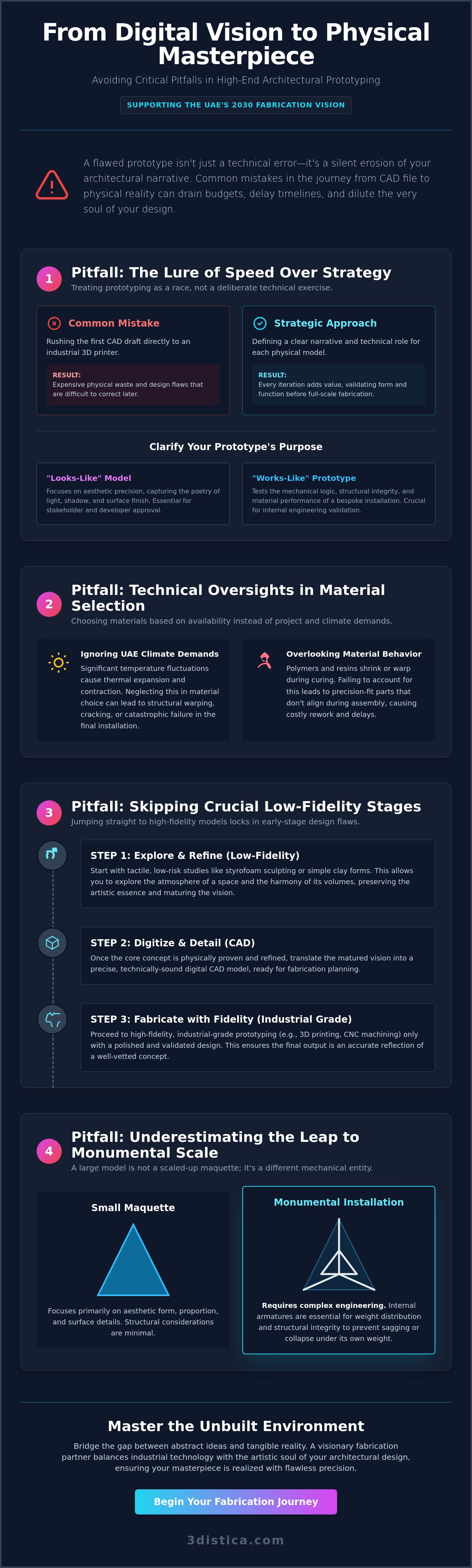
Speed is a seductive metric in the world of high-end fabrication. It promises progress, yet velocity without a clear destination often results in nothing more than expensive physical waste. In the pursuit of a breathtaking architectural vision, the most frequent mistakes to avoid in rapid prototyping occur when the process is treated as a race rather than a deliberate technical exercise. A prototype shouldn't be a guess; it's a calculated step toward a final, immersive reality. Without a strategy, you're simply generating clutter that fails to capture the soul of your design.
Every physical mockup must have a defined narrative role before you select a specific technology. Understanding the distinction between a "looks-like" model and a "works-like" prototype is essential for project clarity. A "looks-like" model focuses on aesthetic precision, capturing the poetry of light and shadow on a surface. Conversely, a "works-like" prototype tests the mechanical logic of a bespoke installation. Rapid prototyping offers a vast array of techniques, and selecting the wrong one can obscure the very nuances you're trying to refine. For monumental UAE installations, establishing a clear technical roadmap ensures that your physical iterations align with the final material requirements and environmental demands.
Precision begins with a question: what must this model prove? You must decide if the iteration is for structural validation or aesthetic approval, as these goals require different fabrication paths. The prototype serves as a physical bridge, translating digital intent into a tangible proof of concept that validates both form and function before full-scale fabrication begins. Matching the fidelity level to your specific audience is equally vital. An internal engineering team might only need a raw, functional print, while a developer requires a sophisticated maquette that evokes a sense of wonder and possibility.
Rushing to an industrial 3D printer with your first CAD draft is a common mistake that overlooks the value of the iterative journey. High-end fabrication thrives on refinement, and jumping straight to high-fidelity models often locks you into design flaws that are expensive to correct later. There's immense value in starting with low-fidelity studies using styrofoam sculpting or simple clay forms. These tactile exercises allow you to explore the atmosphere of a space and the harmony of its volumes with minimal risk. By embracing these early, humble iterations, you preserve the artistic essence of the project, ensuring that the final industrial-grade prototype is a polished reflection of a matured vision.
High-end fabrication requires a deep alignment between the medium and the message. One of the most critical mistakes to avoid in rapid prototyping is selecting materials based on immediate availability rather than the rigorous demands of the final installation. In the UAE, where ambient temperatures can fluctuate significantly, ignoring thermal expansion can lead to catastrophic failure. High-end projects demand a sophisticated understanding of how polymers and resins behave under stress. Studying rapid prototyping methods and best practices reveals that material science is just as vital as digital design. If you don't account for material shrinkage during the curing process, your precision-fit parts won't align when they reach the assembly stage.
Monumental sculptures aren't just large versions of small models; they are entirely different mechanical entities. Weight distribution and support requirements are often underestimated when a project moves from a digital screen to a physical environment. Failing to incorporate internal armatures for large-scale architectural models can cause a structure to sag or collapse under its own weight. This is where the artistry of a visionary fabrication partner becomes indispensable, bridging the gap between a fragile concept and a resilient, tangible reality.
Choosing the right technology involves balancing detail with durability. Industrial 3D printing is unmatched for capturing intricate architectural narratives, yet it can be cost-prohibitive for massive volumes. For monumental scale, fiberglass products offer superior strength-to-weight ratios and longevity in high-temperature climates. A hybrid approach often yields the best results. You might use CNC routing for the primary form and 3D printing for the high-precision details, followed by meticulous manual surface finishing to ensure a seamless, photorealistic atmosphere.
A common error is scaling a digital file without adjusting the wall thickness for physical reality. Digital models don't have weight, but a six-meter fiberglass installation certainly does. You must ensure that the prototype can withstand not only its own weight but also the logistics of transport and assembly. This requires a technical roadmap that includes structural validation. Incorporating hidden reinforcement and planning for modular assembly points allows your vision to transition from the studio to the site without losing its aesthetic precision or structural integrity.
The digital environment is a place of infinite possibility. It's also a place without gravity, friction, or material resistance. One of the most pervasive mistakes to avoid in rapid prototyping is the habit of "throwing the file over the wall" to a fabrication team without prior consultation. This siloed approach creates a disconnect between the visionary architect and the technical artisan. Digital sculpting is a powerful tool, but it requires a deep understanding of physical craftsmanship to be effective. If your CAD model doesn't respect the limitations of the medium, the final result will inevitably lose the nuance that made the concept so compelling.
True innovation happens at the intersection of technology and art. Involving a fabrication artisan during the early CAD modeling stage transforms the process from a simple transaction into a collaborative journey. This is particularly vital in projects involving classic car parts restoration or heritage sites where 3D scanning and reverse engineering bridge the gap between old-world textures and new-world precision. When examining common pitfalls in rapid prototyping, experts emphasize that a lack of technical foresight often leads to models that are visually stunning but physically unbuildable. Avoiding these silos ensures the technical preservation of the design's soul throughout the entire fabrication cycle.
A successful project relies on a seamless transition from the screen to the studio. Collaborative technical reviews serve as the bridge where vision meets reality. These sessions allow the team to identify "unbuildable" digital geometries and solve them through reverse engineering before a single drop of resin is cured. By maintaining end-to-end project management, you ensure that the technical precision of the final piece matches the aesthetic precision of your original intent. It's about creating a dialogue where the technician understands the architect's heart, ensuring every curve and shadow is intentional.
Don't assume a 3D file is a complete set of instructions. It's a common oversight to provide a file without specifying surface tolerances, assembly points, or desired finishes like hydro chroming. Your documentation should communicate the "soul" of the project, not just its dimensions. Clearly defining how light should interact with a surface or how a wall cladding panel should feel to the touch ensures the technical team can execute your vision with absolute fidelity. Precision is found in the details that a CAD file alone cannot convey; it requires a documented narrative of craftsmanship.
A prototype is a physical narrative. It's the first time your unbuilt environment breathes in the real world. One of the most subtle mistakes to avoid in rapid prototyping is mistaking a miniature maquette’s success for full-scale viability. While a small-scale model can evoke a sense of charm, it often hides the complexities that emerge when a design is realized at its intended size. When you scale a project, the relationship between light, shadow, and texture changes completely. A design that feels balanced on a desk can feel overwhelming or hollow when it occupies a room.
Aesthetic precision is the language of high-stakes developer approvals. Overlooking the impact of ambient light on unpainted prototype surfaces is a common oversight that can derail a presentation. Raw 3D printed resins or CNC-machined foams often swallow light in ways that obscure your architectural narrative. Without the correct surface treatment, the soul of the project remains trapped behind a matte, industrial gray. Treating surface finishing as an afterthought is a technical betrayal of the design, as it's the finish that ultimately communicates the atmosphere and prestige of the final installation.
The finish of a prototype is not merely decorative; it's a vital storytelling tool. We believe that the "feel" of a material is as important as its dimensions. Through techniques like hydro chroming and the application of bespoke textures, a simple physical mockup is transformed into a photorealistic artifact. These finishes allow you to test how light interacts with your unbuilt environments, revealing the poetry of reflections that a digital render can only suggest. When a developer can see the play of light on a perfectly finished surface, the vision becomes an undeniable reality. To achieve this level of immersion, explore our bespoke surface finishing services for your next project.
Professional scale models must avoid the "toy-like" appearance that plagues lower-end fabrication. This requires a delicate balance between photorealistic detail and abstract architectural forms. Using CNC routing for complex interior wall cladding prototypes allows for a level of precision that maintains the dignity of the design at any scale. It's about capturing the essence of the space without cluttering the viewer's eye with unnecessary noise. By focusing on the nuance of scale, you ensure that your prototype serves as a sophisticated guide for the final monumental installation, rather than a mere miniature replica.
The UAE is currently witnessing a profound industrial transformation. With the additive manufacturing market forecasted to reach USD 0.6 billion by 2031, the region's commitment to advanced fabrication is undeniable. Yet, in this surge of technological growth, the human element of craftsmanship remains the most vital component. Navigating the common mistakes to avoid in rapid prototyping requires more than just access to a machine; it requires a partner who sees the cinematic potential in every architectural curve. You aren't just looking for a vendor to print a file. You're seeking a visionary artisan who can bridge the gap between an abstract digital scan and a monumental physical installation.
At 3DISTICA, we treat every project as a bespoke narrative of light and space. Our approach leverages industrial 3D printing and precision CNC routing to ensure that the final result isn't just a model, but a flawless asset that preserves your brand's artistic integrity. We understand that the soul of a project is found in its nuances. By integrating 3D scanning and reverse engineering with traditional finishing techniques, we allow architects and developers to explore unbuilt environments with total confidence. This synergy of technology and art ensures that the transition from prototype to large-scale installation is both steady and breathtaking.
Selecting the right studio is a strategic decision that defines the quality of your final asset. A high-end creative partner must demonstrate an ability to handle complex, multi-material projects that involve everything from fiberglass products to intricate architectural maquettes. In-house technical expertise is non-negotiable, as it allows for the seamless integration of design and fabrication. You don't need a mass-production vendor; you need a collaborative guide who understands the poetry of light and shadow. Look for a team that prioritizes the transformative power of atmosphere over mere dimensions, ensuring your project speaks the language of prestige.
Achieving aesthetic precision requires a curated, three-step journey. The process begins with a technical consultation to align your creative vision with the vast material possibilities available in modern fabrication. We then move into iterative prototyping, where we refine geometry and scale to ensure the physical form honors the digital intent. The final stage involves advanced finishing, such as hydro chroming or bespoke texturing, to achieve the desired atmospheric impact. This logical flow from the conceptual "why" to the technical "how" results in a prototype that is a true work of art. We invite you to invite collaboration on your next visionary project with 3DISTICA and experience the difference of meticulous craftsmanship.
Mastering the unbuilt requires a deliberate harmony between technical rigor and artistic vision. We've explored how a strategic approach to material selection and surface finishing transforms a simple mockup into a sophisticated narrative tool. By identifying the critical mistakes to avoid in rapid prototyping, you protect the integrity of your design and ensure a seamless transition from a digital draft to a monumental installation. Precision isn't just about dimensions; it's about capturing the atmosphere and soul of a space through meticulous craftsmanship.
3DISTICA acts as a visionary partner for those who demand aesthetic precision in every iteration. Our advanced UAE-based studio provides end-to-end support, moving fluidly from 3D scanning and reverse engineering to the final, photorealistic finish of a bespoke asset. We understand that your projects are more than just files. They are future landmarks that deserve to be realized with absolute fidelity. Begin your journey from concept to tangible reality with 3DISTICA. Your most ambitious visions are ready to take their place in the physical world.
The most expensive error is initiating fabrication without a defined narrative role or strategic goal, which is among the primary mistakes to avoid in rapid prototyping. This lack of direction leads to physical waste and costly iterations that fail to validate the design. By treating the process as a technical exercise rather than a race, you avoid the drain on resources that occurs when a prototype fails to capture the project's soul.
Industrial 3D printing is highly effective for large-scale architectural models, particularly when capturing the intricate details of unbuilt environments. While standard resins are ideal for precision, monumental projects often benefit from a hybrid approach using CNC routing for primary volumes. This ensures structural integrity while maintaining the aesthetic precision required for high-stakes developer presentations in the region.
Your choice depends on the balance between intricate detail and long-term structural durability. Industrial 3D printing excels at capturing complex architectural narratives and fine textures. Fiberglass products, however, offer superior strength-to-weight ratios for monumental scales. For many bespoke assets, we combine both technologies to achieve a photorealistic finish that withstands environmental stress without compromising on detail.
Surface finishing is the vital bridge that allows a prototype to communicate the intended atmosphere and light interaction of a space. Raw materials often swallow light, obscuring the design's nuance. Through techniques like hydro chroming or custom texturing, a model becomes a photorealistic artifact. This level of finish is essential for securing stakeholder approval and visualizing the poetry of the final installation.
The UAE's high-temperature environment requires materials with specific thermal stability to prevent warping or structural failure. Selecting polymers based on their heat deflection temperature is one of the key mistakes to avoid in rapid prototyping when working in the region. We prioritize bespoke resins and fiberglass composites that maintain their aesthetic precision even when exposed to fluctuating regional temperatures during display.
A maquette serves as an artistic representation of form and atmosphere, while a functional prototype validates mechanical logic and structural performance. Maquettes are essential for storytelling and capturing the essence of an unbuilt space. Functional prototypes focus on technical rigor, testing how components fit or move. Understanding this distinction ensures you select the right fabrication path for your project's specific stage.
Timelines vary based on the project's complexity and the required level of surface finishing. A simple architectural study might be realized in a matter of days; however, a monumental, multi-material sculpture can take several weeks of meticulous craftsmanship. We focus on a steady, curated rhythm that prioritizes technical preservation over rushed results, ensuring every asset arrives with the intended cinematic impact.
3D scanning is indispensable when your project requires the technical preservation of existing forms, such as in classic car parts restoration or heritage site integration. It allows us to bridge the gap between physical reality and digital precision through reverse engineering. This process is one of the most effective ways to ensure new bespoke elements fit perfectly within an established architectural or mechanical context.
