A physical prototype is not merely a preliminary draft; it's a high-fidelity insurance policy for your most ambitious industrial visions. You likely face intense scrutiny when allocating budget to non-final assets, especially as the "Make it in the Emirates 2026" initiative heightens the pressure to deliver flawless local manufacturing. It's a common tension. You want to innovate, yet the shadow of late-stage design failure often looms over the boardroom. Mastering how prototyping reduces manufacturing risk is the essential bridge between an abstract concept and a tangible, market-ready reality.
We'll show you how to transform rapid prototyping from a perceived expense into a high-value strategic asset that secures immediate stakeholder buy-in. This guide provides a structured framework for ROI and distinguishes the specific advantages of methods like industrial 3D printing and high-precision CNC routing. You'll gain the clarity needed to approve advanced fabrication budgets with total confidence. Discover how to navigate the complexities of modern production with the quiet authority of a visionary artisan.
• Understand why high-fidelity maquettes are the essential bridge between abstract digital designs and the tangible realities of large-scale production.
• Master a structured ROI framework that demonstrates how prototyping reduces manufacturing risk by eliminating ambiguity before full-scale fabrication begins.
• Identify the ideal fabrication method—from CNC-routed styrofoam to industrial 3D printing—tailored specifically to your project’s scale and environmental mood.
• Learn to align technical precision with a compelling narrative to secure immediate stakeholder approval for advanced fabrication budgets.
• Discover how the psychological power of a physical unveiling moment creates a decisive competitive edge during high-stakes UAE project bids.
Digital perfection is a seductive illusion. In the UAE, where industrial components and architectural landmarks must meet rigorous standards of excellence, the leap from a pixelated render to a physical object is the most precarious stage of any project. This is where the visionary artisan intervenes. Rapid prototyping serves as the essential bridge, translating abstract data into a form that can be touched, tested, and critiqued. Understanding how prototyping reduces manufacturing risk is no longer a luxury; it's a strategic necessity for leaders navigating the high-stakes environment of the Emirates' industrial sector. A physical model acts as a safeguard, preventing the dilution of creative intent as it moves through the hands of multi-disciplinary teams.
Screen-based renders, while beautiful, often mask the subtle nuances of spatial interaction. They lack the weight of reality. By utilizing rapid prototyping techniques, we manifest the essence of a design in the physical world. This reveals ergonomic misalignments or structural tensions that remain invisible in even the most advanced CAD environments. It's about technology serving artistic intent. When you hold an industrial 3D-printed component or walk around a large-scale maquette, you experience the spatial feeling that a monitor simply cannot convey. This physical dialogue ensures that every curve and joint serves the final narrative of the piece.
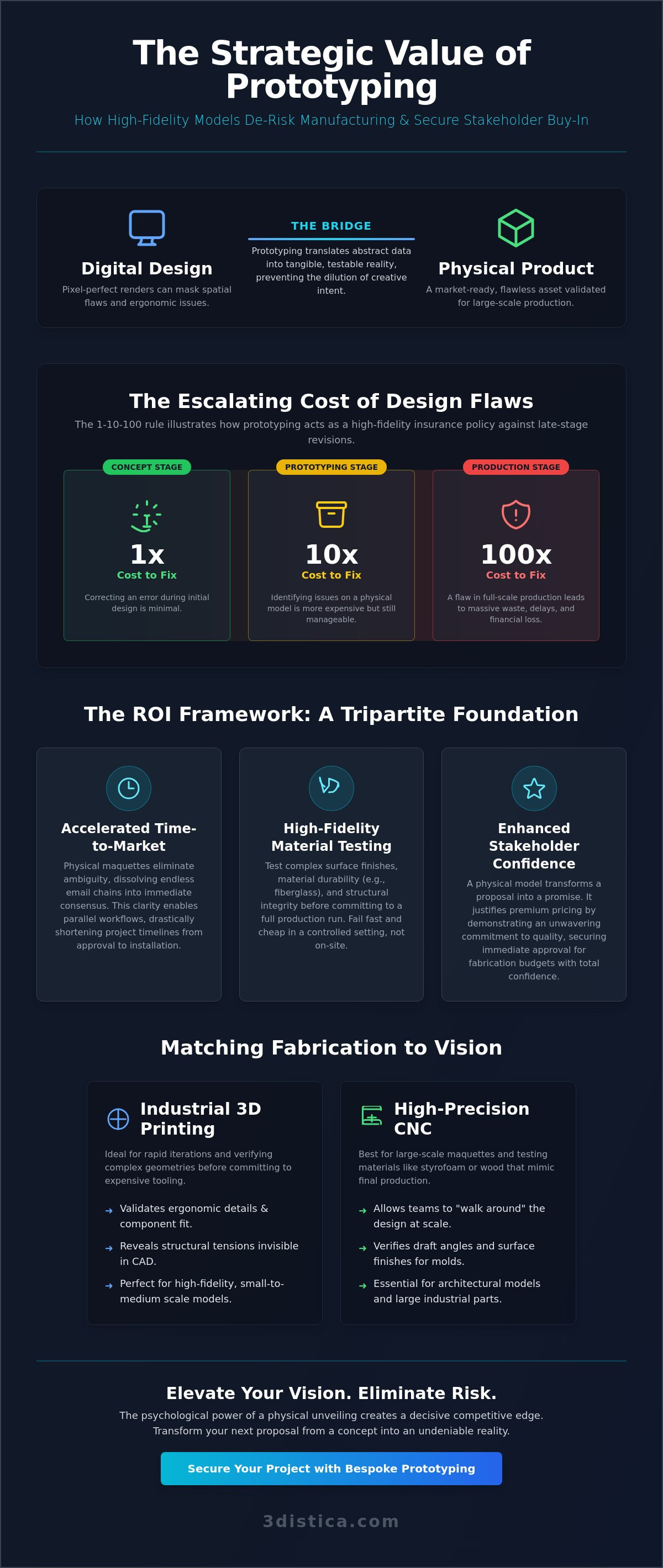
The "right first time" mantra is a dangerous myth in large-scale production. It ignores the compounding nature of error. Industry veterans often cite the 1-10-100 rule: a design flaw that costs 1 د.إ to fix at the conceptual stage will cost 10 د.إ during prototyping and 100 د.إ once it reaches the factory floor. Consider the potential disaster of a flawed fiberglass mold for a series of bespoke interior panels. Without a physical prototype to verify the draft angles and surface finish, an entire production run could be rendered useless, leading to massive waste and project delays. A prototype is a fraction of the cost of a correction. It acts as a high-fidelity insurance policy, securing the project's timeline and budget against the volatility of late-stage revisions. This is fundamentally how prototyping reduces manufacturing risk in a market that demands both speed and absolute precision.
Return on investment in bespoke fabrication is often misunderstood as a simple subtraction of expenses. It is actually a tripartite foundation consisting of Time, Materiality, and Stakeholder Confidence. By investing in a physical model, you aren't just buying an object; you're buying the certainty required to move forward. This approach allows teams to fail fast and cheap in a controlled studio setting rather than during a high-stakes installation in Downtown Dubai. High-fidelity models justify premium project pricing by demonstrating a commitment to quality that a screen-based presentation cannot match. It transforms a proposal into a promise.
The UAE’s fast-paced project cycles don't allow for hesitation. Industrial 3D printing accelerates the approval cycle by removing the ambiguity inherent in digital renders. When stakeholders can touch a physical maquette, the endless back-and-forth of emails dissolves into immediate consensus. This clarity enables parallel workflows. While the final fabrication of large-scale fiberglass products is underway, logistics and assembly teams can use the prototype to plan installation sequences without waiting for the finished asset. Speed becomes a function of clarity, not just machine output.
High-fidelity material testing is where technical precision meets industrial pragmatism. This is exactly how prototyping reduces manufacturing risk by allowing you to test complex surface finishes like hydro chroming or the durability of fiberglass substrates before committing to a full production run. We often employ 3D scanning and reverse engineering to ensure that new components fit perfectly within existing spaces, preventing monumental errors in public art or architectural cladding. If you're looking to secure your next project with this level of detail, exploring bespoke fabrication solutions can provide the technical edge your vision deserves. It's about ensuring that the final outcome is as flawless as the initial concept.
Testing textures and finishes on a small scale to avoid costly rework on large-scale wall cladding or interior panels.
Identifying weak points in complex geometries that CAD might overlook.
Gauging the psychological response to a physical object before the final unveiling.
Every dirham spent on a prototype is a safeguard against the exponentially higher costs of late-stage failure. It's a strategic move that aligns technical requirements with the overarching narrative of the project. By removing the guesswork, you create an atmosphere of exclusivity and trust with your partners.
Selecting the right fabrication medium is a strategic decision that dictates the fidelity of your final vision. While digital sculpting provides the blueprint, the transition to physical form requires a nuanced understanding of material behavior and scale. Industrial leaders must choose between additive and subtractive methods based on the specific demands of the project. This choice is fundamentally how prototyping reduces manufacturing risk; by matching the technology to the requirement, you eliminate the variables that lead to structural or aesthetic failure. Whether you are developing intricate architectural maquettes or massive environmental installations, the method of creation defines the limits of what is possible.
Precision is the heartbeat of the maquette. When creating intricate architectural scale models, the slight variance of a human hand can lead to catastrophic misalignments in the final assembly. Industrial 3D printing offers a level of repeatability and geometric complexity that manual mockups simply cannot achieve. It removes the potential for human error in the translation of CAD data. Industrial 3D printing is a catalyst for creative freedom. It allows designers to experiment with organic shapes and internal lattices that were previously impossible to fabricate, ensuring that the physical essence of the design remains uncompromised by the limitations of traditional tools.
Volume requires a different technical approach. When your project demands large-format architectural elements or wall cladding, CNC routing becomes the preferred methodology. This subtractive process is ideal for sculpting large blocks of styrofoam or wood to create the master patterns for fiberglass products. It allows you to test the scale and spatial feeling of a piece within the actual environment before committing to permanent materials. The transition from a CNC-milled prototype to a final fiberglass product is a journey of refinement. Through casting and mold making, we can iterate on the design, testing the durability and surface tension of the substrate. This iterative cycle is a core component of how prototyping reduces manufacturing risk on a monumental scale.
Best for high-detail vinyl figures, custom RC parts, and complex trophies.
Ideal for large-scale styrofoam sculpting and architectural panels.
The application of hydro chroming or bespoke textures to gauge the emotional impact of the final finish.
Every fabrication path offers a unique narrative. By contrasting these technologies, you ensure that the chosen method aligns with both the technical requirements and the artistic integrity of the work. This curated approach to fabrication transforms a technical necessity into a high-end creative partnership.
Securing a budget for non-final assets requires more than technical justification. It requires a narrative that aligns with the project's soul. In the UAE's competitive landscape, where projects are often monumental in both scale and ambition, a physical model is the most persuasive evidence of feasibility. By integrating 3D scanning data into your presentation, you can demonstrate exactly how a new installation will harmonize with existing structures. This empirical proof is fundamentally how prototyping reduces manufacturing risk; it replaces boardroom speculation with a tangible, undeniable reality. Selecting the right fidelity level is crucial. A rough styrofoam sculpt might suffice for internal spatial checks, but a high-fidelity, hydro-chromed model is what secures early-stage funding from discerning investors.
To convince a board, you must translate artistic value into the language of efficiency. Define clear KPIs that reflect the prototype's impact on the project lifecycle. We recommend tracking the reduction in rework hours, measuring how many design iterations were resolved at the maquette stage rather than during final fabrication. Stakeholder approval velocity is another critical metric. Compare the time taken to reach a consensus using a physical model versus a traditional digital slide deck. When you link prototype success to the final installation’s structural integrity, the investment becomes a logical necessity rather than a discretionary expense.
Budget scrutiny often centers on the perceived cost of "temporary" assets. Counter this by framing the prototype as technical insurance. While stakeholders may argue that high-resolution renders are sufficient, they overlook the tactile culture of the UAE market. In sectors like luxury real estate or bespoke industrial design, the ability to touch and feel a scale model is what closes the gap between interest and investment. High-quality prototypes also possess significant longevity. They often serve as centerpiece marketing assets long after the design phase concludes, providing value that far outlasts the initial fabrication period. If you are ready to elevate your project's presentation, consult with our fabrication specialists to create a model that speaks with quiet authority.
Every visionary project begins with a moment of trust. By constructing a business case rooted in data and emotional resonance, you provide stakeholders with the confidence to move from abstract concepts to physical landmarks. The prototype isn't just a tool for design; it's a catalyst for project momentum.
A high-fidelity physical model is often the silent closer in a competitive bid. In the UAE's landscape of monumental ambition, where visionary projects are the norm, standing out requires more than a digital walkthrough. It requires presence. When you present a meticulously crafted maquette, you aren't just showing a design; you're demonstrating a profound commitment to the client's vision. This tangible evidence is how prototyping reduces manufacturing risk by proving that your technical methodology is as robust as your creative intent. It transforms a proposal from a possibility into an inevitability.
The unveiling moment in a boardroom carries immense psychological weight. There's a specific "wow factor" when a stakeholder first encounters an industrial 3D-printed maquette or a finished fiberglass sample. Physical touch builds an immediate sense of trust and perceived value that is uniquely powerful in the GCC market. It bridges the gap between abstract expectation and physical reality. By providing a prototype, you signal a higher level of investment in the project's success. It shows you've already solved the complex spatial and structural challenges that others are still debating in their renders.
We act as the visionary artisan who bridges the gap between technology and art. Our process is a curated journey, moving from the precision of digital sculpting to the grandeur of monumental installation. We focus on storytelling through technical precision; every curve of a custom award or every texture on a wall cladding panel must resonate with the project's essence. We offer end-to-end support, providing the technical expertise needed to navigate the complexities of modern fabrication with ease. We invite you to collaborate with 3DISTICA to translate your most ambitious concepts into high-fidelity assets that command attention.
The journey from a digital sculpture to a physical landmark is one of constant refinement. By understanding how prototyping reduces manufacturing risk, you secure a strategic advantage that elevates your brand's prestige. Craftsmanship is the future of industrial excellence. Let your next project be defined by the quiet authority of a physical masterpiece that leaves no room for doubt.
The transition from a digital sketch to a physical landmark is a journey defined by the elimination of uncertainty. Precision is the final word. By embracing a structured ROI framework and selecting the right fabrication technologies, you transform a perceived expense into a strategic safeguard. You've seen how prototyping reduces manufacturing risk by validating material choices and securing stakeholder consensus early in the project lifecycle. This is more than a technical requirement; it's an act of craftsmanship that elevates your brand’s prestige in a competitive market.
As the UAE continues to lead the region in advanced manufacturing through the "Make it in the Emirates" initiative, your choice of partner becomes your greatest asset. 3DISTICA stands as the premier 3D design and fabrication studio in the Emirates, specializing in large-scale fiberglass and industrial 3D printing. We provide end-to-end project support, ensuring your narrative remains intact from the first render to the final installation. Begin your fabrication journey with a bespoke consultation at 3DISTICA. Your most ambitious visions deserve the clarity and confidence that only a physical masterpiece can provide.
Physical prototyping provides a tactile dialogue that a digital render cannot replicate. While a 3D render offers visual beauty, it lacks the weight and spatial presence required to test ergonomics or structural fit. A physical maquette reveals how light interacts with surfaces in a real environment, ensuring the final installation captures the intended emotional impact and spatial feeling you've envisioned.
Prototyping typically accelerates the overall timeline by reducing the need for late-stage revisions. While the fabrication of a model might take several days, it eliminates weeks of back-and-forth communication later in the process. Industrial 3D printing in the UAE is designed for rapid deployment, allowing visionary teams to move from digital sculpture to physical form with minimal delay.
Perfecting the design at the prototyping stage is exactly how prototyping reduces manufacturing risk for fiberglass products. By creating a precise CNC-milled master pattern, you ensure the final mold is flawless. This prevents the significant costs associated with wasting expensive resins and glass fibers on a production run that doesn't meet the project's technical or artistic standards.
Aerospace, automotive restoration, and architectural sectors in the UAE are the primary beneficiaries of high-fidelity prototyping. These industries require extreme precision, whether they're restoring classic car parts or creating complex maquettes for new landmarks. Custom awards and high-end advertising solutions also utilize these technologies to ensure their bespoke creations meet the region's demand for prestige and absolute perfection.
3D scanning is a powerful tool for proving technical feasibility, though it's not a strict requirement for every business case. It's particularly valuable when a project must integrate perfectly with an existing environment or a vintage vehicle. By providing precise data on current dimensions, 3D scanning demonstrates a meticulous approach to fitment, which builds immense stakeholder confidence during the approval process.
The choice between CNC milling and industrial 3D printing depends on the balance between scale and intricacy. CNC routing is the superior choice for large-format elements, such as styrofoam blocks for environmental sculptures. Conversely, 3D printing excels at capturing the delicate details of architectural models or vinyl figures. Choosing the correct method is a fundamental step in how prototyping reduces manufacturing risk for your specific project.
A high-fidelity prototype can occasionally serve as a final piece if the material and surface finishing meet the required durability standards. For instance, a 3D-printed trophy or a hydro-chromed collectible is often indistinguishable from a production unit. However, most prototypes are intended as sacrificial masters for casting or structural verification, designed to refine the vision before the final monumental installation.
Styrofoam sculpting via CNC routing is the most cost-effective method for realizing large-scale sculptures and architectural forms. This process allows for rapid material removal, creating a lightweight yet accurate representation of the final volume. Once the styrofoam core is verified, it can be coated or used as a pattern for more permanent fiberglass products, ensuring the artistic integrity remains intact at a manageable investment level.
