What if the machine sitting on your desk is the very thing limiting your creative horizon? While the allure of immediate, desktop-based production is strong, the choice between in-house 3d printing vs service bureau often defines the boundary between a rough prototype and a masterpiece. Many designers believe that owning the hardware guarantees a seamless workflow, yet they often find themselves battling unpredictable maintenance and the limitations of entry-level resins. True innovation requires more than just a printer; it demands a synergy of technical precision and artistic vision.
You deserve a process that honors the soul of your design without the burden of mechanical troubleshooting. This guide explores how to navigate the shift from internal iteration to professional-grade fabrication, ensuring your physical assets reflect the high-fidelity essence of your original concept. We'll examine how to leverage industrial materials like fiberglass and advanced resins to achieve a level of detail that standard desktop machines simply can't touch. By the end, you'll have a clear roadmap for balancing internal agility with the sophisticated capabilities of a dedicated fabrication partner.
• Understand the strategic distinction in in-house 3d printing vs service bureau models, where internal tools facilitate rapid iteration while bureaus provide industrial-grade fidelity.
• Identify the "Iceberg Effect" of hardware ownership, accounting for the hidden costs of specialized resins, maintenance, and operator training that extend far beyond the initial purchase price.
• Discover how to transcend build-volume limitations by accessing large-format printing and specialized materials like fiberglass for architectural models and event structures.
• Apply a decision framework based on project complexity and volume to determine when a simple prototype suffices and when a final masterpiece requires professional fabrication.
• Learn how bespoke fabrication transforms abstract digital concepts into tangible realities through end-to-end support, from digital sculpting to meticulous surface finishing.
The UAE’s architectural and creative landscape is undergoing a profound transformation. We are moving away from mass-produced placeholders toward high-fidelity, bespoke assets that tell a specific story. This shift has forced a reevaluation of how we bring digital concepts into the physical world. The tension between in-house 3d printing vs service bureau is no longer just about hardware ownership; it's about the intended soul of the final object. While one offers the speed of a localized sketch, the other provides the gravity of a finished work of art. In a region where excellence is the baseline, the quality of your physical representation can be the deciding factor in a project's success.
Choosing your path is rarely a binary decision. Many successful studios adopt a hybrid model, using internal machines for the messy, iterative phase of design and partnering with specialists for high-stakes production. Understanding the distinct roles each plays is essential for maintaining both creative momentum and professional standards. It's about knowing when to sketch and when to sculpt.
Desktop machines are the sketchbooks of the modern era. They allow designers to fail fast and iterate often. When you need to verify a specific "form-and-fit" or validate a basic concept, having a printer at your elbow is invaluable. There's a certain psychological weight to holding a physical iteration within hours of finishing a CAD file. It grounds the abstract and provides immediate feedback that a screen cannot replicate. However, these entry-level machines often struggle with structural integrity and a limited palette of materials. They are tools for the drafting stage. They don't have the capacity for the complex finishing or the material resilience required for end-use assets or client-facing presentations.
A professional bureau operates at a different level of the creative atmosphere. It's a sanctuary where advanced 3D printing processes like Selective Laser Sintering (SLS) or industrial-scale FDM meet traditional craftsmanship. A full-service partner doesn't just hand over a raw plastic part; they provide end-to-end support that includes digital sculpting, CNC routing, and complex fiberglass fabrication. This integration allows for the creation of massive architectural models, custom trophies, or intricate car parts that feel substantial and permanent. By combining industrial-grade technology with meticulous hand-finished details, a bureau bridges the gap between a digital file and a tangible reality that commands attention. It's a collaborative journey where technical precision meets artistic intent.
Purchasing a printer is merely an invitation to a much larger financial narrative. While the initial hardware investment might seem manageable, it represents only the visible tip of a complex economic iceberg. When evaluating in-house 3d printing vs service bureau models, one must look beneath the surface at the submerged costs of operation. High-fidelity results require industrial-grade resins and powders that carry significant price tags, often eclipsing the cost of the machine itself within the first year of use. Beyond materials, the environmental demands of these machines are relentless. In the heat of the UAE, maintaining a climate-controlled facility isn't a luxury; it's a prerequisite for material stability and machine longevity.
The true cost often hides in the shadows of hazardous waste management and the specialized ventilation systems required for resin-based systems. These infrastructural needs transform a simple office corner into a high-maintenance laboratory. Every hour your lead designer spends recalibrating a build plate or managing a chemical bath is an hour lost to actual creative vision. This opportunity cost is the most silent yet devastating expense of internalizing production. A detailed analysis of In-house vs. Outsourced 3D Printing reveals that these hidden variables frequently tip the scales toward professional partnership.
Mastering the machine is only half the battle. True excellence in physical assets comes from the hands of artisans who understand the nuances of surface finishing and bespoke post-processing. Professional fabrication requires dedicated technicians who live at the intersection of chemistry and craft. They manage the delicate learning curves of hydro-chroming and large-scale assembly, skills that take years to refine. Finding and retaining this level of talent in the UAE's competitive market adds a layer of recruitment overhead that many studios aren't prepared to sustain. Without this expertise, even the most expensive internal hardware will only produce entry-level results.
Hardware is a depreciating asset in a world of accelerating innovation. A printer that represents the cutting edge today may be a bottleneck by 2026. This rapid pace of technological change creates a constant risk of owning obsolete equipment that can't keep up with evolving client expectations. Machine downtime is an inevitable reality. When an internal printer fails, your project timeline halts. A service bureau absorbs these risks entirely. They manage the maintenance cycles and hardware upgrades, ensuring that your projects always benefit from the latest industrial advancements without the burden of ownership.
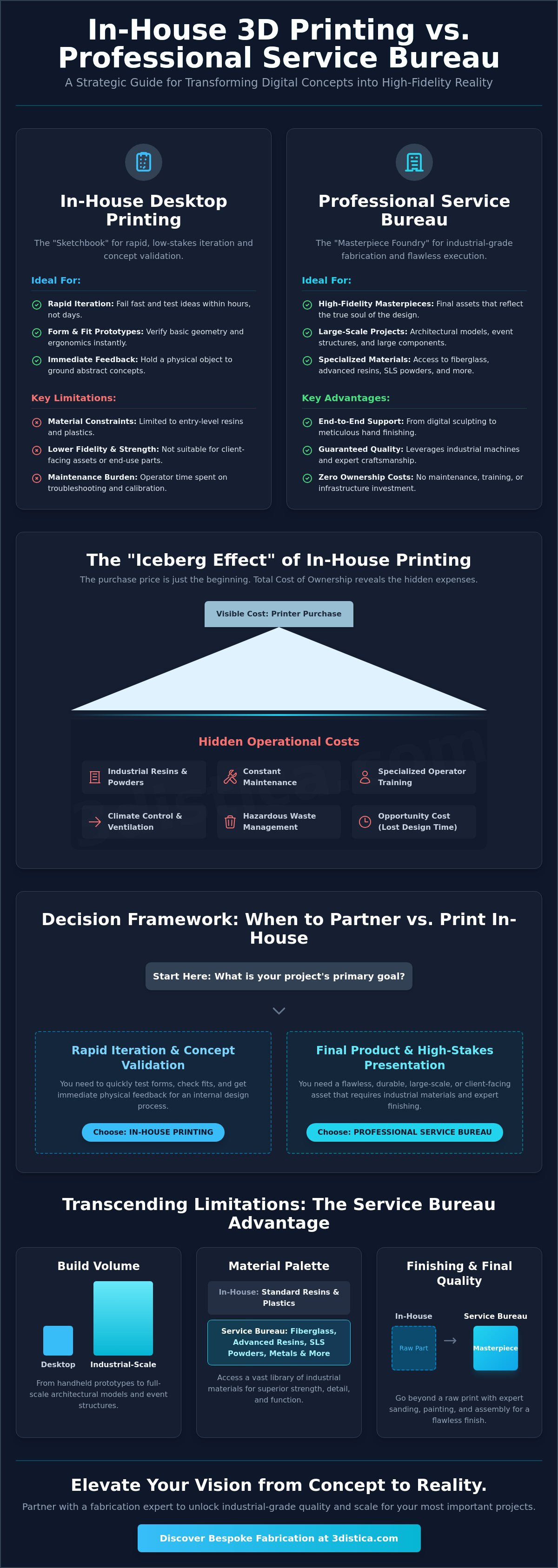
Size defines the boundary of imagination. Most internal labs are tethered to the build volume of a desktop machine, usually limited to a few hundred millimeters. When projects demand monumental presence, the debate of in-house 3d printing vs service bureau shifts from cost to sheer capability. A professional partner provides access to large-format systems that can produce single-piece architectural elements or event structures without the structural weakness of glued assemblies. It's the difference between a desk ornament and a landmark. True scale requires more than just a bigger printer; it requires an ecosystem of industrial tools designed for magnitude.
Industrial fabrication isn't restricted to plastic polymers. It's a symphony of materials. By integrating CNC routing and fiberglass products, a bureau ensures that large-scale assets possess the structural integrity to withstand public interaction. We don't just print; we engineer. Advanced surface treatments can transform a raw substrate into a surface that mimics the cold touch of metal, the grain of stone, or the clarity of glass. These high-fidelity finishes are achieved through specialized hydro-chroming and meticulously applied industrial coatings that entry-level machines simply can't accommodate. This level of refinement ensures that the final physical asset is indistinguishable from the luxury materials it represents.
Architectural maquettes are often the deciding factor in winning national real estate bids. They require a level of precision and scale that internal teams struggle to produce under tight deadlines. Utilizing Styrofoam sculpting as a base, reinforced with fiberglass, allows for the creation of monumental public art and complex topographic models. This hybrid approach combines the speed of additive manufacturing with the soul of manual craftsmanship. The result is a unique texture and presence that resonates with stakeholders on an emotional level. It's about capturing the essence of a space, not just its dimensions.
The UAE's climate presents a unique set of challenges for physical assets. Intense UV exposure and extreme temperatures can cause standard 3D printing filaments to warp or degrade within weeks. A service bureau offers access to high-temp resins and carbon fiber composites designed for environmental resilience. For those restoring history, industrial 3D scanning and reverse engineering allow for the recreation of classic car parts with modern durability. It's about ensuring that a bespoke creation remains as vibrant in five years as it is on the day of installation. When durability is non-negotiable, industrial materials are the only path forward.
Strategic clarity is the foundation of every successful fabrication project. Deciding between in-house 3d printing vs service bureau requires an honest assessment of two primary axes: volume and complexity. Internal machines excel at producing a high volume of low-fidelity iterations, yet they often falter when faced with the intricate demands of a final masterpiece. It's a balance of intent. If the goal is a rough draft to test a mechanical hinge, the convenience of a desktop printer is undeniable. However, when the physical asset must carry the emotional weight of a brand or the precision of an architectural vision, the specialized expertise of a bureau becomes the essential insurance policy against project failure.
Risk is a silent partner in this decision. Complex projects involving multi-material assemblies or large-scale wall cladding carry a high cost of failure that internal labs aren't equipped to absorb. A professional studio provides more than just a print; they provide a guarantee of fidelity. By outsourcing high-impact assets, you transfer the technical burden to a partner who understands the interplay of elemental forces and material science. This allows your team to remain focused on the conceptual narrative while we handle the meticulous execution of the bespoke fabrication process. The choice between in-house 3d printing vs service bureau isn't just about budget; it's about the threshold of excellence you wish to cross.
Internal production is most effective when the stakes are localized. Consider these factors before hitting print in your own studio:
• Does the project require simple geometry and standard, non-industrial materials?
• Is the primary goal internal communication or basic form testing rather than a client-facing presentation?
• Do you have the internal bandwidth for the hours of post-processing, sanding, and support removal required?
• Is the build volume within the limits of a standard desktop plate without requiring complex assembly?
• Is the timeline flexible enough to accommodate potential machine failures and multiple reprints?
The transition to a professional partner is often marked by the need for a presence that transcends the capabilities of consumer hardware. If your project involves dimensions that exceed standard build plates, such as monumental sculptures or intricate architectural maquettes, a bureau is the only path to structural integrity. Fixed deadlines also demand professional intervention. When the cost of a failed print is measured in lost contracts or delayed exhibitions, the reliability of industrial-grade systems is non-negotiable. You need a partner who can bridge the gap between an abstract idea and a tangible, high-fidelity reality with calm confidence.
True creation begins where the machine ends. While the technical debate between in-house 3d printing vs service bureau often centers on hardware and costs, the real value lies in the human element of craftsmanship. 3DISTICA acts as the bridge between an abstract digital concept and a tangible reality that carries emotional weight. We don't merely manufacture parts; we curate experiences. By moving beyond the limitations of internal labs, you unlock a realm where artistic integrity is never sacrificed for technical feasibility. This collaborative approach ensures that every detail, from the subtle grain of a surface to the structural balance of a monumental sculpture, is meticulously refined to meet the highest standards.
Our role as a visionary artisan partner is to handle the complexities of the physical world so your team can remain in the realm of pure imagination. We understand the specific demands of the UAE market, where excellence is expected and the environment is unforgiving. Choosing a professional partner provides the peace of mind that comes from knowing your project is in the hands of those who speak the language of both design and engineering. It's about transforming a simple model into a narrative-driven asset that stands the test of time. When you weigh in-house 3d printing vs service bureau, remember that a partner offers a shared commitment to your vision's success.
Our methodology is a curated journey from digital sculpting to final technical setup. We begin by translating your vision into manufacture-ready files, ensuring that every curve and joint is optimized for durability. Whether we are utilizing industrial 3D printing, CNC routing, or hand-laid fiberglass products, our material selection is always driven by the project's ultimate purpose. We manage the intricate logistics of large-scale assembly and on-site installation, ensuring that monumental projects are executed with the same precision as a delicate maquette. It's a process where technical expertise and artistic passion converge to create something truly exceptional.
Collaborating with a specialized studio allows your team to transcend the daily maintenance of internal hardware. You gain access to a national partner who understands the regional aesthetic and structural requirements unique to our landscape. This partnership fosters a culture of innovation, where the focus remains on the storytelling potential of design rather than the troubleshooting of entry-level machines. We invite you to collaborate with 3DISTICA on your next bespoke project and discover the transformative power of professional fabrication. Let's bridge the gap between your most ambitious ideas and a physical reality that inspires wonder.
The landscape of modern creation demands a nuanced understanding of in-house 3d printing vs service bureau models. While internal tools provide the speed needed for initial drafting, transitioning to a professional partner ensures your final assets possess the weight and presence they deserve. True excellence requires a mastery of industrial materials and specialized finishing techniques that transcend the capabilities of standard studio hardware. By delegating the technical complexities of large-scale architectural models and bespoke event structures to a dedicated artisan, you empower your team to focus on the pure essence of design.
3DISTICA stands as your visionary partner, offering end-to-end support from digital sculpting to final on-site installation. Our expertise in industrial 3D printing and fiberglass fabrication transforms abstract concepts into tangible realities that resonate with authority. We don't just deliver products; we refine narratives. We invite you to start your bespoke fabrication project with 3DISTICA and bring your most ambitious visions to life with confidence. The physical world is waiting for your next masterpiece.
The primary advantage is the access to industrial-grade fidelity and a broader spectrum of advanced technologies. When comparing in-house 3d printing vs service bureau models, the bureau provides the specialized expertise required for high-stakes projects. This includes access to large-format machines and professional finishing that entry-level hardware cannot replicate. You gain a partner who understands the intersection of technical precision and artistic intent, ensuring your final assets command professional respect.
Calculating ROI requires looking beyond the initial purchase price to the total cost of ownership. You must account for specialized resins, maintenance cycles, and the electricity required for climate-controlled environments. Factor in the labor costs of your designers troubleshooting machines instead of creating. When you compare these hidden expenses to the predictable project timelines of a bureau, the strategic value of outsourcing complex work becomes clear.
Professional bureaus offer comprehensive end-to-end support that begins long before the first layer is printed. This includes 3D scanning and reverse engineering to capture the essence of physical objects for digital refinement. Digital sculpting services help translate abstract concepts into manufacture-ready files. This collaborative approach ensures that the technical methodology aligns perfectly with your original creative vision, bridging the gap between digital and tangible reality.
Professional studios provide access to industrial materials like fiberglass, carbon fiber, and high-temperature resins designed for environmental resilience. Most in-house printers are restricted to standard filaments that lack the structural integrity for outdoor installations or architectural cladding. Using industrial-grade materials ensures your projects withstand the UAE’s unique climate factors. This material diversity allows for a level of craftsmanship and durability that consumer-grade machines simply cannot offer.
Outsourcing large-scale sculptures is generally more cost-effective when you consider structural integrity and labor. Printing in sections in-house requires extensive manual assembly and sanding, which often leaves visible seams and weak points. A bureau uses large-format printing or Styrofoam sculpting to create seamless, monumental assets. This reduces the risk of failure and ensures a high-fidelity finish that reflects the sophisticated standards of your professional brand.
A service bureau integrates traditional craftsmanship with additive manufacturing to achieve superior aesthetics. Skilled artisans handle the meticulous post-processing, including hydro-chroming and custom surface coating to mimic metal or stone textures. This ensures that every architectural maquette captures the emotional impact of a design. The final assembly is handled with technical precision, resulting in a polished masterpiece that is ready for marketing suites or high-stakes presentations.
When evaluating in-house 3d printing vs service bureau options in the UAE, look for a partner with local expertise and a proven portfolio. Your partner should demonstrate a deep understanding of regional aesthetic standards and large-scale logistics. Seek a visionary artisan who offers collaborative guidance rather than just a mass-produced service. Reliability and the ability to bridge abstract ideas with tangible, high-fidelity results are the hallmarks of an elite fabrication studio.
Professional studios utilize high-precision 3D scanning to breathe new life into obsolete components. This is essential for classic car parts restoration or the recreation of historical artifacts. By capturing the exact geometry of a worn part, we can reverse engineer a digital model and manufacture a replacement with modern industrial durability. This process ensures that the soul of the original is preserved while improving the structural integrity for future use.
