
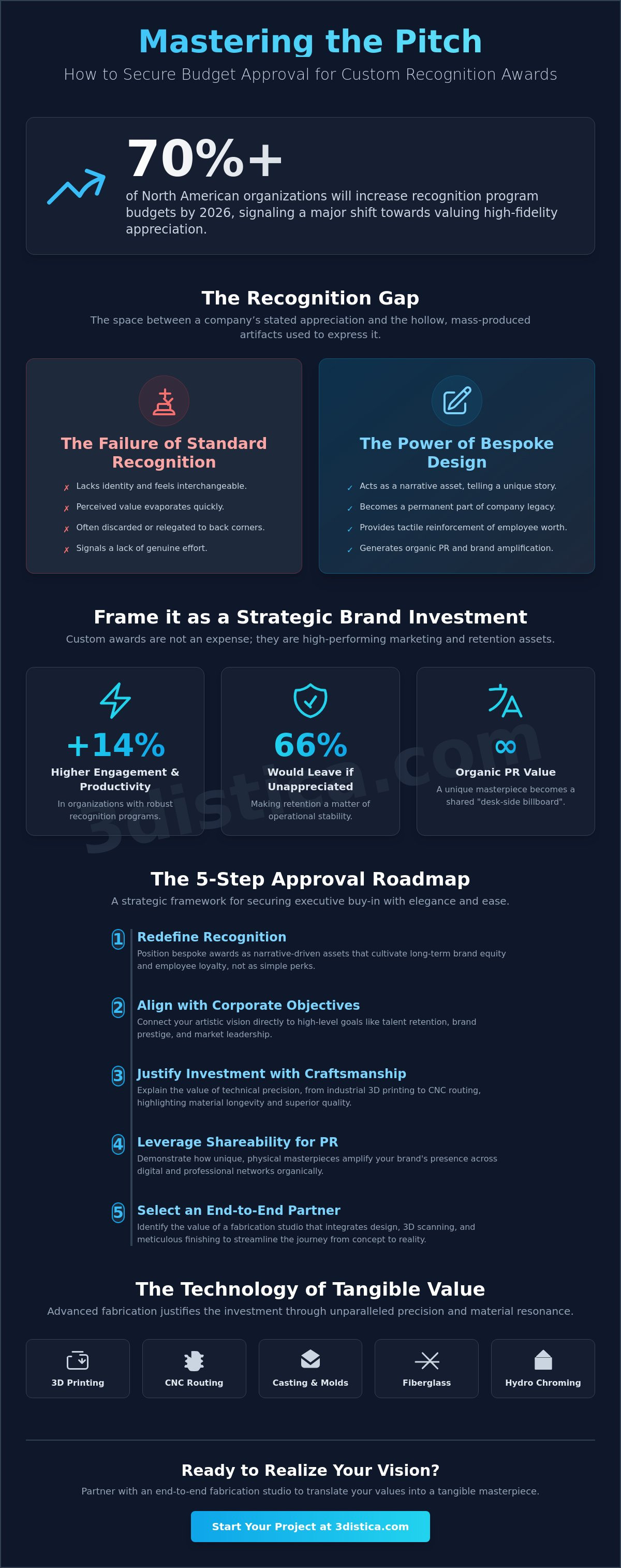
Over 70% of North American organizations anticipate budget increases for their recognition programs in 2026. This shift reflects a growing awareness that high-fidelity appreciation is the strongest driver of talent retention, yet the path to securing these funds often feels clouded by technical jargon and fiscal scrutiny. You likely understand the transformative power of a bespoke object, but you might worry about being perceived as wasteful or struggle to explain the ROI of intricate 3D printing over a standard catalog piece. It's a common tension between the desire for artistic excellence and the necessity of corporate accountability.
We'll provide the clarity you need to bridge that gap and master how to get budget approval for a custom award through a data-driven strategic framework. You will gain the tools to present a proposal that treats recognition as essential infrastructure for brand equity rather than a simple perk. This guide explores how to justify technical fabrication costs and select a partner who can translate your abstract values into a tangible masterpiece that secures executive buy-in with elegance and ease.
• Redefine recognition by positioning bespoke awards as narrative-driven assets that cultivate long-term brand equity and employee loyalty.
• Master the strategic roadmap for how to get budget approval for a custom award by aligning your artistic vision with high-level corporate objectives.
• Evaluate the technical precision of industrial 3D printing and CNC routing to justify investment through craftsmanship and material longevity.
• Leverage the organic shareability of unique, physical masterpieces to amplify your brand’s PR presence across digital and professional networks.
• Identify the value of an end-to-end fabrication partner who integrates 3D scanning and meticulous finishing to streamline the journey from concept to reality.
A trophy is a marker. A bespoke award, however, is a deliberate translation of corporate identity into a three-dimensional form that captures the essence of a milestone. When you move beyond the standard catalog, you stop purchasing commodities and start investing in narrative assets. These objects don't just sit on a shelf; they anchor the recipient’s achievement to the company’s visual history. Understanding how to get budget approval for a custom award starts with shifting the executive perspective from procurement to storytelling. By framing the award as a physical manifestation of brand equity, you justify the transition from a fleeting gesture to a permanent legacy.
Generic plaques often suffer a quiet fate. They are relegated to back corners or eventually discarded because they lack a soul. This is the commodity trap. When an award looks identical to one from a different industry or a different era, its perceived value evaporates. The recipient recognizes the lack of effort, which inadvertently signals that their contribution was equally interchangeable. The broader landscape of employee recognition often overlooks the physical medium through which gratitude is delivered. We define this disconnect as the Recognition Gap: the space between a company’s stated appreciation for its talent and the hollow, mass-produced artifacts used to express it. Closing this gap requires a commitment to high-fidelity design that mirrors the excellence it seeks to honor.
Design is a language. It articulates the silent values of an organization through the interplay of light, shadow, and material weight. Custom shapes allow for a level of symbolism that a catalog item cannot reach. Perhaps the award mirrors the sweep of your headquarters' architecture or incorporates the specific geometric motifs of your brand’s visual identity. This level of detail creates a sense of exclusivity and trust. When a recipient feels the weight of a piece crafted through casting and mold making or observes the precision of CNC routing, they experience a tactile reinforcement of their worth.
Bespoke recognition offers several strategic advantages over mass-produced goods:
Using specific textures like hydro chroming or fiberglass tells a story of innovation and modernity.
Awards can be designed to complement the environmental mood of a professional space.
A custom-fabricated masterpiece becomes a conversation starter, extending its "shelf-life" indefinitely.
By focusing on these elemental visual forces, you position the project as a high-end creative partnership. It's no longer about a line item in a ledger; it's about capturing the feeling of a space and the essence of a project. This is the foundation of a successful business case for bespoke recognition.
To successfully navigate how to get budget approval for a custom award, one must redefine the trophy as a high-performing marketing and retention asset. It's a shift from viewing a physical object as an expense to recognizing it as a strategic investment in your organization's human capital and public image. When an award is truly unique, it possesses an inherent magnetism that demands to be shared. In a digital-first world, a bespoke masterpiece often becomes the centerpiece of a recipient's professional network, generating organic PR value that far exceeds its fabrication cost. This is the intersection where technical precision meets executive strategy.
A high-quality award elevates the prestige of an entire ceremony. It transforms a standard corporate gathering into a high-stakes event that commands respect from both internal teams and external stakeholders. This elevation is critical for long-term ROI; organizations with robust recognition programs see 14% higher engagement and productivity levels. By investing in meaningful, physical symbols of success, you're directly addressing the retention imperative. Data from 2025 indicates that 66% of employees would leave their roles if they felt unappreciated, making the case for bespoke recognition a matter of operational stability.
A custom-designed award acts as a permanent desk-side billboard. Unlike digital badges that vanish into a feed, a physical object occupies a place of honor in a professional's environment, constantly reinforcing brand loyalty. The multiplier effect is significant; a single high-quality piece can generate dozens of impressions across platforms like LinkedIn, where peers and competitors witness your company's commitment to excellence. Research into the Value and ROI of Employee Recognition suggests that these visible markers of appreciation are essential for maintaining the motivation levels that drive a 23% increase in profitability. In high-stakes industries like finance or tech, this prestige factor is a currency that attracts and keeps elite talent.
Exclusivity is born from precision. High-fidelity representation ensures that every curve, texture, and hue aligns perfectly with your established visual language. This is where technical mastery meets brand strategy. By utilizing advanced techniques such as surface finishing and hydro chroming, a fabrication partner can replicate brand-specific pantones or metallic finishes with absolute accuracy. This level of detail signals to stakeholders that your standards for recognition are as rigorous as your standards for business. When the award feels like a natural extension of the brand's architectural or digital presence, it ceases to be a mere gift and becomes a symbol of belonging.
The path to understanding how to get budget approval for a custom award requires a deep dive into the technical methodology of modern fabrication. It's not enough to present a vision; you must demonstrate how specific technologies optimize every dollar spent. Traditional methods often carry significant overhead in the form of physical molds, which can become a financial hurdle for low-volume, high-complexity projects. By pivoting toward advanced digital workflows, we can bypass these legacy constraints and focus resources on the artistic refinement that truly defines a masterpiece. This technical transparency builds trust with stakeholders who value both innovation and fiscal responsibility.
Precision is the hallmark of a high-end creative partner. Utilizing CNC routing and laser cutting allows for the creation of intricate geometries at scale, ensuring that a series of awards remains consistent in its high-fidelity representation. This level of accuracy is paired with a "Design-for-Manufacture" (DFM) approach. DFM isn't about cutting corners; it's about structural intelligence. By optimizing the design for the specific fabrication path early in the process, we eliminate unnecessary labor costs and material waste, allowing the budget to be redirected toward premium surface treatments that elevate the recipient's experience.
Industrial 3D printing offers a radical departure from the limitations of traditional casting. For complex, one-off designs, 3D printing is often more cost-effective because it removes the need for expensive, permanent molds that carry significant upfront cost even for small items. Digital sculpting allows us to iterate rapidly within a virtual space, using CAD modeling to visualize the final outcome before a single gram of material is spent. This digital-first workflow eliminates the risk of physical errors and ensures that the conceptual essence of the project is preserved from the first sketch to the final print.
The emotional impact of an award is often determined by its final millimeter. Specialized techniques like surface finishing and hydro chroming add a layer of perceived value that far outweighs the cost of the raw material. Whether you're choosing fiberglass products for their enduring resilience or styrofoam sculpting for large-scale, immersive event props, the finish is what creates the "wow" factor. We balance material density with high-end manual craftsmanship to ensure the award feels substantial in the hand. This interplay of light, weight, and texture reinforces the sense of exclusivity that makes a bespoke award a permanent fixture in a professional's life.
Securing executive buy-in is an exercise in strategic curation. It requires more than a simple request; it demands a structured narrative that bridges the gap between creative vision and fiscal reality. To master how to get budget approval for a custom award, you must guide leadership through a logical progression of value, starting with the conceptual purpose before discussing the technical methodology. This roadmap ensures that your proposal is seen not as a luxury, but as a necessary investment in the company’s visual history.
Focus on the emotional impact and strategic objectives rather than the physical dimensions.
Discuss the vision with key stakeholders before the formal presentation to build a coalition of support.
Offer "Good, Better, Best" frameworks to give leadership a sense of control over the investment level.
De-risk the decision by using high-fidelity digital models to show exactly what the final masterpiece will look like.
Link the project to a specific event, such as a 10th anniversary or a significant merger, to provide a sense of urgency.
Your formal proposal should highlight brand alignment and potential social reach. Leadership often views event costs in isolation, so compare the award’s lasting impact to other line items. While catering serves a temporary purpose, a bespoke award provides a permanent brand impression. Address the lead time objection immediately by presenting a transparent production timeline that includes phases for design, 3D scanning and reverse engineering, and final finishing. This level of organization suggests that the internal processes are as polished as the final product.
When leadership suggests a standard trophy is sufficient, pivot to the "Cost of Low Quality." A cheap award doesn't just fail to inspire; it can actively damage a brand’s reputation by signaling a lack of care. If resistance persists, propose a pilot program for a single, high-profile category to prove the impact of meaningful recognition. This subtle approach invites collaboration rather than demanding attention. To begin this journey, explore our gallery of custom awards and trophies to find the right aesthetic anchor for your proposal.
The final phase of your strategic journey is the transition from conceptual approval to tangible reality. Selecting the right partner is as vital as the proposal itself. An end-to-end fabrication studio acts as a visionary guide, bridging the gap between an abstract idea and a physical masterpiece through technical mastery. This partnership ensures the high-fidelity vision presented to leadership remains preserved throughout the production cycle. When discussing how to get budget approval for a custom award, you should emphasize the efficiency of a single-source partner. Such a collaborator minimizes the friction of hand-offs between designers and technicians, ensuring that the internal processes are as organized as the public-facing results.
Technical precision serves as a silent guardian of your project timeline. Expertise in 3D scanning and reverse engineering or CNC routing allows a studio to accelerate development without compromising the artistic integrity of the work. These tools are for optimization. By evaluating a partner’s portfolio of complex architectural scale models or corporate installations, you gain confidence in their ability to handle the nuances of your project. Securing the right partner is the final step in how to get budget approval for a custom award, as it proves you have a reliable path to execution. Transparency in fabrication fees is equally essential. A reliable studio provides a curated breakdown of costs, moving logically from the conceptual purpose to the final outcome. This clarity reinforces the trust you’ve established with your executive stakeholders.
Refinement begins with the translation of an abstract concept into a manufacture-ready digital model. This phase is about capturing the feeling of the project. Through iterative prototyping, you can test the physical feel of the piece, assessing weight and material density before the full production run begins. A visionary artisan understands that design is about more than dimensions; it’s about the emotional impact of the final form. This collaborative approach ensures the award resonates deeply with its recipient, moving beyond a mere object to become a symbol of belonging.
The process doesn’t end when the award leaves the studio. Managing the logistics of delicate trophies or monumental styrofoam sculpting requires a meticulous eye for detail. For complex event structures or large-scale displays, on-site assembly ensures the final presentation is as polished as the design itself. This steady, curated rhythm of execution provides the peace of mind that your investment will be delivered with grace and professionalism. Collaborate with 3DISTICA to bring your visionary award concept to life.
Securing high-level buy-in requires a shift from procurement to narrative. You've seen how bespoke recognition functions as a permanent brand impression, driving both social reach and employee loyalty. By mastering how to get budget approval for a custom award through a data-driven business case, you position yourself as a strategic partner rather than a mere coordinator. You're no longer just ordering a trophy; you're curating a milestone in your company's visual history. This transition ensures that your recognition program reflects the same excellence as the talent it honors.
Realizing this vision requires a technician who is also a storyteller. We offer end-to-end support, moving with precision from digital sculpting to the final installation. Our expertise in industrial 3D printing and fiberglass fabrication ensures that every detail mirrors the essence of your project. We invite you to request a bespoke fabrication proposal for your next recognition project and experience a visionary artisan approach to technical precision. The path to extraordinary recognition is ready for your leadership. We look forward to crafting your next masterpiece together.
Custom awards reflect the complexity of their unique design rather than the volume of mass-produced goods. While a standard trophy relies on existing molds, bespoke pieces involve digital sculpting and tailored finishing. This investment pays dividends in brand equity and recipient engagement, moving beyond the commodity trap discussed earlier. The final cost depends on material density and the intricacy of the technical fabrication process.
A standard timeline usually spans several weeks to allow for the meticulous phases of design, 3D scanning, and surface finishing. Each project is unique, so the duration depends on the complexity of the geometry and the specific materials chosen. Planning ahead is essential to ensure every detail aligns with the high-fidelity standards of your corporate event and allows for necessary refinement.
Industrial 3D printing is a premier choice for high-end recognition due to its ability to capture intricate, narrative-driven forms. It allows for a level of technical precision that traditional casting often struggles to achieve at low volumes. When paired with hydro chroming or metallic paints, the result is a sophisticated masterpiece that feels substantial and exclusive, perfectly suited for the modern boardroom.
Fiberglass products offer exceptional durability and a premium feel, making them ideal for awards intended to be permanent legacy pieces. These materials resist environmental wear and maintain their structural integrity over time. For larger, more immersive event props, styrofoam sculpting provides the necessary scale while maintaining a refined aesthetic through specialized surface treatments that protect the underlying form from the elements.
Frame the costs as an investment in specialized technology and narrative assets rather than mere material consumption. Explaining how to get budget approval for a custom award involves highlighting how digital sculpting and CNC routing eliminate the need for expensive, one-time physical molds. This technical efficiency allows the budget to focus on craftsmanship and high-fidelity finishing rather than the waste associated with legacy methods.
Modern fabrication techniques like 3D printing and CNC milling make low-volume production highly accessible. Unlike traditional methods that require high minimum orders to offset mold costs, digital workflows allow for the creation of even a single masterpiece. This flexibility ensures that exclusive, high-stakes recognition remains a viable option for small executive teams or specialized milestones without the burden of excess inventory.
A studio requires a clear understanding of the conceptual vision, preferred materials, and the desired scale. Providing architectural references, brand-specific geometric motifs, or a rough 3D model allows for a more precise technical assessment. This information ensures the final proposal reflects both the artistic intent and the functional requirements of the project, leading to a transparent and reliable production plan.
Prototyping de-risks the investment by providing a physical or high-fidelity digital representation of the final award. It allows stakeholders to experience the weight, texture, and visual harmony of the design before full-scale production begins. This tangible proof of concept builds confidence in the project's success and simplifies the path of how to get budget approval for a custom award by removing ambiguity.
