Precision is the silent language of luxury. With 79 percent of manufacturing leaders identifying the skilled labor shortage as their primary external challenge in 2026, the ability to translate a digital vision into a flawless physical asset is a rare and vital expertise. You likely understand the frustration of seeing a bespoke project compromised by material discrepancies or a lack of workflow transparency. It's a delicate transition where the essence of a design can easily be lost. We believe your creative intent should remain uncompromised, which is why understanding how to ensure fabrication quality through a synthesis of technology and craft is essential for any high-stakes commission.
Excellence is a continuous synthesis of digital fidelity and material mastery. This guide reveals the protocols necessary to master technical precision and artisanal craftsmanship for the most demanding projects. You'll learn to navigate 2026 standards, including the implementation of ISO 9001:2026 quality frameworks and the AWS D1.1:2025 structural welding code. We'll explore a workflow that integrates industrial 3D printing and advanced 3D scanning to eliminate rework before production begins. By the end of this article, you'll possess the framework needed to achieve seamless installations and a perfect alignment between your artistic vision and the final, tangible outcome.
• Understand the evolution of structural durability in 2026. This shift demands a sophisticated approach to aesthetic fidelity, particularly within the discerning United Arab Emirates market.
• Master the protocols of how to ensure fabrication quality by synchronizing digital twins with material resilience. This ensures that every fiberglass or polymer element withstands the unique environmental stressors of the GCC.
• Resolve the translation gap between concept and reality. Utilizing 3D scanning as a verification bridge ensures that the final physical asset mirrors the intricate nuances of its digital origin.
• Adopt a rigorous pre-production and in-process inspection framework. This meticulous checklist guarantees that every bespoke project achieves a zero-rework production cycle and seamless spatial integration.
In the sophisticated landscape of 2026, quality has evolved from a simple checklist into a deep-seated philosophy. It's the precise intersection where structural durability meets high-fidelity aesthetic representation. For bespoke projects, excellence isn't a post-production luxury; it's a foundational requirement. Understanding how to ensure fabrication quality requires looking beneath the surface to the very bones of the creation. In the United Arab Emirates, this demand for excellence is amplified. The region's architectural ambitions and extreme environmental conditions require standards that often surpass global averages, pushing fabricators to innovate with every weld and layer.
True quality acts as an invisible hand. It's the internal structural integrity that allows for a flawless external surface finish. Without a robust core, even the most exquisite hydro-chroming or digital printing will eventually falter. Establishing a rigorous process of Quality control (QC) ensures that every component, from internal bracing to the final coat of paint, adheres to the original intent. We measure this success through specific Key Performance Indicators: dimensional accuracy, material purity, and surface tension. These metrics provide a map for the artisan, ensuring that the abstract beauty of a design is grounded in technical reality.
Errors don't stay small. A 1mm discrepancy in an architectural scale model might seem negligible in a digital render, but it creates a cascading failure during final assembly. These technical lapses lead to significant rework and, more importantly, damage the brand narrative. When a high-profile event installation shows visible seams or poor material choices, it breaks the immersion of the space. Fabrication Quality is the perfect alignment of intent and output.
Bespoke creation is the antithesis of industrial mass-production. It requires a visionary artisan who treats every industrial 3D printing task or styrofoam sculpture as a piece of narrative art. Technical precision is the tool, but artistic intuition is the guide. In the UAE, where projects often redefine the possible, you need a collaborative partner who understands the essence of your design. This partnership ensures that the complexity of the workflow remains elegant, resulting in a physical asset that captures the soul of the original vision. By prioritizing these artisanal values, creators can discover how to ensure fabrication quality that lasts for decades.
Quality begins long before the first layer of resin is poured or the first tool path is carved. It starts in the digital ether, where a "manufacture-ready" CAD file acts as the primary DNA of your project. This digital twin is more than just a visual representation; it's a precise technical document that accounts for material shrinkage, structural load, and assembly tolerances. When we consider how to ensure fabrication quality, we must first verify that the digital foundation is flawless. A design that looks perfect on a screen can fail in the physical world if the digital fidelity doesn't translate into actionable data for industrial 3D printing or CNC routing.
In the United Arab Emirates and the broader GCC region, the environment is a constant, unforgiving adversary. High UV exposure and extreme thermal fluctuations can degrade inferior materials within months. Sourcing polymers and fiberglass with superior thermal stability is essential for any asset intended for public or outdoor spaces. We verify raw material properties through batch testing and certification before production ever begins. Adhering to rigorous standards, similar to the federal quality control requirements seen in high-stakes manufacturing, ensures that every component is fit for its specific environmental mood. This meticulous attention to material selection is a hallmark of the bespoke fabrication services we provide for visionary partners.
Composite fabrication is a delicate dance of chemistry and craft. Managing the resin-to-glass ratio is critical; too much resin makes the part brittle, while too little leaves it structurally weak. We employ strict visual inspection protocols to detect air bubbles or potential delamination in fiberglass products. Because ambient humidity and temperature can drastically alter curing cycles, the workshop environment must be as controlled as a laboratory to ensure the final piece retains its intended strength and finish.
Large-format 3D printing introduces unique challenges, particularly regarding layer adhesion and infill density. We verify these parameters at every stage to prevent internal voids that could compromise the asset. For CNC laser cutting and routing, tool-path optimization is vital to prevent material stress and warping. To close the loop on quality, 3D scanning provides a digital proof of physical accuracy. By overlaying a scan of the finished object onto the original CAD file, we provide a transparent, data-driven confirmation that the physical reality matches the artistic vision perfectly. This synthesis of technology and intuition is how to ensure fabrication quality in an era of increasingly complex designs.
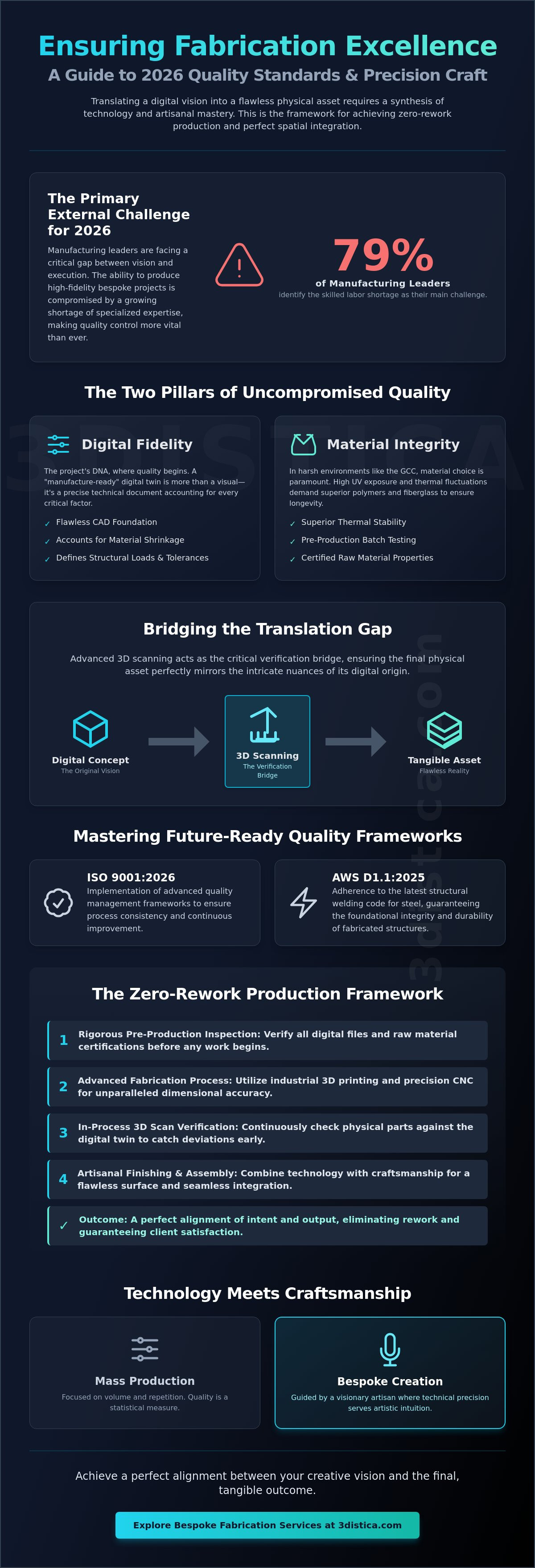
The transition from a digital blueprint to a physical object is rarely a linear path. It is a translation. Digital models exist in a sterile vacuum, free from the constraints of gravity, light, or material resistance. Physical reality, however, is reactive. Learning how to ensure fabrication quality means recognizing that a perfect CAD file is only the beginning of the journey. The "Translation Gap" occurs when the nuances of a digital design—complex organic curves or sharp geometric intersections—meet the physical limitations of a chosen medium. Bridging this gap requires a visionary approach where technology acts as an objective arbiter of artistic intent.
We utilize 3D scanning and reverse engineering as the primary bridge for this verification. By capturing high-resolution data of a physical prototype, we can overlay it against the original digital sculpture to identify even the most minute deviations. This is particularly vital for projects like classic car parts restoration or intricate vinyl figures, where every micron matters. Prototyping serves as a critical quality gate; creating architectural scale models or maquettes allows stakeholders to experience the spatial feeling of a design before committing to large-scale production. This iterative step ensures that the final installation aligns perfectly with the conceptual narrative.
Managing the varying tolerances of different fabrication methods is essential for a cohesive final product. While CNC routing offers extreme geometric precision, manual styrofoam sculpting provides the organic nuance that machines sometimes lack. Balancing these methods requires a structured framework.
| Metric | Digital File | Physical Output |
|---|---|---|
| Tolerance | Infinite Precision | ±0.1mm to 2.0mm (Method Dependent) |
| Texture | Procedural/Visual | Tactile/Surface Tension |
| Structural Load | Simulated/Theoretical | Environmental/Physical Stress |
Implementing real-time monitoring during long-duration industrial 3D printing runs allows us to catch layer shifts or adhesion issues the moment they occur. Advanced 3D scanning ensures 99.9% fidelity to the original artist’s vision by providing a data-backed comparison between the virtual and the real.
The emotional impact of a custom award or a large-scale sculpture is often decided in the final millimeters of its surface. Achieving uniformity across expansive areas requires mastery of techniques like hydro chroming and high-gloss surface finishing. It isn't just about shine; it's about how the light interacts with the form to tell a story. We employ rigorous color matching protocols to translate digital Pantone values into physical paint applications, ensuring the environmental mood remains consistent. Whether it's the sleek finish of custom RC parts or the textured depth of interior wall cladding, the surface finish is the final, essential step in how to ensure fabrication quality that resonates on a human level.
Excellence in bespoke creation is never accidental. It is the result of a disciplined choreography where technical benchmarks meet artistic intuition. To master how to ensure fabrication quality, one must view the project as a living narrative that requires constant validation. This checklist serves as the definitive protocol for 2026, moving beyond simple shop-floor checks to encompass the entire lifecycle of a custom asset.
Cross-reference manufacture-ready CAD files against specific material data sheets to ensure thermal stability for the GCC climate.
Conduct structural audits at critical milestones, such as verifying internal armatures before the final skinning of a monumental sculpture.
Utilize high-resolution metrology and 3D scanning to validate dimensional accuracy against the original digital twin.
Execute secure handling protocols and climate-controlled transport to maintain surface integrity during transit.
Perform an environmental impact assessment, adhering to the ISO 14001:2026 standard published on April 15, 2026, to ensure the project meets modern sustainability requirements.
This structured approach eliminates the "Translation Gap" discussed earlier, ensuring that the physical object retains the soul of the digital design. If you are ready to begin a project where precision is guaranteed, you can partner with our visionary artisans to bring your concept to life.
The internal skeleton of a project is as vital as its finish. For monumental sculptures, we perform rigorous internal structure checks before the application of fiberglass or styrofoam. This ensures long-term durability and safety. Similarly, for wall cladding and interior panels, we verify the dimensions of CNC-routed components before they reach the assembly stage. When restoring classic car parts or developing custom RC components, a dedicated mockup phase allows us to test the fit and finish, preventing costly rework during the final installation.
Quality does not end at the studio door. The transition from the workshop to the final site is a high-risk phase where high-fidelity fiberglass products are susceptible to surface micro-cracks if handled incorrectly. We implement specialized handling protocols to preserve the surface tension and aesthetic purity of every piece. For architectural scale models and maquettes, technical setup protocols are essential to ensure the intricate details remain intact. The ultimate goal is to maintain the spatial feeling of the work, ensuring that the emotional impact envisioned in the studio is perfectly preserved in its final environment. This holistic view of the workflow is how to ensure fabrication quality that stands the test of time.
At 3DISTICA, we don't just build objects. We manifest visions. In a region defined by its architectural audacity, the United Arab Emirates requires more than just a vendor; it demands a visionary partner. Our methodology is a curated journey that begins with the abstract and ends with the tangible. This is how to ensure fabrication quality at the highest level: by maintaining a thread of narrative continuity from the first digital brushstroke to the final bolt on-site. We believe that technical precision should never come at the expense of artistic soul, and our end-to-end approach ensures that neither is compromised.
Precision is our primary dialect. In a recent project involving monumental public art, we were tasked with achieving micron-level accuracy across a multi-meter installation. By synchronizing industrial 3D printing with high-fidelity 3D scanning, we verified every curve against its digital twin in real time. This process allowed us to identify and resolve potential deviations before they could impact the assembly, resulting in a flawless physical mirror of the artist's intent. Our guarantee is simple yet profound: we provide bespoke quality that captures the true essence of your vision, ensuring that the final asset resonates with the exact emotional impact you intended.
Our expertise serves the most demanding sectors in the region. We provide tailored fabrication for architecture, high-profile events, and luxury corporate branding, ensuring that every piece is optimized for the unique GCC environment. By integrating 3D scanning and reverse engineering into our standard workflow, we effectively eliminate project risk and material waste. Whether you require intricate wall cladding or custom awards and trophies, our process is designed to deliver excellence without compromise. Explore the possibilities of our 3DISTICA Fabrication Services to see how we can transform your complex designs into physical reality.
We invite you to view us as a collaborative guide rather than a mere service provider. Our Dubai-based studio serves as a sanctuary for design, where technology and art converge to serve the wider GCC region. We understand the complexities of visual communication and the importance of spatial feeling. By choosing to how to ensure fabrication quality through our meticulous standards, you are choosing a partner dedicated to artistic integrity and technical mastery. We don't just deliver a final product; we orchestrate an experience of creation and refinement. Collaborate with us on your next visionary project and discover what happens when technical precision meets the heart of a craftsman.
The boundary between thought and matter is where true artistry resides. We've explored how the synthesis of digital twins and specialized GCC material expertise ensures that every creation withstands the elements while maintaining its conceptual soul. Mastering how to ensure fabrication quality isn't just about technical checks; it's about a relentless commitment to narrative fidelity through ISO-standard precision protocols. From the initial industrial 3D printing layers to the final CNC tool path, each step must be a deliberate act of refinement. By bridging the translation gap with advanced 3D scanning, you ensure that your most ambitious visions are never lost in the transition to reality. The future of bespoke design belongs to those who refuse to settle for anything less than perfection. Your vision deserves the permanence of masterful execution. We invite you to step into a partnership where your most complex ideas are treated with the reverence they deserve.
Begin your journey from concept to tangible reality with 3DISTICA
Structural safety is guaranteed through the integration of internal armatures and rigorous structural audits during the pre-skinning phase. For monumental sculptures, we verify the load-bearing capacity of the internal skeleton before applying styrofoam or fiberglass finishes. This multi-layered approach ensures the asset remains stable under environmental stress and human interaction, preserving the spatial feeling of the work for decades.
Industrial 3D printing tolerances typically range from ±0.1mm to 2.0mm depending on the specific technology and material chosen. While digital files offer infinite precision, physical reality requires managing these slight variances to ensure seamless assembly. We use advanced metrology to confirm that every bespoke project meets these high-fidelity requirements, ensuring that the physical output mirrors the digital intent.
You can verify fiberglass quality by inspecting the resin-to-glass ratio and checking for signs of air bubbles or delamination. High-quality fiberglass products should have a uniform surface tension and complete structural rigidity. We conduct visual and tactile inspections at critical milestones to ensure the composite curing cycle was perfectly managed within a controlled workshop environment.
3D scanning is the primary tool for ensuring the accuracy of classic car parts restoration and custom RC parts. By creating a digital twin of an existing component, we can reverse engineer the geometry with absolute precision. This data-driven approach is a key part of how to ensure fabrication quality when original blueprints are no longer available or accessible.
Look for partners who adhere to the latest international benchmarks, such as the ISO 9001:2026 standard for Quality Management. It's also vital to ensure compliance with the AWS D1.1:2025 Structural Welding Code, which is the current standard for 2026. These certifications provide a transparent framework for how to ensure fabrication quality and technical excellence in high-stakes projects.
The extreme heat and high UV levels of the GCC require materials with exceptional thermal stability and UV resistance. Polymers and fiberglass must be specifically formulated to prevent warping or degradation in desert conditions. We source raw materials that are certified to maintain their structural and aesthetic integrity, ensuring that outdoor installations don't lose their narrative impact over time.
While a perfect replication is the goal, physical reality often presents a "Translation Gap" that requires expert navigation. We achieve 99.9% fidelity to the original artist’s vision by using 3D scanning to bridge the gap between digital models and tangible assets. This allows us to adjust for material behavior and ensure the final spatial feeling is preserved through every stage of production.
Industrial 3D printing offers superior material purity, layer adhesion, and large-format scale compared to consumer-grade alternatives. It's the difference between a mass-produced retail good and a bespoke art form. Our industrial processes provide the structural durability needed for complex architectural scale models and high-end wall cladding, ensuring that every detail is captured with professional-grade precision.
