The most expensive material isn't always the strongest for your specific vision. While carbon fiber is often celebrated as the pinnacle of performance, the reality of fiberglass vs carbon fiber strength is a narrative of trade-offs rather than a simple hierarchy. You've likely felt the tension of balancing a project's weight with its structural integrity, only to worry that over-engineering might lead to unnecessary budget overruns. It's a common challenge for architects and designers who refuse to compromise on the essence of a space or the longevity of a bespoke installation.
This guide clarifies those complexities. You'll discover the nuanced structural differences between these composites, from the resilient volume of fiberglass to the surgical precision of carbon fiber. We'll examine how 2026 market shifts, including the 10% to 20% price increase for Torayca products and the implementation of ISO 13094:2025, impact your material selection. By the end, you'll have the technical justification needed to choose a material that ensures durability in harsh climates and supports the transformative power of your fabrication project. We'll explore the interplay of these elemental forces to help you move from an abstract idea to a tangible, high-fidelity reality.
• Understand how the harmonious marriage of reinforcement fibers and resin matrices defines the core structural character of any high-end composite.
• Learn to distinguish between tensile and flexural properties to ensure your material selection can withstand both pulling forces and bending loads without permanent deformation.
• Master the framework for evaluating fiberglass vs carbon fiber strength by contrasting the surgical stiffness required for thin-walled parts with the resilient toughness of silica-based glass.
• Evaluate the environmental longevity of each material, specifically how thermal stability and UV resistance influence the performance of bespoke installations in fluctuating climates.
• Discover a methodology for bridging the gap between abstract design and tangible reality through integrated 3D scanning and expert fabrication techniques.
• The Elemental Choice: Defining Fiberglass and Carbon Fiber Strength
• The Science of Strength: Tensile and Flexural Properties Compared
• Rigidity vs. Resilience: A Practical Comparison Framework
• Selecting for Longevity: Environmental and Thermal Stability
• The 3DISTICA Approach: Bespoke Fabrication and Material Mastery
Composites represent a harmonious marriage between raw reinforcement and a binding polymer. They're not merely materials; they're engineered solutions where reinforcement fibers provide the skeleton and a resin matrix acts as the protective skin. To understand the nuances of fiberglass vs carbon fiber strength, one must first appreciate their elemental origins. Fiberglass is a resilient, silica-based medium, often chosen for its ability to flow into high-volume forms while maintaining a rugged versatility. It's a workhorse of the design world, offering a balance of durability and cost-effectiveness. In contrast, carbon fiber sits at the pinnacle of lightweight engineering. It offers a high-fidelity precision that feels almost surgical in its application, providing unmatched stiffness for projects where every gram of weight matters. Strength in this context isn't a singular metric. It's a complex interplay of tensile, flexural, and compressive forces that dictate how a bespoke object lives and breathes within its intended environment.
The polymer matrix does more than just hold fibers in place; it shields them from environmental degradation and transfers physical loads between the individual strands. Within this matrix, the orientation of the fibers is the silent architect of the piece's performance. Aligning fibers in a specific direction allows for tailored rigidity, a process where material science meets the steady hand of artisanal craftsmanship. A deep understanding of foundational fiberglass properties helps designers predict how a structure will respond to real-world stressors. When we manipulate these fibers during the fabrication process, we're not just building a part; we're directing the flow of energy through the material. This intentionality ensures that the final product possesses the exact fiberglass vs carbon fiber strength profile required for its specific role, whether that's a delicate award or a robust architectural panel.
Bespoke fabrication demands more than just a beautiful surface. It requires a structural soul. When creating monumental sculptures or intricate wall cladding, the integrity of the asset is paramount to its long-term success. There's a profound emotional security in knowing a large-scale project is engineered for eternity, standing firm against the elements and the passage of time. This technical confidence allows for a delicate balance between the physical weight of architectural elements and the practicalities of national logistics. Choosing the right composite ensures that the final result remains as enduring as the original vision. It's about moving beyond simple aesthetics to ensure that the structural reality of the project can support the weight of its own narrative. By selecting the correct material, we bridge the gap between an abstract idea and a tangible, high-fidelity reality that performs as beautifully as it looks.
Quantifying the performance of a composite requires a shift from conceptual vision to empirical data. When evaluating fiberglass vs carbon fiber strength, we look to established composites industry standards to guide our selection. These metrics, such as those defined by ASTM D3039 for tensile properties, provide the technical foundation for architectural confidence. While both materials offer immense potential, they respond to physical stress in fundamentally different ways. One thrives under the rigors of extreme tension; the other finds its purpose in resilient flexibility. Understanding these nuances allows us to bridge the gap between an abstract idea and a tangible, high-fidelity reality.
Tensile strength is the maximum stress a material withstands while being stretched. In this arena, carbon fiber's crystalline lattice is unmatched. The tightly bonded carbon atoms create a filament of unparalleled load-bearing capacity, making it essential for thin-walled parts that must support significant weight without stretching. Fiberglass serves as a reliable workhorse for the industry. It provides moderate structural support for high-volume forms where the extreme tensile limits of carbon are not required. Choosing between them often comes down to the specific modulus, or the stiffness-to-weight ratio, which dictates how a structure behaves under load. While foundational standards like ASTM D3039 remain the authority for material comparison in 2026, newer protocols like ISO 13094:2025 help us understand the strength of bonded assemblies in complex fabrications.
Flexural strength measures how much a panel or component can bend before permanent deformation or failure occurs. This is where the narrative of fiberglass vs carbon fiber strength becomes a study of resilience versus rigidity. Fiberglass possesses a unique ability to absorb energy and return to its original shape, a property often leveraged for vibration damping in architectural panels. It is a forgiving material. Carbon fiber is inherently brittle despite its extreme strength. It maintains its form with surgical precision until the point of failure, where it breaks suddenly rather than deforming. To manage these traits, we meticulously select the resin matrix to enhance the natural properties of the fiber. The right polymer can soften the brittle nature of carbon or add a layer of protection to fiberglass. For designers seeking bespoke fabrication expertise, this balance of chemistry and physics is the key to a successful installation.
Fatigue resistance also plays a vital role in the longevity of a project. Carbon fiber excels in environments with cyclical loading, resisting the micro-fractures that can plague metal or lesser composites over decades. Fiberglass offers superior acoustic and vibration management, making it ideal for large-scale interior elements or public art. By adhering to ASTM D790 for flexural testing, we ensure every element meets the rigorous demands of the physical world while maintaining its artistic integrity.
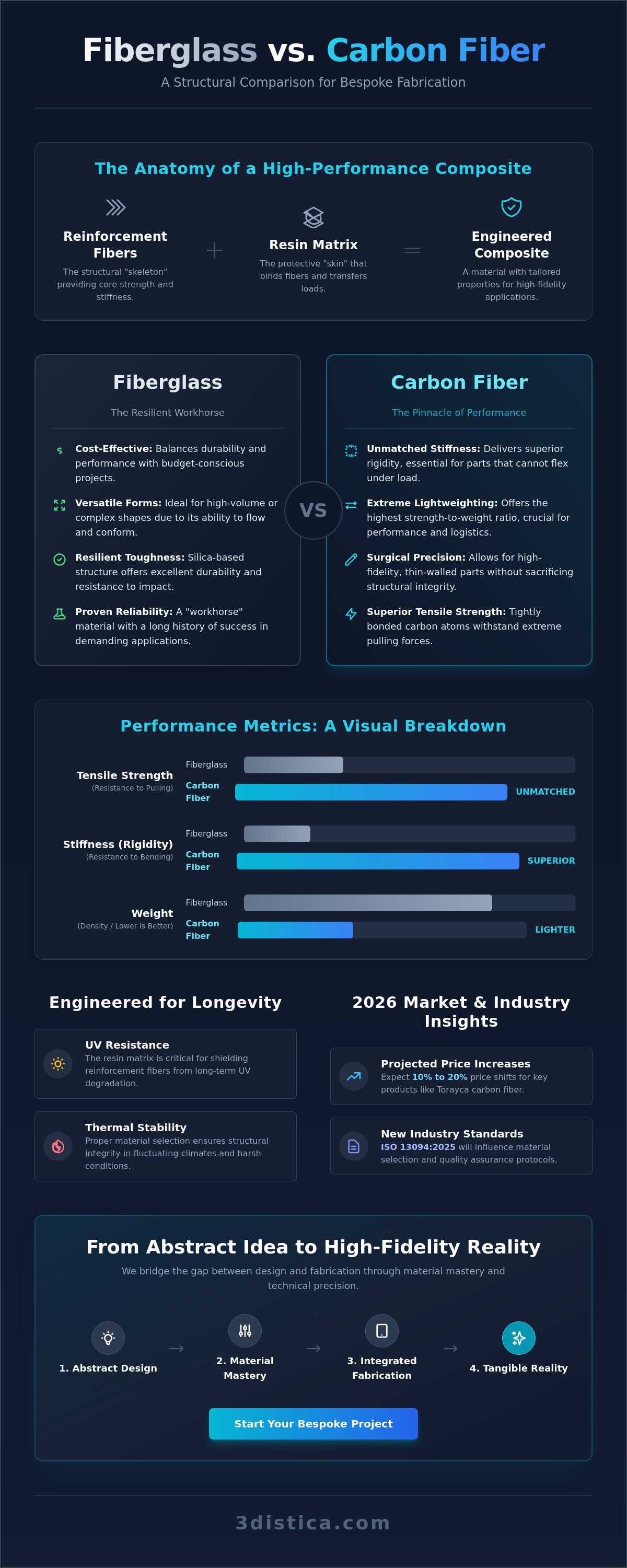
Strength isn't a static metric. While raw PSI numbers offer a technical baseline, the true character of a material emerges through its balance of rigidity and resilience. When evaluating fiberglass vs carbon fiber strength, designers must distinguish between a material’s ability to resist bending and its capacity to absorb impact without shattering. Carbon fiber is the master of stiffness, maintaining its geometry under immense mechanical loads with surgical precision. Fiberglass, however, is the champion of toughness. It possesses a unique molecular grace that allows it to deflect and recover where more rigid materials might fail. This distinction is the cornerstone of material selection for any high-fidelity fabrication project, ensuring the final object performs exactly as intended.
Precision demands a zero-flex profile. For Architectural Scale Models & Maquettes, even a millimeter of deviation can compromise the narrative of a design. Carbon fiber’s high specific modulus ensures that thin-walled components remain dimensionally stable, even when subjected to continuous stress. This makes it the ideal choice for Custom RC Parts where performance hinges on predictable aerodynamics and structural rigidity. To achieve this level of accuracy, CNC Routing & Laser Cutting is often employed to refine these high-rigidity parts, ensuring every edge aligns with the original digital vision. The result is a component that feels immutable, providing a sense of technical permanence that lesser materials cannot replicate.
Durability often requires a more forgiving nature. In high-traffic environments or public art installations, impact resistance is frequently more valuable than absolute stiffness. Fiberglass is the preferred medium for Wall Cladding & Interior Panels and large-scale outdoor kiosks because it survives the accidental bump or environmental pressure better than its carbon counterpart. While carbon fiber is incredibly strong, it is also brittle; it tends to shatter upon reaching its limit. Fiberglass absorbs energy, making it a cost-efficient choice for monumental forms that must endure the public's touch.
Economic considerations also play a role in this selection. With 2026 market prices making fiberglass dramatically more affordable per kilogram than non-aerospace carbon fiber, the justification for Fiberglass Products in large-scale projects is clear. It allows for the creation of expansive assets without the prohibitive costs associated with carbon’s complex production chain. However, designers should be aware of the weight penalty. Attempting to match carbon fiber's stiffness with fiberglass requires significantly more material thickness, which can complicate the logistics of national transport for large-scale architectural elements.
Longevity is the true test of fiberglass vs carbon fiber strength. In climates with extreme thermal variance, a material's physical dimensions must remain constant to preserve the integrity of the design. Carbon fiber is celebrated for its exceptionally low coefficient of thermal expansion. It remains immutable, even as the sun beats down on a structure. This dimensional stability is why it is preferred for high-precision components that cannot afford to warp. Fiberglass, while slightly more prone to expansion, offers its own set of environmental advantages. It is naturally non-conductive, making it the perfect choice for specialized electronic housings or Custom RC Parts that require radio-transparency. This property ensures that internal electronics remain shielded from interference, a critical factor for high-fidelity technical projects.
When a project involves large-scale architectural installations, managing the physical shift of materials is a critical engineering task. The coefficient of thermal expansion determines how seamlessly joints remain aligned when ambient temperatures shift from desert heat to conditioned interiors. Carbon fiber provides the zero-flex, zero-shift profile needed for intricate assemblies. Fiberglass requires more deliberate planning in its mounting systems to accommodate movement, yet it remains a staple for monumental forms due to its inherent resilience. By understanding these thermal behaviors, we can ensure that the visual harmony of a structure is never compromised by the elements.
The environmental stressors of the UAE, particularly the intense UV exposure and high humidity, demand a sophisticated approach to material protection. Both composites are naturally corrosion-free, unlike traditional metals. However, carbon fiber possesses a hidden vulnerability: galvanic corrosion. When it comes into contact with certain metals, such as aluminum or steel, a chemical reaction can weaken the bond over time. Fiberglass remains completely inert, making it the gold standard for marine applications or high-humidity interior elements. It's a material that speaks the language of the environment, resisting the salt and moisture that would degrade lesser substances.
Protecting the composite core is essential for long-term survival. High-fidelity Surface Finishing & Hydro Chroming acts as a sacrificial layer against the elements, preserving the structural essence of the work. For Wall Cladding & Interior Panels, this finish isn't just about aesthetics; it's a shield. Whether you're restoring Classic Car Parts Restoration or installing a public sculpture, the choice of finish determines the maintenance rhythm of the piece. To ensure your next project withstands the test of time and climate, we invite you to consult with our master fabricators at 3DISTICA. Our team understands how to bridge the gap between an abstract idea and a tangible, enduring reality.
Form follows feeling. Our studio exists at the intersection of technical precision and narrative storytelling, where we transform complex architectural challenges into elegant composite solutions. We don't just build; we translate your vision into a physical reality that resonates with the core essence of your project. Our methodology ensures that the technical debate regarding fiberglass vs carbon fiber strength moves beyond theory into practical, high-fidelity application. We utilize advanced 3D Scanning & Reverse Engineering to capture the exact essence of a design before translating it into a structural masterpiece. This process allows us to bridge the gap between an abstract idea and a tangible reality, ensuring every curve and load-bearing element aligns with the original architectural intent.
Precision is the heartbeat of our studio. By merging Industrial 3D Printing with traditional fiberglass craftsmanship, we create forms that were once considered impossible to fabricate. Our CNC Routing & Laser Cutting processes refine these structures, resulting in seamless Wall Cladding & Interior Panels that define the mood and atmosphere of a space. We elevate the raw fiberglass vs carbon fiber strength with artistic grace through meticulous Surface Finishing & Hydro Chroming. This isn't just about surface protection. It is about imbuing a project with a sense of wonder and exclusivity that signals a deep commitment to quality and detail. Every piece of Fiberglass Products we deliver is treated as a bespoke art form rather than a mass-produced component.
Collaboration is the core of our success. We provide end-to-end support for architects and event designers across the country, ensuring that monumental installations are handled with the care and sophistication they deserve. From the initial development of Architectural Scale Models & Maquettes to the final technical setup, our team manages the complexities of logistics and national transport with calm confidence. We understand that your reputation relies on the longevity and impact of the finished work. Our internal processes are curated to be as polished as the objects we create, providing a steady and reliable flow from conceptual purpose to final outcome. We invite you to request a consultation with our visionary artisans to discuss your project's material needs. Let us help you navigate the nuances of composite selection to create something truly transformative for your next bespoke fabrication project.
Selecting the right composite is a deliberate act of balancing technical requirements with artistic intent. You've seen that the dialogue surrounding fiberglass vs carbon fiber strength isn't about finding a single winner; it's about choosing the correct partner for your design's specific environment and scale. Whether you require the surgical rigidity of carbon fiber for precision parts or the resilient, high-volume toughness of fiberglass for monumental forms, your choice dictates the longevity and emotional impact of the final installation. Every detail, from the resin matrix to the fiber orientation, serves the broader narrative of your space.
At 3DISTICA, we specialize in bridging the gap between abstract concepts and tangible structural reality. Our expertise in large-scale monumental installations, supported by advanced CNC routing and 3D scanning capabilities, ensures every project is executed with high-fidelity precision. We're here to guide you through every stage of end-to-end bespoke production, ensuring your work remains as enduring as it is beautiful. We invite you to begin your bespoke fabrication journey with 3DISTICA and discover the transformative power of expertly crafted materials. Let's create an enduring legacy together.
Carbon fiber possesses higher tensile strength, while fiberglass offers superior impact toughness. The comparison of fiberglass vs carbon fiber strength depends entirely on the application. Carbon fiber atoms are tightly bonded in a crystalline lattice, providing immense rigidity for load-bearing. Fiberglass uses silica strands that absorb energy more effectively, preventing the brittle failure often seen in carbon under sudden physical shock or vibration.
Carbon fiber is justified when absolute dimensional stability and zero-flex are required for intricate maquettes. While it carries a higher material cost, the precision it offers ensures that delicate elements don't warp over time. For high-fidelity representation of complex geometries, the investment in carbon fiber's stiffness ensures the model remains a faithful, immutable replica of the original digital vision.
Fiberglass is an industry standard for body panels and classic car restoration due to its versatility and ease of repair. It provides a durable, lightweight alternative to steel without the extreme cost of carbon. While it doesn't match carbon fiber's ultimate weight reduction, its ability to withstand environmental stress makes it ideal for high-performance aesthetics and structural body components that require resilience.
Carbon fiber tends to shatter or splinter when its ultimate strength threshold is exceeded. Unlike metals that bend or fiberglass that may delaminate, carbon's brittle nature means it fails suddenly without significant deformation. This characteristic makes it essential to engineer a safety margin into the design, particularly for structural elements that might face unpredictable physical trauma or high-velocity impacts.
The intense heat and humidity of the UAE test the dimensional accuracy of any composite. Carbon fiber remains exceptionally stable due to its low coefficient of thermal expansion, preventing joints from shifting in the desert sun. Fiberglass expands more significantly under heat. This requires designers to plan for movement in large-scale wall cladding or outdoor installations to ensure the structural integrity remains uncompromised by the climate.
Fiberglass is generally the superior choice for monumental public art due to its impact resilience and cost-efficiency. It survives the public's touch and accidental bumps better than brittle carbon fiber. Additionally, fiberglass is completely immune to galvanic corrosion. This makes it a more reliable medium for high-humidity environments where the sculpture might interact with various metal mounting systems or architectural frames.
Industrial 3D printing techniques can utilize both materials as reinforcement for complex, high-performance parts. By embedding continuous strands of fiberglass or carbon fiber into a polymer matrix, we create components that rival the strength of traditional layups. This technology allows us to produce high-fidelity prototypes and custom RC parts that combine the speed of digital fabrication with the structural performance of advanced composites.
Carbon fiber offers a superior strength-to-weight ratio, allowing for the creation of incredibly light yet rigid awards. This makes it the perfect medium for trophies with thin, gravity-defying geometries that must feel substantial yet remain easy to handle. While fiberglass is strong, achieving the same level of thin-walled rigidity would require more material thickness, which ultimately increases the physical weight of the final piece.
