A visionary design doesn't require a digital architect to find its form. Many creators feel sidelined by the rigid demands of CAD software, fearing their hand-drawn concepts or physical samples lack the technical passport needed for modern manufacturing. Achieving professional fabrication without a 3d model is a sophisticated reality that honors the essence of your original intent. We understand the frustration of seeing a project stall because the digital bridge is missing. It's a common hurdle that often leads to concerns about accuracy, cost, and the eventual fidelity of the final asset.
You're about to see a clear path from a simple sketch to a large-scale industrial installation. We'll explore how advanced 3D scanning and reverse engineering act as a silent conduit, capturing every subtle detail of a physical object or conceptual drawing. This article outlines a curated process where technical precision meets artistic integrity. You'll learn how a dedicated creative partner manages the entire design-to-production pipeline, ensuring your vision transitions from a raw idea to a tangible, high-end reality with elegance and ease.
• Understand that high-fidelity production is entirely achievable starting only from hand-drawn sketches or existing physical artifacts.
• Master the nuances of fabrication without a 3d model by leveraging professional 3D scanning and reverse engineering to create a precise digital blueprint.
• Evaluate the benefits of manual styrofoam sculpting versus automated CNC routing to determine the most evocative method for your specific project.
• Learn how to define environmental context and scale requirements to streamline the transition from an abstract concept to a tangible physical asset.
• Discover how a bespoke fabrication partner can navigate the entire design-to-installation journey for custom awards, architectural models, and large-scale installations.
A vision often begins as a spark of intuition rather than a collection of coordinates. You might have a hand-drawn sketch or a physical artifact that carries the weight of your project's soul, yet the path to production feels obstructed by the absence of a digital file. This is a common dilemma. Many creators worry that without a pre-existing blueprint, their ideas will remain trapped in the conceptual phase. Professional fabrication studios view this not as a roadblock, but as the beginning of a collaborative narrative.
Design-led fabrication is a bespoke service that prioritizes the abstract concept. It recognizes that the essence of a project is found in its intended feeling and spatial impact, not just its dimensions. By partnering with a visionary artisan, you gain a guide who can interpret a manual sketch and translate it into a tangible, industrial-grade asset. This process bridges the gap between a raw idea and a physical reality, ensuring that the final output honors the original inspiration.
It's a common misconception that you must arrive at a studio with a production-ready file in hand. While advanced technologies like industrial 3D printing and CNC routing require digital data to operate, the studio's role is to generate these assets for you. Choosing fabrication without a 3d model simply means the technical heavy lifting happens within the studio's design phase. Manual craftsmanship, such as styrofoam sculpting, can often bypass digital masters entirely, allowing for a more tactile and immediate creation of large-scale forms. This fluid transition between manual skill and automated output is a core component of digital modeling and fabrication, where the studio translates your intent into the language of machines. Ultimately, fabrication-readiness is a state of technical alignment where the project's material needs and structural logic are resolved, regardless of the initial file format.
When a physical object already exists but its digital twin is missing, 3D scanning serves as the essential bridge. This technology allows for the precise restoration of classic car parts or the replication of legacy architectural elements with absolute fidelity. Reverse engineering captures the intricate nuances of a real-world object, turning it into a versatile digital resource that can be refined, scaled, or reproduced.
• Captures organic geometries that are difficult to model manually.
• Ensures perfect fitment for restoration projects.
• Reduces the margin of error compared to traditional manual measuring.
This data-driven approach allows for the creation of new fiberglass products or custom awards that maintain a direct connection to their physical origins. It's a process that respects the past while utilizing modern precision to build for the future.
The journey from a tactile concept to a digital master is a curated transition. When you pursue fabrication without a 3d model, the technical burden shifts from your shoulders to the studio's specialized workflow. This process isn't merely about data entry; it's a sophisticated translation of artistic intent into manufacture-ready files. By combining high-resolution capture with intuitive digital sculpting, a visionary artisan ensures that the final physical asset retains the soul of the original sketch while meeting the rigorous demands of industrial production.
For projects rooted in existing forms, industrial 3D scanning serves as the primary conduit for data creation. This technology projects light patterns onto physical maquettes or legacy components, capturing complex organic geometries with sub-millimeter precision. It's an indispensable tool for classic car parts restoration, where original blueprints may no longer exist, or for replicating intricate architectural elements that require absolute fidelity. These scans provide a high-fidelity foundation that can be refined and scaled, allowing for the creation of new fiberglass products or wall cladding that fits perfectly within its intended environment.
When the starting point is a 2D sketch or a series of reference images, the process moves into the hands of a digital sculptor. These artists use professional CAD software to build a three-dimensional volume from the ground up, interpreting your vision through a lens of technical possibility. Collaboration is essential during the mockup phase, as it allows you to refine the silhouette and details before any material is cut. In this context, the digital sculptor acts as a translator of spatial feeling into coordinates, ensuring the digital blueprint captures the emotional impact you intended for the final piece.
This technical foundation is what makes large-scale fabrication possible. Every digital stroke is evaluated for structural integrity, ensuring that a custom award or a massive styrofoam sculpture is balanced and durable. Research into modeling-free personal fabrication suggests a growing shift toward these accessible workflows, where the focus remains on the creative outcome rather than the complexity of the software. By entrusting this stage to a professional partner, you ensure that the path to production is both elegant and precise. If you're ready to see your concept take shape, exploring the capabilities of a specialized bespoke fabrication studio can turn your abstract vision into a tangible reality.
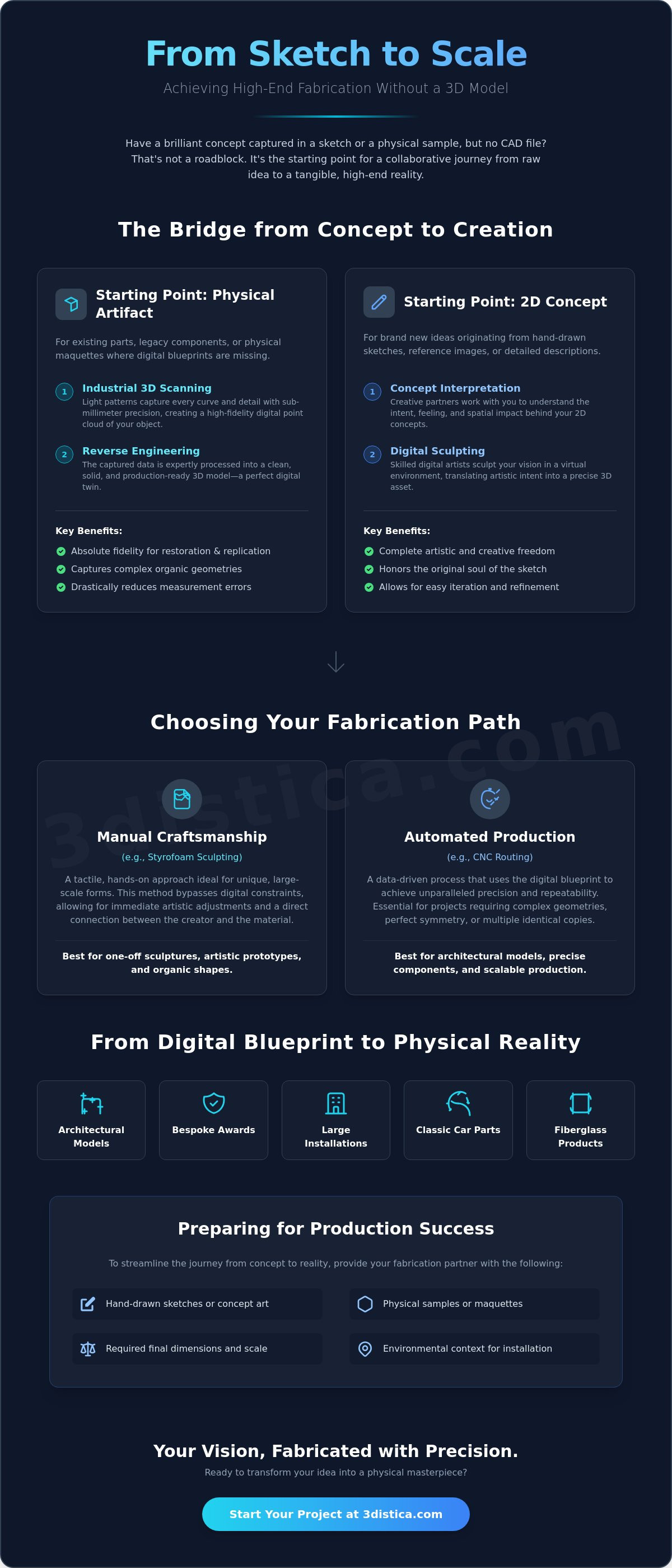
The decision to employ manual sculpting or automated machinery is a deliberate choice in the creative narrative. While some projects demand the cold precision of a laser, others find their soul through the human hand. Pursuing fabrication without a 3d model allows for a fluid methodology where the artisan's intuition guides the material. This approach often involves a design from imperfect examples, where a physical sample or a weathered component serves as the genesis for a refined asset. By prioritizing the conceptual essence over digital prerequisites, we ensure the final physical object resonates with its intended environment.
Large-scale event props and monumental art pieces often find their footing in styrofoam sculpting. It's a medium that offers unparalleled speed and cost-effectiveness, especially for temporary installations or environmental branding. Once the core volume is carved, the application of fiberglass products provides the necessary structural integrity and durability. This manual path bypasses the digital bottleneck, allowing a visionary artisan to sculpt with an immediacy that software cannot always replicate. Specialized surface finishing then transforms the porous foam into a sleek, industrial-grade masterpiece that commands attention.
Precision doesn't always require a purely digital origin. A hybrid workflow combines the best of both worlds, integrating 3D printing for intricate components within a larger manual build. CNC routing excels in producing architectural wall cladding and interior panels with geometric complexity that remains consistent across large surface areas. For high-fidelity results, hydro chroming and advanced surface finishing are applied to mixed-media projects, ensuring a uniform, premium appearance. This synergy between machine and hand allows for the creation of vinyl figures or custom awards that possess both technical accuracy and artistic character.
Some may worry that manual work lacks the exactitude of a computer-generated file. However, an artisan's eye identifies the subtle curves and emotional weight that an algorithm might overlook. True precision in fabrication without a 3d model isn't just about matching a coordinate; it's about capturing the essence of the design. This human element ensures that the final asset isn't just a replica, but a refined realization of your original vision. Whether you're commissioning architectural scale models or custom RC parts, the right path is the one that best preserves the integrity of your concept.
Transitioning from a conceptual vision to a physical asset requires a shared language between you and your creative partner. When starting a journey of fabrication without a 3d model, the quality of your initial reference materials dictates the fluidity of the design phase. It's not about having perfect technical drawings; it's about providing the environmental and emotional context that allows a visionary artisan to interpret your intent with precision. This collaborative foundation ensures that the final industrial-grade asset resonates with the soul of your original idea.
The most effective consultations begin with a curated collection of references. Orthographic sketches, providing front, side, and top views, are invaluable for establishing basic proportions and structural logic. However, perspective drawings and mood boards are equally vital for communicating the desired spatial feeling and surface quality. If you possess a physical prototype, even a rough clay model or a weathered component, it can be provided to the studio for 3D scanning and reverse engineering. This allows for the capture of organic textures and subtle nuances that are often lost in 2D representations, ensuring the digital twin is a faithful evolution of the physical source.
Environmental context is a primary driver of material selection and production methodology. For large-scale installations in the UAE, fiberglass products are often preferred due to their remarkable resilience against extreme heat and humidity. Understanding the final destination of the piece, whether it's an indoor wall cladding project or an outdoor monumental sculpture, ensures the studio selects the correct resins and surface finishing techniques. Scale also plays a pivotal role in determining the path forward. While industrial 3D printing is ideal for high-detail custom awards or intricate RC parts, CNC routing is better suited for expansive architectural panels and interior panels.
Before your first meeting, consider this checklist to define your project's primary purpose:
Is the piece purely aesthetic, or must it withstand specific mechanical or functional stress?
What is the intended lifespan of the installation, and will it be permanent or temporary?
Will it be viewed from a distance or up close, where subtle details and hydro chroming finishes matter most?
Does the space require specific fire ratings, UV protection, or weatherproofing?
By clarifying these elements early, you bridge the gap between abstract thought and industrial reality. This preparation allows the studio to act as a true extension of your creative team, navigating the complexities of production with elegance. If you're ready to transform your vision into a physical masterpiece, start your journey with a bespoke fabrication consultation today.
A visionary design deserves a partner who respects the weight of the original concept. Across the UAE, 3DISTICA has established itself as the premier studio for those seeking to transform abstract ideas into high-fidelity physical assets. We don't just execute; we curate. Our process is designed for clients who value artistic integrity as much as technical precision, offering a sanctuary for projects that begin as a hand-drawn sketch or a physical artifact. By specializing in fabrication without a 3d model, we remove the technical barriers that often stifle creativity, allowing you to focus on the narrative impact of your work.
Our studio operates at the intersection of craftsmanship and technology, positioning us as a visionary artisan for the modern age. We understand that the essence of a project isn't found in a file format, but in the interplay of light, shadow, and material. From the initial conceptual purpose to the final installation, our team provides a steady and curated rhythm that ensures your vision remains uncompromised.
The transition from a raw idea to a manufacture-ready file is handled entirely within our studio. Our internal design team possesses a deep understanding of spatial feeling, working meticulously to capture the essence of your project before a single cut is made. We utilize high-fidelity 3D scanning and reverse engineering to create digital twins of physical samples, ensuring that even the most complex organic geometries are preserved. Whether we're restoring classic car parts or developing custom awards, our digital sculpting phase is a collaborative dialogue that ensures the final output is a refined realization of your vision.
Our expertise extends across a diverse palette of materials, from resilient fiberglass products and industrial polymers to large-scale styrofoam sculpting. We possess the technical capacity to handle monumental sculptures and intricate architectural wall cladding, ensuring that every element is built to withstand the unique environmental demands of the region. This end-to-end service model includes professional logistics and on-site assembly across the Emirates, providing a polished and professional experience from start to finish. We invite you to collaborate with 3DISTICA on your next vision and discover the ease of a truly bespoke production journey.
The journey from a conceptual sketch to an industrial-grade asset is a narrative of transformation. You've discovered that professional fabrication without a 3d model isn't just possible; it's a refined process that honors your original intent through reverse engineering and digital sculpting. By providing clear environmental context and reference materials, you empower a visionary artisan to bridge the gap between abstract thought and physical form with absolute precision.
Whether your vision requires the resilience of fiberglass, the intricate detail of industrial 3D printing, or the monumental scale of CNC routing, the path to production is now clear. 3DISTICA provides full-service design, prototyping, and national installation support across the GCC, ensuring every project meets the highest standards of craftsmanship. We specialize in navigating the complexities of the design-to-production pipeline, even when a digital blueprint doesn't yet exist. We invite you to begin your bespoke fabrication journey with 3DISTICA and watch your most ambitious concepts take shape with elegance. Your vision is ready to become a tangible reality.
Yes, we can create custom awards and trophies using a single reference photo as a conceptual starting point. Our digital sculptors interpret the visual details of the image to build a three-dimensional volume from scratch. This process ensures that the final physical asset captures the intended aesthetic while allowing for unique modifications that distinguish your design from the original reference.
Fiberglass products are the superior choice for large outdoor sculptures intended for the UAE's demanding climate. This material offers exceptional resistance to high temperatures and intense UV exposure, preventing the warping or degradation often seen in lesser polymers. When combined with specialized surface finishing, fiberglass ensures that your monumental installation remains structurally sound and visually striking for years to come.
Our 3D scanning process for classic car parts restoration involves projecting non-contact light patterns onto the original component to capture its exact geometry with sub-millimeter precision. This data-driven approach allows us to create a digital twin that serves as the blueprint for production. It's an ideal solution for components that are no longer manufactured, ensuring a perfect fit and historical accuracy.
You don't need any CAD expertise to collaborate with our studio on a project. We specialize in fabrication without a 3d model, meaning our internal design team manages the entire technical transition from your initial sketch or physical sample. We act as your technical partner, translating your creative vision into the precise coordinates required for industrial production.
The timeline for the design-to-fabrication process depends on the complexity of the concept and the scale of the material. A typical project begins with a design phase where we refine the digital blueprint, followed by the physical production and finishing stages. While simple prototypes may move quickly, large-scale architectural elements or intricate sculptures require a more curated schedule to ensure the highest fidelity.
Yes, we can scale a small clay model into a life-sized fiberglass statue using high-resolution 3D scanning. Once the physical maquette is digitized, we can manipulate the scale to any dimension while preserving the organic textures of the original hand-sculpted piece. This method allows for the creation of monumental art that retains the intimate, tactile feel of the artist's hand.
The primary difference lies in the production methodology: CNC routing is a subtractive process ideal for large architectural wall cladding, while 3D printing is an additive process suited for intricate, high-detail components. CNC is often more efficient for expansive surfaces and interior panels. Conversely, industrial 3D printing allows for complex internal geometries and fine details in custom RC parts or vinyl figures.
It's entirely possible to fabricate bespoke architectural wall panels and interior panels without pre-existing technical drawings. By choosing fabrication without a 3d model, you can provide us with mood boards or simple sketches, and our team will develop the necessary digital blueprints. We ensure that the final panels align perfectly with your spatial requirements and the intended environmental mood of the project.
