An outdoor sign isn't a temporary graphic. It's a permanent architectural asset that defines the soul of a project. With aluminum prices climbing 33% as of early 2026, the industry has shifted its focus toward materials that offer genuine longevity rather than frequent replacement. Selecting a truly durable material for outdoor signs is a strategic decision. It ensures your brand's narrative remains vivid against the relentless erosion of sand and the bleaching power of UV rays.
You've likely seen high-end branding lose its luster as panels warp or colors fade within months. We believe every installation should maintain its aesthetic precision regardless of the environment. This guide explores how to achieve a photorealistic finish that remains pristine for years by leveraging advanced composites and precision fabrication. We'll examine the technical specifications of high-performance materials and the artistry required to maintain brand prestige in the most demanding climates.
• Understand how thermal cycles and UV radiation compromise standard substrates, ensuring your choice maintains structural integrity over time.
• Evaluate the technical balance between weight and impact resistance when selecting a durable material for outdoor signs, from aluminum composites to high-clarity polycarbonate.
• Discover why fiberglass (GRP) serves as the definitive medium for complex, three-dimensional architectural signage that demands weather-defying performance.
• Learn how industrial-grade surface finishes and UV shields preserve a photorealistic aesthetic against sand abrasion and environmental decay.
• Explore the transition from generic signage to bespoke fabrication, where every detail is engineered to reflect the unique soul of your brand's physical presence.
Material integrity is the silent foundation of any architectural narrative. It's the ability of a structure to maintain its intended form and deep color saturation through years of exposure. When selecting a durable material for outdoor signs, one must look beyond the surface. We view signage as a permanent element of the built environment, not a temporary graphic. This requires a deep understanding of how physics and chemistry interact with the materials we choose to shape.
Standard substrates often fail because they ignore the laws of thermodynamics. In regions where ambient temperatures reach 45°C, surface temperatures on dark signage can easily exceed 70°C. This creates immense structural stress. Materials with high expansion coefficients warp, causing the architectural precision of the design to buckle. This distortion is more than a visual flaw; it's a failure of the material to respect the space it occupies.
Stability is paramount for any high-performance installation. We focus on substrates engineered to remain chemically and physically stable between 40°C and 60°C. This ensures the sign doesn't just survive the summer; it retains its cinematic impact without bowing or cracking. For engineers, we recommend calculating mounting tolerances using the specific coefficient of linear thermal expansion. A practical rule of thumb is providing a clearance of 3mm for every meter of material length to accommodate natural movement without compromising the structural frame.
Sunlight is both a spotlight and a solvent. High UV indices act as a catalyst for molecular breakdown in standard polymers and cheap plastics. The rays penetrate the surface, snapping the chemical bonds that hold pigments and structural chains together. UV-stability is the resistance of a material to chemical degradation under ultraviolet light. To prevent this, we utilize UV-stabilized resins and high-grade pigments that lock in the photorealistic quality of the original design. This technical choice ensures that the atmosphere of the project remains as vibrant as the day it was conceived.
Arid landscapes introduce the constant friction of airborne particulates. Sand acts as a relentless abrasive, slowly stripping away surface clarity and dulling the atmosphere of the installation. This erosion is particularly visible on gloss finishes where microscopic scratches scatter light, destroying the deep blacks and vibrant hues of a brand's palette. Understanding the history and evolution of signage materials and technology allows us to choose finishes that resist this mechanical weathering. By selecting a durable material for outdoor signs that incorporates industrial-grade hard-coat technology, we ensure the architectural narrative remains sharp and legible. This technical approach transforms a sign from a mere object into a resilient piece of art that bridges the gap between an abstract vision and tangible reality.
Selecting a durable material for outdoor signs requires a delicate balance between aesthetic ambition and engineering reality. It isn't just about picking a substrate; it's about selecting a partner for the architecture that can withstand the test of time. Every material carries its own narrative and technical profile, dictating how it interacts with light, wind, and temperature over a decade of exposure.
Marine-grade aluminum remains the gold standard for humid coastal environments. It inherently resists the oxidation that plagues lesser alloys in salt-heavy air. For larger installations, Aluminum Composite Panels (ACP), such as Dibond, utilize a sophisticated "sandwich" construction. This technique bonds two thin sheets of aluminum to a solid polyethylene core, creating a panel with a remarkable weight-to-strength ratio. This structure prevents the "oil-canning" or rippling effect often seen in large, unsupported metal sheets. When designing for public infrastructure or high-visibility projects, referencing FHWA sign material specifications ensures your choice aligns with national safety and longevity standards. Choose metal when structural permanence and high-wind resistance are your primary objectives.
Acrylic and polycarbonate dominate the landscape of illuminated signage, yet they serve different roles. Cast acrylic is the artisan's choice; it's produced in individual batches, resulting in a higher molecular weight and better resistance to chemical crazing than extruded alternatives. While acrylic offers 92% light transmission, it's inherently brittle. For signs at ground level where physical impact is a risk, polycarbonate is the superior choice. It's roughly 200 times stronger than glass, making it virtually unbreakable under standard conditions. For large-format displays exceeding 2 meters in width, a minimum thickness of 4.5mm is required to maintain surface flatness and prevent bowing under wind load.
High-Density Urethane (HDU) provides a vital bridge between tradition and technology. It perfectly mimics the texture of carved wood but remains completely rot-proof and waterproof. Because it lacks the organic grain structure of natural timber, it won't crack or peel, even after years of direct sun exposure. This makes it an ideal medium for dimensional signs that require a classic, prestigious aesthetic without the intensive maintenance of organic materials.
The lifespan of these materials varies significantly based on their chemical composition. While standard vinyl might fail in 3 years, marine-grade aluminum and UV-treated polycarbonate can maintain their integrity for over 10 years. If you're looking to elevate your project's visual impact through high-end fabrication, exploring bespoke digital printing and advertising solutions can help bridge the gap between material durability and brand prestige. This approach ensures that the atmosphere of your space remains as vivid and compelling as the day it was conceived.
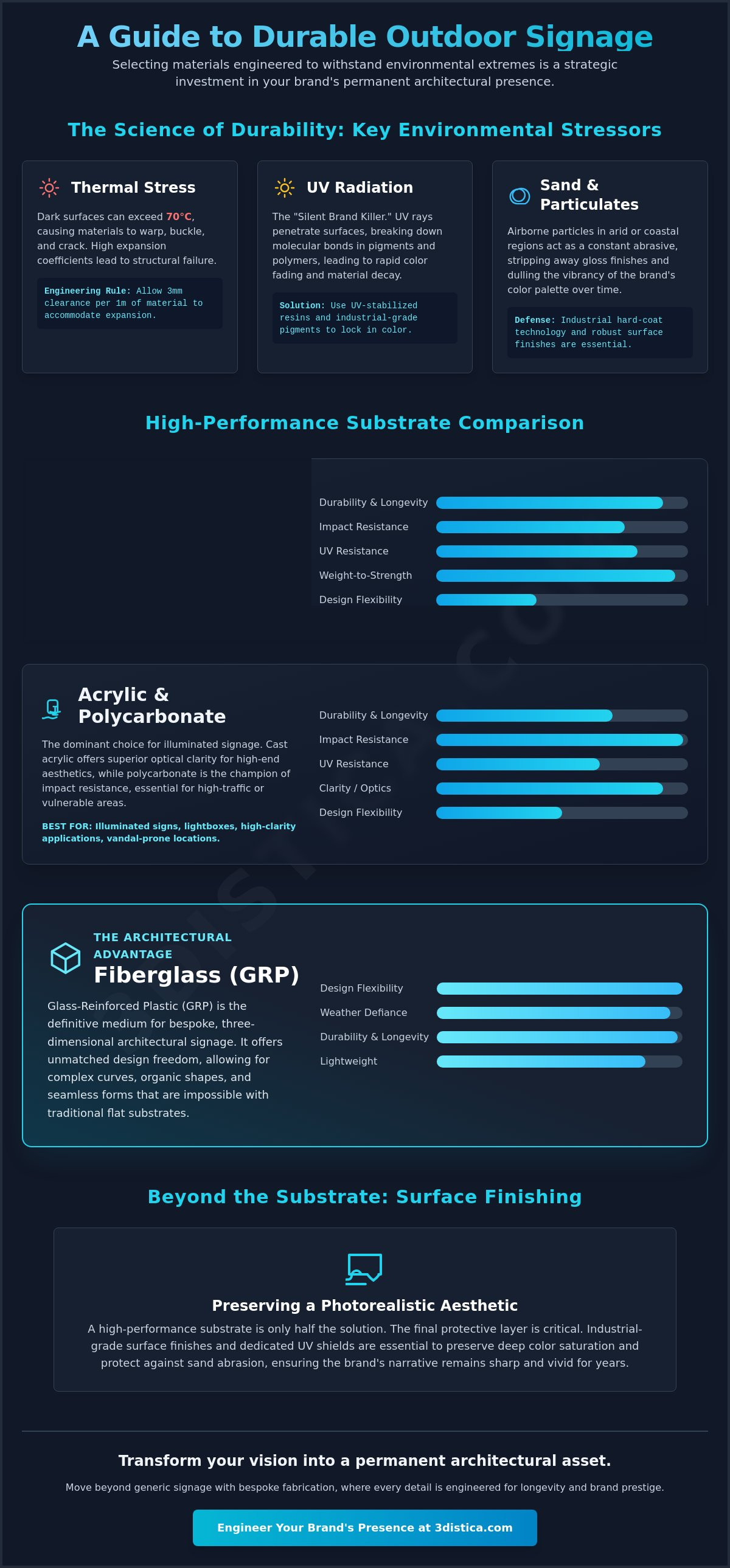
While aluminum and acrylic provide structural reliability, they often struggle with complex, organic geometries. Fiberglass, or Glass Reinforced Plastic (GRP), emerges as the definitive durable material for outdoor signs that demand a three-dimensional presence. It transcends the limitations of flat substrates, allowing architects to sculpt light and shadow into the brand's physical form. This material doesn't just sit on a surface; it commands the space it occupies with a quiet, sophisticated authority.
GRP is the artisan's choice for monumental installations. It provides a level of creative freedom that CNC milling on flat panels can't achieve. This versatility makes it ideal for projects where the sign must function as a piece of public art or a landmark. Its ability to hold intricate detail while remaining structurally sound ensures that the architectural narrative remains intact, even in the most unforgiving environments.
GRP is resilient. Its composite structure provides a chemical resistance that standard polymers simply cannot match. It's essentially immune to the corrosive effects of moisture and saline environments, making it indispensable for coastal developments where traditional metals might eventually succumb to oxidation. Maintenance is nearly nonexistent because the material doesn't warp, rot, or attract biological growth. GRP offers the durability of stone with a fraction of the weight. This weight advantage is critical for monumental rooftop installations where structural load limits are a primary concern. It allows for massive, high-impact branding without the need for excessive structural reinforcement of the building itself.
The journey from an abstract concept to a tangible asset begins with digital precision. We use 3D scanning and CNC milling to create master molds with micron-level accuracy. This process ensures that every nuance of the original vision is preserved in the final GRP form. It's a method that marries technology with craftsmanship, ensuring a photorealistic result that feels both modern and timeless. By choosing custom fiberglass fabrication, developers can realize unbuilt environments with a level of aesthetic precision that mass-produced signage cannot replicate. This bespoke approach allows for the creation of unique textures and seamless joints that are impossible with other materials. It's about bridging the gap between a visionary idea and a physical reality that remains pristine for decades. When you select a durable material for outdoor signs, you're investing in the permanent legacy of your brand's atmosphere.
The choice of a durable material for outdoor signs is only half of the architectural equation. If the substrate is the skeleton of the installation, the surface finish is its skin. It's the primary interface between the brand's identity and the harsh external environment. A high-performance finish preserves the photorealistic depth of a design, ensuring the atmosphere of the project remains immersive for years. Without a sophisticated topcoat, even the most resilient substrate eventually loses its aesthetic precision to the relentless friction of the elements.
Industrial-grade polyurethane coatings act as a molecular shield. These high-solid clear coats provide a barrier against sand abrasion, which acts like liquid sandpaper in arid regions. Unlike standard lamination that can delaminate or yellow within 24 months, these automotive-grade finishes bond chemically to the substrate. This creates a surface that's hard enough to resist scratching while remaining flexible enough to expand with the material during the thermal cycles we've previously analyzed.
The distinction between mass-produced signage and bespoke fabrication lies in the quality of the protective layers. Standard lamination is a physical film; high-solid clear coats are a chemical integration. For public-facing signs, anti-graffiti coatings offer an essential layer of defense, allowing for the removal of paint or ink without damaging the underlying graphic. Selecting the right finish requires an understanding of local light. In desert landscapes where solar intensity is extreme, matte finishes are often preferred to diffuse light and prevent blinding glare. Gloss finishes offer a deep, cinematic luster but require higher maintenance to preserve their reflective clarity against microscopic sand damage.
Traditional plating often fails on non-metallic substrates because the different expansion rates cause the metal layer to peel. Hydro chroming solves this by applying a layer of silver nitrate through a specialized spray process. This creates a high-end, reflective finish that mirrors the prestige of polished steel while maintaining the lightweight benefits of fiberglass or 3D-printed polymers. This method ensures the finish doesn't just sit on the surface; it becomes part of the architectural narrative. It provides a level of nuance and light-play that standard paints cannot replicate. To achieve this level of immersion, we invite you to explore our custom surface finishing services. This bespoke approach ensures your project bridges the gap between technical resilience and breathtaking visual impact. By integrating these advanced layers, you ensure your choice of a durable material for outdoor signs remains a permanent asset to your brand's physical presence.
Off-the-shelf signage is a compromise. It asks the architecture to adapt to the limitations of mass production, often resulting in a visual disconnect that weakens the brand's narrative. True prestige is found in bespoke fabrication, where a project-based approach ensures that every element is engineered for its specific environment. When selecting a durable material for outdoor signs, the fabrication process is what converts a raw substrate into a permanent landmark. This end-to-end support, moving from initial prototyping to final installation, guarantees that technical specifications like UV stability and thermal resilience are perfectly executed. With aluminum prices having increased 33% as of early 2026, a bespoke approach also ensures material efficiency, reducing waste while maximizing structural impact.
The transition from a digital concept to a physical asset requires a collaborative guide who understands the soul of a project. We don't just deliver a file; we navigate the complexities of visual communication with you. Before the first mold is cast, a meticulous consultation defines the path forward. We consider the following parameters to ensure the installation honors the architectural narrative:
• Exact dimensions and spatial orientation to optimize the poetry of light and shadow.
• Specific site conditions, including wind load requirements and compliance with the MUTCD 11th Edition standards required by January 18, 2026.
• Aesthetic goals that prioritize photorealistic finishes and a sense of brand immersion.
Our process begins with absolute precision. We use 3D scanning and reverse engineering to ensure that new installations integrate seamlessly with existing structures or unbuilt environments. This is where the abstract becomes tangible. By creating architectural scale models and maquettes, we allow developers to visualize the interplay of volume and atmosphere before full-scale production begins. It's an invitation to capture the feeling of a space, moving beyond mere dimensions to create a lasting emotional impact that reflects your brand's unique soul.
The final stage is a delicate transition from the studio to the site. Monumental signs require more than just mounting; they require a technical setup that accounts for structural load and environmental stress. Specialized handling ensures that high-end bespoke assets arrive and are positioned with the same aesthetic precision they were designed with. This level of care preserves the integrity of the surface finishes and the structural form we've meticulously refined throughout the process. We invite you to partner with 3DISTICA for your next fabrication project to bridge the gap between abstract design and a breathtaking, permanent reality.
A sign is the final brushstroke on an architectural canvas. It's the moment where an abstract brand identity becomes a tangible physical reality. This exploration has shown that selecting a durable material for outdoor signs requires a synergy between advanced GRP composites and industrial-grade surface engineering. Longevity isn't found in mass-produced solutions; it lives in the meticulous application of UV-stabilized resins and photorealistic finishes that resist the 70°C surface temperatures common in extreme climates.
3DISTICA acts as your high-end creative partner, specializing in industrial-grade fiberglass products and bespoke surface finishing tailored for the GCC region. We provide end-to-end expertise, from initial 3D scanning to the final, seamless installation of monumental assets. This collaborative process ensures that every nuance of your design is preserved against the erosion of time and sand. We invite you to begin your bespoke fabrication journey with 3DISTICA and transform your vision into a resilient piece of art. Let's build something that remains breathtaking for decades to come.
Fiberglass (GRP) and Aluminum Composite Panels (ACP) are the most resilient options for extreme thermal environments. While standard plastics often warp when temperatures exceed 45°C, these materials maintain structural integrity at 60°C and beyond. They offer a lower coefficient of thermal expansion; this ensures the sign remains flat and aesthetically precise during intense solar cycles without buckling or distorting.
A professionally fabricated fiberglass sign typically lasts between 10 and 15 years in harsh outdoor conditions. This longevity is due to the material's inherent resistance to UV radiation and moisture absorption. When treated with high-solid polyurethane clear coats, the structural form and color saturation remain pristine, making it a reliable choice for a durable material for outdoor signs.
Marine-grade aluminum does not rust, but it can experience surface pitting if it isn't properly treated. Using 5000-series alloys provides the necessary resistance to salt-heavy air found in coastal developments. We apply industrial-grade protective coatings to prevent the white oxidation that often affects untreated aluminum; this ensures the architectural narrative remains undisturbed by the corrosive sea air.
Industrial 3D printing is highly suitable for permanent signage when using high-performance polymers like ASA or carbon-fiber-reinforced resins. These materials are engineered for UV stability and impact resistance. We often use 3D printing to create complex master molds or intricate components that are finished with weather-resistant layers to ensure they function as permanent architectural assets for years.
Preventing solar fading requires the use of UV-stabilized pigments and industrial-grade topcoats. These clear coats act as a filter, blocking the specific wavelengths of light that break molecular bonds in standard inks. We utilize automotive-grade finishing techniques that lock in color saturation; this ensures the photorealistic quality of your brand's presence remains vivid for over a decade of direct exposure.
GRP (Glass Reinforced Plastic) is a composite material that provides significantly higher tensile strength and thermal stability than standard PVC or acrylic. Standard plastics are prone to becoming brittle and cracking after 24 months of UV exposure. GRP uses a matrix of glass fibers that prevents structural failure, offering the permanence of stone with the creative flexibility of a polymer.
You can achieve a flawless chrome aesthetic on fiberglass or 3D-printed substrates through hydro chroming. This process involves a chemical silvering technique that creates a mirror-like finish without the weight or peeling issues of traditional electroplating. It allows for high-end, reflective branding on complex, non-metallic shapes that would be impossible to plate using conventional, mass-production methods.
High-end composite signage requires minimal maintenance, usually limited to a gentle cleaning with water and a soft cloth every 6 months. This simple routine removes the abrasive sand and dust that can dull a finish over time. Because we use a durable material for outdoor signs and industrial coatings, there's no need for frequent repainting or the structural repairs common with traditional wood or vinyl.
