
Why commit heavily upfront to a static steel mold for a vision that is still evolving? In the UAE's sophisticated industrial landscape, the traditional path to production often feels like a barrier to true innovation rather than a bridge. You've likely experienced the frustration of prohibitive upfront costs and the long lead times that delay your entry into the market. A precise cost analysis of low volume manufacturing methods shows that high-fidelity results are no longer tethered to massive capital investments. We understand that your project deserves a manufacturing strategy as refined and adaptable as the design itself.
This guide empowers you to master the economics of small-batch production by discovering fabrication methods that bypass the limitations of traditional tooling. We'll explore how industrial 3D printing and advanced casting can transform your conceptual sketches into tangible realities with meticulous detail. You'll learn to balance unit costs against initial investment while maintaining the artistic integrity of your work. By the end of this exploration, you'll have the clarity to choose a production partner in the Emirates who values craftsmanship as much as technical precision.
• Escape the "Valley of Death" in traditional production by mastering a cost analysis of low volume manufacturing methods to identify where static tooling expenses erode your margins.
• Discover the tool-less agility of industrial 3D printing, allowing for rapid design iterations and complex geometries that traditional molds cannot replicate.
• Explore the potential of vacuum casting and fiberglass for high-fidelity finishes, ideal for creating durable environmental assets or production-grade parts.
• Identify the optimal fabrication path for your specific volume using a strategic decision matrix that balances material properties, lead times, and unit costs.
• Understand how to bridge the gap between conceptual design and tangible reality through a collaborative production process that prioritizes artistic integrity.
Every ambitious project begins with a vision. Yet, many of these visions are silenced early by the crushing weight of initial capital requirements. This is the financial "Valley of Death," a phase where the high cost of traditional tooling prevents a concept from ever reaching the hands of its intended audience. In the UAE's competitive landscape, understanding the cost analysis of low volume manufacturing methods is the difference between a successful launch and a project that stalls on the drawing board. It's about moving beyond the rigid structures of the past to embrace a more fluid, narrative-driven approach to creation.
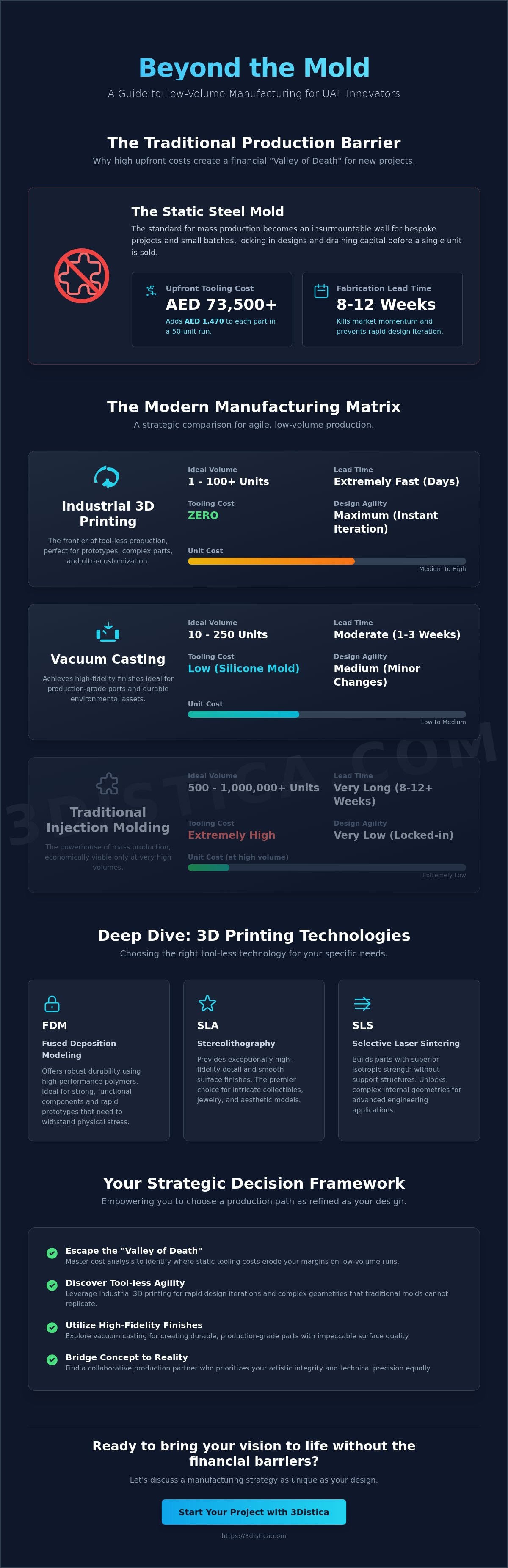
Amortization reveals the true story of production. Consider an expensive high-precision steel mold. If your production run is limited to 50 bespoke units, the tooling cost alone adds a significant premium to every single item before a drop of material is even poured. Beyond the dirhams, there's the invisible cost of time. Waiting eight to twelve weeks for a mold to be fabricated creates a lead time bottleneck that can kill market momentum in an instant. For the visionary artisan, these delays are not just logistical hurdles; they are barriers to the transformative power of design.
Traditional manufacturing creates a steep divide between capital expenditure (CAPEX) and operational expenditure (OPEX). For mass production, the high upfront cost of a mold eventually disappears into the volume. However, for quantities under 500 units, that CAPEX becomes an insurmountable wall. Demand in the Emirates' luxury and technology sectors is often volatile and highly specific. Investing heavily in static tooling for a product that might require immediate refinement is a high-stakes risk that few can justify. When the market shifts, a steel mold becomes a heavy, expensive relic of an outdated idea.
True innovation requires the freedom to evolve. By utilizing Industrial 3D Printing: The Frontier of Tool-less Production, designers treat their physical products as living documents. You can update a digital file in minutes. Re-machining a steel mold is a costly, multi-week ordeal that forces a design lock-in. This digital agility reduces the risk of "failure to launch" by allowing for real-world testing and rapid iteration. It transforms the manufacturing process into a bespoke art form. Customization becomes a standard feature rather than a logistical nightmare, ensuring each piece captures the exact essence of the project's narrative without the burden of static hardware.
Traditional manufacturing relies on the physical constraint of a mold. Industrial 3D printing, or additive manufacturing, elegantly dismantles this requirement. By building objects layer by layer directly from a digital file, it bypasses the need for expensive tooling entirely. This shift represents a fundamental change in the cost analysis of low volume manufacturing methods; it moves the investment from rigid hardware to digital precision. In the Emirates, where architectural ambition and bespoke design converge, this tool-less philosophy allows for a level of creative freedom that was previously restricted by the high entry costs of mass production.
Choosing the right technology is an exercise in balancing mechanical necessity with visual intent. FDM (Fused Deposition Modeling) offers robust durability for functional components, while SLA (Stereolithography) provides the high-fidelity detail required for intricate collectibles or jewelry. For parts requiring superior isotropic strength and complex geometries, SLS (Selective Laser Sintering) is the preferred choice. The evolution of materials has been equally transformative. We now utilize high-performance polymers that rival injection-molded plastics in both strength and thermal stability, ensuring that a 3D-printed part isn't just a placeholder but a permanent, end-use asset. For those seeking to bring these complex visions to life, exploring industrial 3D printing services offers a direct path to tangible innovation.
Industrial filaments and powders have surpassed the limitations of early prototyping materials. Today's SLS nylon and high-grade FDM thermoplastics offer strength-to-weight ratios that often exceed those of traditionally molded ABS. This technology allows for the creation of internal lattice structures, which are physically impossible to achieve with molding. These lattices provide structural integrity while significantly reducing weight. With professional surface finishing, these parts achieve the smooth, "molded-look" aesthetics required for high-end commercial applications without the eight-week wait for a steel tool.
The journey from CAD to production is now measured in hours. This rapid workflow is essential for the UAE’s fast-paced event and advertising sectors, where timelines are often as ambitious as the designs themselves. On-demand production allows businesses to print only what they sell, effectively eliminating the need for expensive inventory and storage. By removing the "scars" of traditional scaling-such as design lock-in and high scrap rates-3D printing ensures that every iteration is an improvement. This agility is a core component of a modern cost analysis of low volume manufacturing methods, prioritizing responsiveness over static stock.
While 3D printing offers pure digital freedom, sometimes a project demands a tangible weight or a specific material property that only casting can provide. This is where vacuum casting and fiberglass emerge as the artisan’s preferred path. These methods act as a bridge between the fluid world of digital sculpting and the rigid requirements of industrial production. By utilizing a 3D-printed master to create a silicone or fiberglass mold, we preserve the intricate details of the original design while enabling a small-batch run that remains economically viable. It's a process that respects the emotional impact of the object as much as its technical specifications.
A thorough cost analysis of low volume manufacturing methods often highlights these techniques as the most balanced choice for projects requiring between 10 and 100 units. Unlike the massive investments required for steel tooling, silicone molds are relatively inexpensive to produce and can be ready in days. This approach allows for the use of production-grade urethanes that mimic the feel and performance of mass-produced plastics. It provides a level of fidelity that satisfies the most discerning eye. For the visionary creator, this hybrid workflow ensures that the transition from a single prototype to a limited series is seamless and sophisticated.
Silicone molds offer a sophisticated middle ground. They allow for the replication of complex surface textures and fine details that might be lost in other processes. The material versatility is remarkable; we can produce parts that are crystal clear, elastomeric and flexible, or high-heat resistant. This flexibility is essential when the NIST cost-effectiveness analysis of additive manufacturing suggests that pure 3D printing might become less efficient as quantities increase. Casting ensures that each piece in a limited series maintains a consistent, high-end finish that feels bespoke rather than mass-produced.
When the vision grows in scale, fiberglass (GRP) becomes the undisputed choice. It is the ideal medium for large-format environmental assets and architectural elements that must withstand the UAE’s intense climate. Fiberglass offers exceptional UV resistance and thermal stability, ensuring that a monumental sculpture or a custom interior panel remains pristine under the desert sun. By combining CNC routing for the initial pattern with manual fiberglass layup, we achieve a level of architectural precision that mass production cannot match. This method allows for the creation of massive, durable structures without the prohibitive costs of large-scale industrial molds. It remains a cornerstone of any modern cost analysis of low volume manufacturing methods for the architectural and advertising sectors.
The final layer of this process is the surface finish. Whether it is the metallic luster of hydro-chroming or a custom-textured coating, these manual refinements transform a technical component into a piece of art. It's about capturing the essence of a space through meticulous craftsmanship and an unwavering focus on the interplay of visual forces.
Choosing the right production path is a delicate balance of aesthetic intent and fiscal responsibility. It requires a disciplined framework that weighs the complexity of a part against the intended production run. A meticulous cost analysis of low volume manufacturing methods reveals that the most expensive choice is often the one that lacks flexibility. In the UAE, where projects move with remarkable velocity, the ability to select a method that aligns with your narrative is a competitive necessity. You must consider not only the visible unit price but also the hidden investment of post-processing and manual refinement that brings a piece to life.
Material performance should never be sacrificed for perceived savings. While industrial 3D printing offers speed, certain mechanical requirements might dictate the use of casting resins or fiberglass composites. Each method carries its own set of "hidden" costs, particularly regarding the artisanal labor required for surface finishing. Whether it is sanding, priming, or hydro-chroming, these steps are vital to achieving a high-fidelity result that resonates with a professional audience. If you are ready to evaluate the best path for your project, a consultation on bespoke production strategies can provide the technical clarity you need.
The "First-Mover" advantage is a powerful force in the Emirates. Tool-less methods allow you to reach the market while your competitors are still waiting for international mold shipments to clear customs. This speed facilitates a rapid response to client feedback, allowing for digital adjustments that would be impossible with steel tooling. By choosing national fabrication, you eliminate the logistical risks of global shipping and maintain direct control over the quality and timing of your output. This proximity ensures that the final result captures the exact spatial feeling you intended.
Every project has a crossover point where the economics shift. While injection molding becomes the logical choice for thousands of units, "low volume" remains a relative term that spans from a single sculpture to a hundred functional parts. A Total Cost of Ownership (TCO) analysis for small-batch projects must account for the initial tooling, the cost of storage, and the potential for design obsolescence. For most bespoke UAE projects, the agility offered by a cost analysis of low volume manufacturing methods proves that avoiding static tooling is the most sustainable way to protect both your budget and your artistic vision.
A vision is only as powerful as its physical execution. At 3DISTICA, we believe that a cost analysis of low volume manufacturing methods is merely the starting point of a much deeper creative journey. We position ourselves as a high-end creative partner, sitting at the intersection of technical precision and narrative-driven presentation. Our philosophy treats every project as a bespoke art form rather than a mass-produced service. By integrating industrial 3D printing, CNC routing, and fiberglass fabrication into a unified workflow, we provide the UAE’s architectural and event sectors with a direct path from digital sculpting to final installation. We understand the core essence of your design and possess the technical authority to bring it to life with quiet confidence.
The transition from an abstract idea to a tangible reality requires more than just machinery. It demands a visionary artisan who can act as a technical guide through the complexities of modern fabrication. Our technology stack is curated to ensure that the transformative power of environmental elements is never lost in translation. Whether we are utilizing 3D scanning for reverse engineering or CNC routing for intricate wall cladding, the focus remains on capturing the feeling of a space. This meticulous attention to detail ensures that the final outcome is not just a product, but a sophisticated piece of visual communication that resonates with its intended audience.
Our artisans translate your most ambitious concepts into physical assets with a focus on tailored quality. We recognize that high-fidelity visual representation is essential for professional partners in the corporate and advertising sectors. Surface finishing is where the narrative truly takes shape. From the metallic depth of hydro-chroming to the subtle textures of hand-applied coatings, these refinements ensure each piece carries weight and prestige. We don't just deliver a final product; we foster a collaborative partnership that prioritizes the storytelling potential of your design. This commitment to craftsmanship is what allows us to bridge the gap between the conceptual and the concrete with such elegance.
Reliability is the foundation of every national project we undertake. Our capacity extends to monumental sculptures, architectural scale models, and complex interior panels that define the UAE’s spatial landscape. We manage the entire lifecycle of a project, ensuring that the internal processes are as polished as the public-facing results. This end-to-end approach provides a sense of ease and professionalism, allowing you to focus on the broader vision while we handle the technical methodology. If you are ready to move beyond the prohibitive costs of traditional tooling and explore a more agile, artistic path, we invite you to invite a collaboration on your next fabrication project and witness the intersection of technology and art.
Mastering small-batch production is about more than just avoiding the high entry costs of traditional molds. It's about reclaiming your design agility and ensuring every detail reflects the project's original essence. We've explored how tool-less methods like industrial 3D printing and artisan techniques like vacuum casting provide a path to market that's both fast and financially sound. A disciplined cost analysis of low volume manufacturing methods proves that the future of UAE production lies in bespoke, high-fidelity solutions that prioritize narrative over mass-produced uniformity. By partnering with a studio that offers industrial-grade 3D printing, CNC routing, and expert fiberglass finishing, you ensure your vision is realized through end-to-end project management that respects both your timeline and your artistic integrity.
The transition from a digital concept to a physical masterpiece requires a partner who understands the intersection of technology and art. We invite you to Begin your bespoke fabrication journey with 3DISTICA and discover the possibilities of a production process without boundaries. Your most ambitious ideas don't need to wait for a mold; they simply need the right hands to shape them. Let's create something extraordinary together.
Vacuum casting is typically the most cost-effective solution for a run of 100 parts. It allows the initial investment of a silicone mold to be amortized across the entire batch while providing production-grade finishes. This method bridges the gap between the speed of 3D printing and the material properties of traditional molding without the heavy capital expenditure of steel tools.
Industrial 3D printed parts are frequently utilized as final products in the UAE's aerospace, automotive, and interior design sectors. When utilizing Selective Laser Sintering (SLS) or high-performance FDM materials like Nylon 12, the parts possess the mechanical strength and thermal stability required for functional use. These components aren't just prototypes; they're durable assets that perform reliably in demanding environments.
Fiberglass often provides superior durability for large-scale environmental assets compared to standard injection-molded plastics. Its high strength-to-weight ratio and inherent resistance to corrosion make it ideal for monumental structures. In a comprehensive cost analysis of low volume manufacturing methods, fiberglass stands out for its ability to maintain structural integrity over long periods without the brittleness sometimes found in mass-produced resins.
Most low-volume casting projects are completed within 7 to 14 days. This timeframe covers the creation of a 3D-printed master pattern, the fabrication of the silicone mold, and the final casting of the parts. This rapid turnaround is a significant advantage for local businesses that need to respond to market demands far faster than international shipping allows.
Professional surface finishing can transform a raw 3D print into a high-fidelity object with a mirror-like finish. Through a meticulous process of sanding, priming, and the application of specialized coatings like hydro-chroming, we achieve aesthetics that are indistinguishable from injection molding. This artisanal refinement ensures that the final piece captures the premium spatial feeling required for luxury displays and corporate awards.
The transition to injection molding is usually justified when production volumes exceed 500 to 1,000 units. At this "tipping point," the lower per-unit cost of molding begins to offset the high upfront investment in steel or aluminum tooling. A precise cost analysis of low volume manufacturing methods helps identify exactly when your project scales beyond the economic efficiency of tool-less production.
We act as a collaborative guide, offering technical expertise to refine your design for the chosen manufacturing path. Our services include 3D scanning and reverse engineering to ensure that digital files are perfectly optimized for industrial printing or casting. This partnership ensures that the abstract essence of your project is translated accurately into a tangible, high-quality reality.
Fiberglass (GRP) and UV-stable polymers like ASA are the most reliable choices for the UAE's intense climate. These materials are specifically selected for their ability to withstand temperatures exceeding 50°C and prolonged exposure to high UV indices. They ensure that architectural cladding or outdoor sculptures remain pristine and structurally sound under the desert sun for years.
