%25201-1.webp)
The most intricate digital model often loses its soul when forced into the wrong physical medium. You've likely felt the tension of this transition, where the perfection of a CAD file meets the uncompromising laws of physics. Choosing between 3d printing vs cnc for prototypes is the pivotal moment where your vision either gains momentum or faces costly technical hurdles.
It's natural to feel uncertain about material durability in the intense UAE climate or to worry that a machine might strip away the subtle nuances of your design. You deserve a methodology that respects the artistry of your work without sacrificing structural integrity or precision. This article offers a clear framework for selecting the ideal fabrication path, ensuring your next high-fidelity prototype is both evocative and functional. We'll examine the interplay of additive and subtractive manufacturing, focusing on how to achieve a master-level finish that prepares your project for its ultimate scale. Discover how to bridge the gap between an abstract idea and a tangible reality with elegance and confidence.
• Master the selection between 3d printing vs cnc for prototypes by aligning your design's geometric complexity with the most effective fabrication methodology.
• Navigate technical specifications with ease, comparing the high-precision tolerances of subtractive machining against the unparalleled creative freedom of additive layering.
• Optimize your project’s narrative and budget by identifying the economic crossover points where conceptual mockups transition into scalable, high-fidelity components.
• Explore how hybrid workflows combine the strengths of various techniques to produce durable architectural maquettes and bespoke installations designed for the UAE’s distinctive climate.
• Transform abstract concepts into tangible art through a comprehensive process that encompasses digital refinement, industrial fabrication, and meticulous surface finishing.
Every masterpiece begins as a quiet whisper in a digital workspace. A prototype serves as the vital bridge where abstract artistry meets the tactile world, transforming a concept into a physical reality that can be felt, tested, and refined. In this pursuit of perfection, the choice between 3d printing vs cnc for prototypes becomes a defining strategic decision for any visionary. These two pillars of modern fabrication represent fundamentally different philosophies of creation. While one builds form from nothingness, the other reveals it by stripping away the superfluous. This choice dictates not only the speed of your development but the very soul of the final object.
In the high-stakes design landscape of the UAE, where architectural maquettes and monumental installations must withstand both intense scrutiny and environmental heat, precision is non-negotiable. Designers often face a creative tension: the desire for total geometric freedom versus the necessity of structural material integrity. Rapid prototyping has evolved to offer sophisticated solutions for both, yet the methodology you select will influence how your project scales from a singular mockup to a functional reality. Understanding these distinct natures is essential for maintaining the artistic integrity of your work.
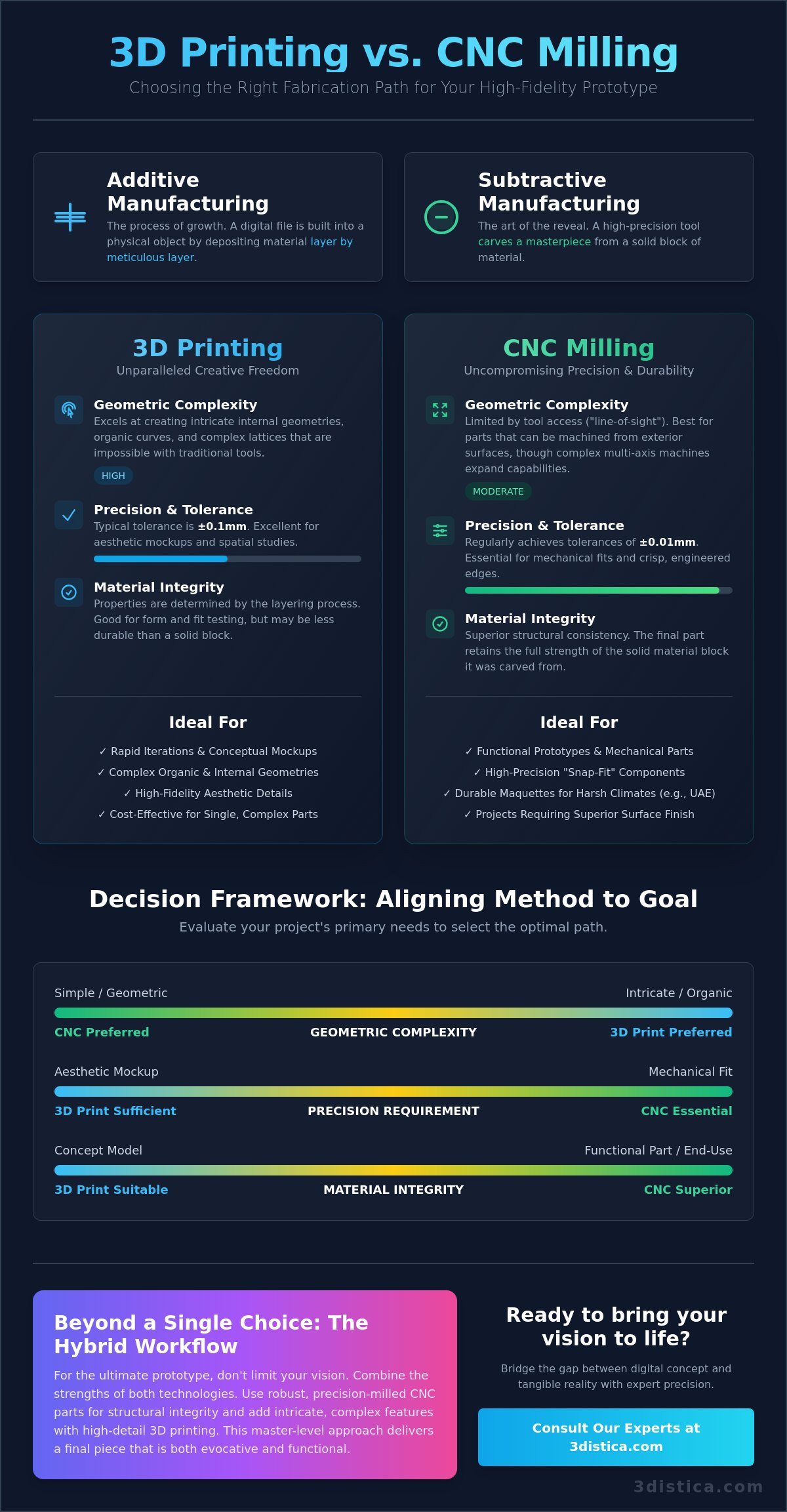
Additive manufacturing is a process of growth. It translates a digital CAD file into a physical object by depositing material layer by meticulous layer. This methodology excels at creating complex internal geometries that traditional tools simply cannot reach. If your design features organic curves or intricate lattices, industrial 3D printing offers a speed of iteration that keeps pace with the most fluid creative process. It's the preferred choice when the goal is to capture high-fidelity details that would otherwise be trapped inside a solid block.
CNC milling is the art of the reveal. It's a subtractive process where a high-precision tool carves a masterpiece from a solid block of material. This method is inherently sculptural, mirroring the tradition of stone carving but with the absolute accuracy of digital control. Because the final piece is born from a single, dense "blank," it retains superior material properties and structural consistency. Whether utilizing CNC routing for interior panels or complex mechanical parts, this technique ensures the final prototype possesses a weight and durability that feels professional and permanent.
The choice between 3d printing vs cnc for prototypes is often decided by the tactile demands of the final presentation. A visionary understands that a prototype is more than a visual check; it's a sensory experience where weight, density, and surface temperature communicate quality. While additive manufacturing offers a swift path to visualizing form, subtractive machining provides a level of material realism that's difficult to replicate. The decision requires a meticulous analysis of how the object will be handled and the environment where it will reside. In the UAE, where ambient heat and UV intensity can compromise lesser materials, selecting a process that ensures long-term stability is a mark of professional foresight.
Precision defines the threshold of professional trust. CNC machining regularly achieves tolerances of ±0.01mm, making it the essential choice for components requiring an exacting mechanical fit or a crisp, machined edge. Industrial 3D printing typically operates within a range of ±0.1mm. This is more than sufficient for aesthetic mockups and complex spatial studies, but it may lack the "snap-fit" certainty of a carved part. Balancing these technical requirements with your artistic intent ensures the physical result matches the digital promise.
Interlocking parts and deep internal undercuts are the natural domain of additive layering. These features allow for a level of complexity that traditional tools cannot reach due to "line-of-sight" limitations. CNC milling requires clear access for the cutting bit, which can restrict certain organic or hollow designs. Design for manufacturability is the delicate balance between an artist's uninhibited vision and the cold reality of mechanical tools. When your project demands both intricate detail and structural resilience, exploring fiberglass products as a finishing medium can bridge the gap between these two worlds.
Density speaks to the subconscious. CNC allows you to work with production-grade metals, hardwoods, and engineering plastics that possess a natural weight and "feel." The landscape is shifting, however. As highlighted in The State of 3D Printing, industrial resins and composite filaments are becoming increasingly sophisticated, offering properties that mimic traditional materials with surprising fidelity. Whether you choose the raw strength of a machined blank or the layered complexity of a high-end resin, the goal remains the same: to create an object that feels as permanent as the idea it represents.
Innovation requires a pragmatic foundation. The financial narrative of a project often hinges on the efficiency of its earliest physical iterations, where every decision impacts the final outcome. When evaluating 3d printing vs cnc for prototypes, you must look beyond the immediate invoice to understand the total cost of ownership. This calculation is a symphony of machine runtime, raw material volume, and the manual artistry required for final refinement. While one method may offer a lower entry point, the other might provide the scalability needed to transition from a single mockup to a limited series with greater grace.
Industrial 3D printing excels in the creation of 'one-off' conceptual mockups. Because it bypasses the intensive setup and programming time required for traditional tools, it allows a digital file to manifest as a physical object with remarkable speed. However, cost drivers differ significantly between the two. For additive processes, the primary expense is material volume; for subtractive processes, it's machine time and setup complexity. Research indicates that complex geometries can increase CNC setup costs by 20% to 50% due to the intricate fixturing required to hold the part in place. For a visionary, understanding these levers is the key to balancing a bold aesthetic with a disciplined budget.
Hidden costs often reside in the final stages of production. A raw 3D print or a machined blank is rarely the final chapter of a project's story. Achieving a high-fidelity surface requires meticulous post-processing, such as professional surface finishing and hydro chroming. These steps demand significant manual labor, which must be factored into the initial economic strategy to avoid unexpected hurdles during the transition from lab to showroom.
In the fast-paced GCC market, speed is a competitive advantage. 3D printing accelerates the conceptual phase, allowing designers to fail fast and refine even faster. Conversely, CNC is indispensable for creating functional prototypes that require real-world stress testing or specific mechanical properties. Adopting a hybrid manufacturing strategy allows you to use additive methods for rapid form studies while reserving CNC for the high-precision components that define the project's structural integrity. This dual approach optimizes both your timeline and your creative energy.
The environmental narrative of a project is increasingly important to modern partners. Additive manufacturing offers up to 35% material efficiency savings compared to subtractive methods by only using the substance necessary to build the form. CNC machining, by its nature, produces "swarf" or waste material as the part is revealed from the block. Precision planning ensures that material overhead is reduced in national fabrication projects, aligning technical excellence with a commitment to responsible creation.
In the grand theaters of UAE urban development and national celebration, a prototype transcends its role as a mere test piece. It becomes a persuasive narrative tool. For the visionary architect or event designer, the debate of 3d printing vs cnc for prototypes isn't just about technical specs; it's about capturing the essence of a space before the first stone is laid. A physical model allows stakeholders to experience the interplay of light, shadow, and scale in a way that no digital render can replicate. These high-fidelity maquettes are often the deciding factor in winning monumental public art commissions or securing investment for high-rise developments.
Prototypes also serve as a vital proof of concept for large-scale fiberglass structures. By creating a precise miniature, designers can anticipate structural challenges and refine surface aesthetics before committing to full-scale fabrication. This phase acts as a bridge between a daring idea and a functional, durable reality. Whether you're planning a complex geometric pavilion or a series of bespoke interior panels, the prototype is the first tangible chapter of your project's story.
Creating a world-class architectural model requires a sophisticated blend of technologies. We often utilize industrial 3D printing to capture the intricate, repeating patterns of a modern facade, while CNC routing handles the sweeping structural topography of the surrounding landscape. This multi-material approach, incorporating acrylic, wood, and resin, ensures absolute scale accuracy. The psychological impact of a high-fidelity physical model in a real estate presentation is profound. It transforms a conceptual proposal into an inevitable reality, fostering a sense of trust and exclusivity with potential partners.
The event sector demands a unique combination of aesthetic flair and logistical practicality. Prototyping custom awards and trophies for prestigious national ceremonies allows for the perfection of weight and balance before final production. For larger event installations, we develop lightweight yet durable props that can withstand the rigors of public interaction. The process typically begins with a 3D-printed miniature to verify the design's emotional impact. Once the concept is proven, we transition to full-scale architectural scale models and maquettes or fiberglass fabrications that maintain the original's delicate detail at a monumental scale.
The journey from a digital file to a tangible object is a process of refinement. At 3DISTICA, we don't view this as a series of mechanical steps. We see it as the birth of a narrative. Whether the project demands 3d printing vs cnc for prototypes, our role is to act as the collaborative guide who ensures the original vision remains untarnished. We position ourselves at the intersection of technical precision and artistic intuition, providing a sanctuary for ideas that require more than just a standard manufacturing output. Our studio is where the cold accuracy of a machine meets the warm, deliberate touch of a master craftsman.
Precision is our language. We speak it through every micron of a CNC-routed panel and every layer of a high-fidelity resin print. This integrated approach allows us to handle the entire lifecycle of a project, from the initial digital sculpting to the final installation on-site. By maintaining a deep understanding of the core essence of a project, we ensure that the transition from a CAD model to a physical prototype is seamless and evocative. This is bespoke fabrication elevated to an art form, tailored specifically for those who value the subtle details that define excellence.
We believe every physical asset should carry the "feeling" of the space it's intended to inhabit. Our process begins with a deep dive into your conceptual goals, ensuring that the chosen methodology respects the soul of the design. Surface finishing and hydro chroming are not mere afterthoughts; they are the essential elements that elevate a prototype from a functional test to a presentation-ready masterpiece. By applying these meticulous textures and coatings, we provide a level of immersion that captures the imagination of stakeholders and partners across the UAE. Our commitment is to maintain the highest level of artistic integrity, ensuring that every curve and edge reflects your original intent.
Success in complex fabrication requires a partner who understands the harmony of different technologies. Having industrial 3D printing, high-precision CNC routing, and fiberglass expertise under one roof allows us to move fluidly between methodologies as the project evolves. This integration reduces project friction, eliminating the logistical hurdles of managing multiple vendors and ensuring a unified quality standard. We invite you to bring your most ambitious concepts to our team, where we can explore the interplay of visual forces together. Invite a conversation for your next bespoke project and discover how we can transform your digital vision into a tangible reality with elegance and poise.
The physical prototype is the first tangible chapter of your project's story. It's the moment where abstract digital art finally meets the uncompromising laws of physics. We've explored how the choice between 3d printing vs cnc for prototypes defines the scalability and soul of your narrative. While additive methods offer uninhibited geometric exploration, subtractive machining provides the structural weight and material realism necessary for professional trust. Balancing these forces requires a partner who values artistic integrity as much as technical precision.
We pride ourselves on an end-to-end bespoke production process that honors the essence of your design. Our expertise in industrial 3D printing and CNC milling ensures every detail is captured with absolute fidelity. Combined with specialized surface finishing, we create objects that don't just exist; they resonate. Begin your project’s transformation with a bespoke fabrication quote and let's bring your most ambitious concepts into the tactile world. Your vision deserves a reality that commands attention and inspires wonder.
CNC machining is generally superior for functional testing that requires real-world stress or specific mechanical properties. While industrial 3D printing is excellent for form and fit, CNC parts are carved from solid blocks, ensuring uniform material strength and density. This makes subtractive methods the preferred choice for prototypes that must endure physical loads or high-speed rotations without the risk of internal porosity.
CNC machining typically provides a smoother finish directly from the machine, but 3D printing can match this quality through professional post-processing. Subtractive tools leave a clean, crisp surface with minimal tool marks. In contrast, additive parts often require meticulous sanding and surface finishing to achieve a high-fidelity look. With the right artisan touch, both methods can produce a flawless, exhibition-ready exterior for any project.
3D printing is usually more cost-effective for a single architectural model with intricate, repeating details. It bypasses the extensive setup and programming time required for complex CNC machines. When debating 3d printing vs cnc for prototypes of a singular nature, the ability of additive manufacturing to grow complex facades in one build often results in lower labor overhead for conceptual mockups.
The primary limitation for 3D printing in the UAE climate is the thermal stability of certain resins and filaments. Intense UV exposure and heat can cause lesser polymers to warp or degrade over time. We address this by selecting industrial-grade composites or transitioning the prototype into fiberglass products, which offer the long-term durability and environmental resistance required for the region's specific conditions.
The choice for a large-scale sculpture depends on the volume and the desired internal structure. Additive manufacturing is ideal for organic, hollow forms that require minimal weight and complex internal lattices. Subtractive methods like CNC routing or styrofoam sculpting are better suited for massive, solid volumes. Often, a visionary project uses a hybrid approach to ensure both structural integrity and intricate surface detail.
Yes, we frequently integrate both methodologies to leverage their unique strengths within a single bespoke project. We might use CNC routing for a precise structural base and industrial 3D printing for the complex, organic details that sit atop it. This hybrid workflow ensures that the final prototype is both technically sound and artistically evocative, providing a complete solution for the most sophisticated designs.
We typically require high-resolution STL or OBJ files for additive processes and STEP or IGES files for subtractive machining. These formats ensure that every nuance of your digital sculpting is accurately translated into the physical world. Providing clean, watertight models allows our technicians to focus on the refinement of the piece rather than correcting digital errors, accelerating the transition from concept to reality.
A typical high-fidelity prototype can take anywhere from a few days to several weeks, depending on the complexity and finishing required. Rapid form studies might be completed in a steady 72-hour window. However, a monumental maquette involving multi-material assembly and hydro chroming requires a more curated timeline. This ensures every detail meets our standard of excellence and reflects the original artistic intent of the project.
